We need your help now

Support from readers like you keeps The Journal open.

You are visiting us because we have something you value. Independent, unbiased news that tells the truth. Advertising revenue goes some way to support our mission, but this year it has not been enough.

If you've seen value in our reporting, please contribute what you can, so we can continue to produce accurate and meaningful journalism. For everyone who needs it.

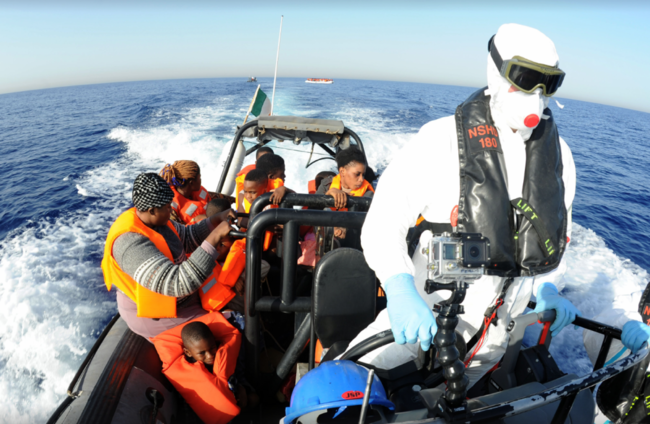
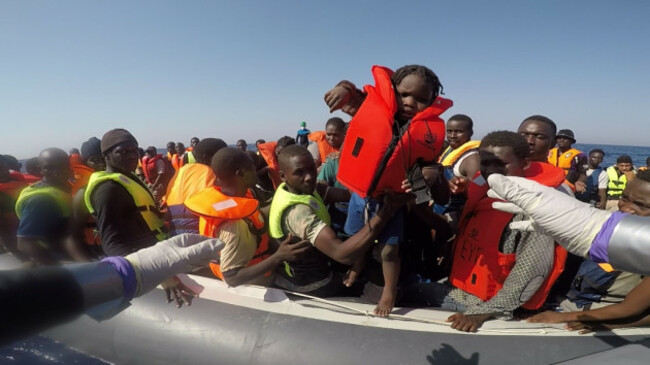
A naval service rigid inflatable boat returns to the LÉ Samuel Beckett with rescued migrants in the Mediterranean. Irish Defence Forces

'The moment I realised why they did it': An Irish officer on the 2015 Mediterranean rescue mission

Irish officers are credited with saving thousands of lives during their deployment amid the Mediterranean migrant crisis.

TEN YEARS AGO Irish men and women left Ireland and were deployed to the rolling temperamental seas off Libya.

Irish naval ships were in the Mediterranean working as part of the European humanitarian effort Operation Pontus to halt the mass loss of lives of migrants attempting to cross from north Africa to Europe.

Stories and images came home of Irish sailors performing CPR on lifeless bodies, pulling babies from near-death drownings, and frantically throwing life jackets to drowning desperate souls.

The Irish mission – known as Operation Pontus – began in May 2015 and is credited with saving the lives of thousands of people over the following years. 

One of those Irish naval sailors, who headed south out of Cork Harbour and made his way on one of those deployments, was Dublin man Tony Geraghty – at the time he was the commanding officer of the LÉ Samuel Beckett.

Geraghty – who retired recently at the senior rank of Commander – sat down with The Journal to tell that story for the first time.

“Do you know I have a chest full of medals, and if you told me I had to hand them all back, and I could keep one, that’s it, I’d keep the Pontus one,” he said. 

“If you were to take away every memory in my life, you can have them all, just don’t take the Pontus one.”

Geraghty grew up close to the sea near Dun Laoghaire in Dublin – he developed a love of the water from his father who was a keen sailor and he spent time sailing around Dublin Bay in his spare time. 

He said that he realised from a young age that he would never work in a normal office job. Watching the navy ships and the famed Asgard II sail training vessel coming in close to home piqued his interest in a life on the waves. 

There was a “small service history” in the family and that led him to apply for the navy in the late 1980s and he was commissioned as an officer in 1991 – one of the many Dubliners who moved south to near the naval base at Haulbowline in Cork Harbour. 

His first command of a vessel was in 2006, but it is that time on LÉ Samuel Beckett, sailing through the temperamental waters of the Mediterranean, that he repeatedly comes back to speak about – the defining moment of a 35 year military career. 

The context for that mission was that extensive media coverage showed the world the horrific death toll in the Mediterranean as migrants, having paid unscrupulous people smugglers, attempted to cross the sea to Europe. 

Some 900,000 migrants and refugees – many fleeing conflict and persecution in Syria, Iraq and Afghanistan – arrived on European shores in 2015 alone, with over 3,000 lives lost during the journey.

There were civilian and non-governmental organisations carrying out rescue operations along with some States in the region but it was not enough. 

The European Union decided it could not stand idly by and Ireland felt the same so the Irish Naval Service was tasked with sending ships to patrol with other naval vessels. 

36314245322_5f5d175bc9_o An Irish Navy sailor point of view image as he reaches for a child onboard a rubber boat.

Saving lives at sea

The initial EU response was Operation Sophia focused on combating human trafficking and smuggling by identifying and then disrupting the organised criminal organisations involved.

Then Operation Pontus was a more direct response to the human toll and was focused on a humanitarian mission for search and rescue with the sole motive of saving lives. It was this that Geraghty and the various naval crews responded to for a period of time in the mid-2010s. 

“The LÉ Eithne was the first ship to go, she was followed by the LÉ Niamh and then, in the latter half, the LÉ Samuel Beckett went down there. There was a crew of 59 total and we were down there for three months,” he said. 

Geraghty headed south in September 2015 with his crew and was tasked to patrol an area off the Libyan coast. It was soon that the radio lit up and they were dispatched to begin the rescues.

The former naval commander recounts the second rescue operation as the moment he realised the visceral nature of the crisis and why people are willing to take such risks to flee Africa.

“I remember the moment I understood it,” he said.

The Journal / YouTube

Geraghty describes the scene – the normal rolling waves had turned to be much bigger and more dangerous as the wind gathered into a gale. He and his crew were alerted to a rubber inflatable boat with 80 people onboard floundering ten miles from their position.

The Irish naval speak for such a vessel is a ‘Platform in Distress’, known to sailors as a Pid. 

It was to be their second rescue of the deployment and he directed his crew to make “best speed” to recover the struggling people.

When Geraghty and his crew on the LÉ Samuel Beckett arrived it was a chaotic scene – it took them 45 minutes to get the 80 people to safety. 

He believes that if they were any slower getting there it would have been a significant loss of life. 

“At that stage, I was 25 years in the Navy. I was looking at it and thinking that is was about to capsize, and those people were about to go in the water.

“And I remember thinking about it and looking at women with children. And that was the moment I realised why they did it. These people, regardless of what anybody thinks.

“Women would have left their country in Central Africa and they would have been on foot for quite a while with their children.

“They would have been exposed to rape, beatings, shootings, organ harvesting, people trafficking, slavery -  you only need to look at the UN reports.”

He added: “They’re not stupid, they have phones, they knew what was ahead of them. They know when they get to the Libyan coast, that they’re even more exposed because they’re isolated there. They may or may not get into a boat.

“They may or may not have got into a boat without a life jacket. The boat isn’t built with any level of quality control yet they just head in a general northerly direction and lots of them have drowned.

“They have all that information but they still left their own country – so the only way they could reconcile that entire trip was all of that is better than where they are coming from – all of it is worthwhile.”

The Irish Naval Service deployment was just two years, lasting from 2015 to 2017 - The European Union ended the operation in 2019.

Geraghty believes it was a meaningful and successful mission despite the limited EU commitment to it. 

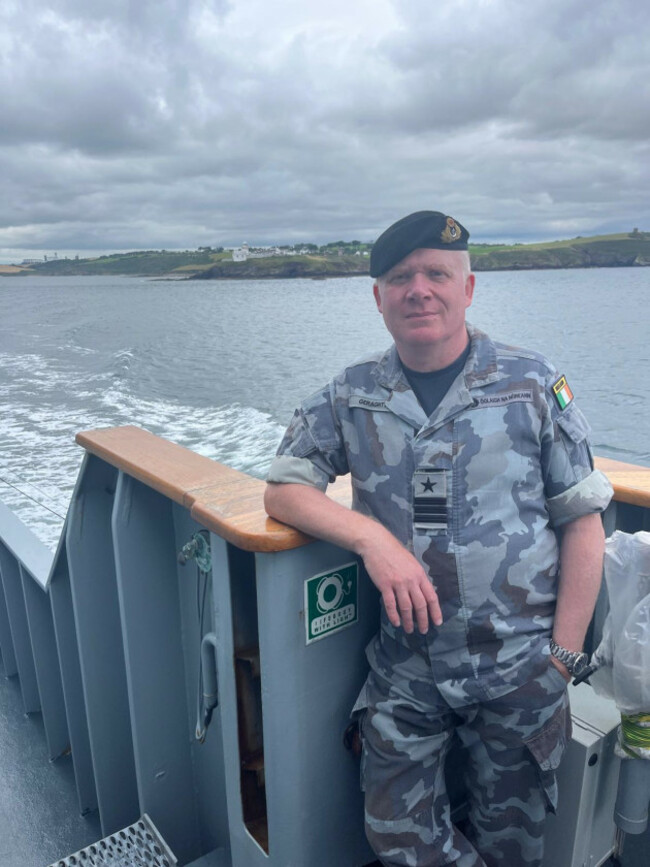
WhatsApp Image 2025-08-27 at 16.54.35 Commander Tony Geraghty on his last patrol shortly before his retirement recently.

Decisive maritime presence

The former naval officer returned to Ireland and was on his way to more senior command roles.

Those command roles, including managing naval operations and fishery protection work, informed his view of what it means to have a navy ship patrolling in the massive Irish Exclusive Economic Zone. 

“A warship is more than just a weapons system—it is a visible expression of national sovereignty, reflecting both domestic priorities and foreign policy,” he said. 

Geraghty believes that sovereignty is enforced through “a decisive maritime presence at sea”.

He said activities such as boardings of fishing vessels off the coast do not happen in isolation and has a greater strategic purpose. 

“What it is actually doing is it is ensuring the long term sustainability of the fishing stocks in the Irish country.

If the fishing industry off the west coast were to collapse overnight because of Irish fishing places like Dingle, Rossaveel, Castletownbere would be in a very difficult economic situation.

“It is with that in mind that boardings are being done by the State,” he added. 

Geraghty also described subsea infrastructure such as pipelines and cables as “economic enablers” which are also critical to protecting State interests.

He echoes a scenario from a secretive State wide exercise, known as “Púca” in which there was a table top test of State response for a supposed sabotage attack on a number of internet lines on the seabed.  

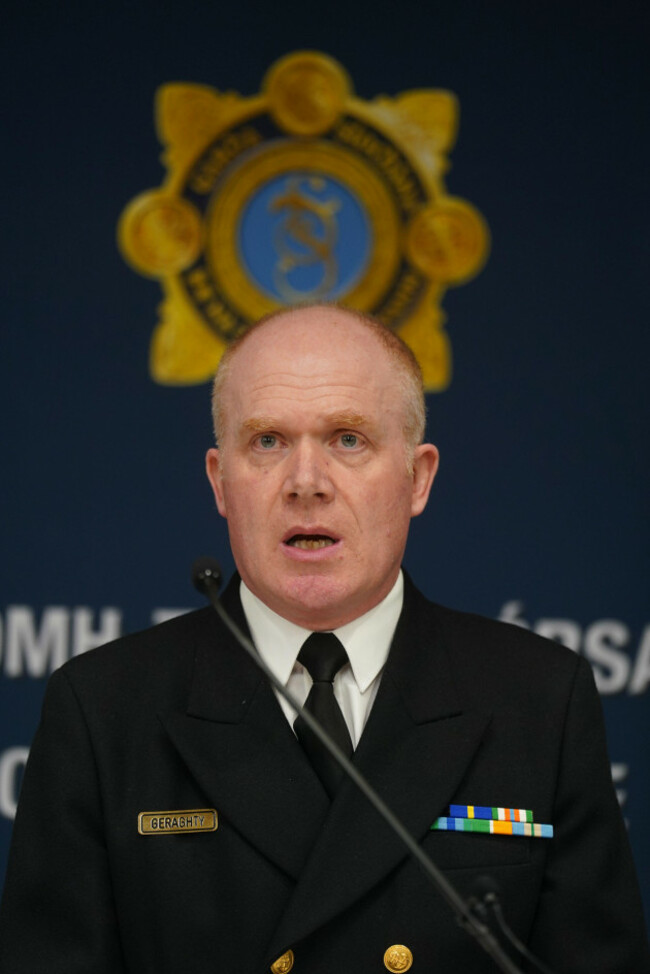
commander-tony-geraghty-fleet-operations-commander-irish-naval-service-of-the-joint-task-force-jtf-comprising-of-the-revenue-customs-service-naval-service-and-an-garda-siochana-during-a-press-co Commander Tony Geraghty, who was Fleet Operations Commander at the time, speaking during a press conference following the MV Matthew operation. Alamy Stock Photo Alamy Stock Photo

Geraghty stresses the need for a major and committed effort to make the proposed National Maritime Security Strategy to fit the needs of those working in the area.

“If you were to suddenly manage to cut the transatlantic cables, the global economy wouldn’t kind of slowly come to a stop – it would be a shuddering end to global economies if you’re to cut some of them,” he added.

He said the following of suspect vessels by Irish and other partner nations warships is a critical way to prevent that from happening. He is concerned about a disconnect among members of the public who, he believes, are misunderstanding the need for a military.

“That, perhaps, is the piece people are missing, or the understanding at that in fact, and the fact why a military is needed – that is the purpose,” he added. 

In recent weeks Geraghty went for one last patrol on an Irish naval vessel and on his return he ended his time as an officer. 

“It was just time, that was how I felt for maybe the last 24 months – I could have stayed on seven more years but I just thought the time was right to go and do something different,” he added. 

“The Naval Service and the wider maritime community have given me everything—professionally and personally—and for that I am deeply thankful. It has been a privilege, and now feels the right time to look ahead to the next chapter of my life.”

Readers like you are keeping these stories free for everyone...
A mix of advertising and supporting contributions helps keep paywalls away from valuable information like this article. Over 5,000 readers like you have already stepped up and support us with a monthly payment or a once-off donation.

Close
JournalTv
News in 60 seconds