We need your help now

Support from readers like you keeps The Journal open.

You are visiting us because we have something you value. Independent, unbiased news that tells the truth. Advertising revenue goes some way to support our mission, but this year it has not been enough.

If you've seen value in our reporting, please contribute what you can, so we can continue to produce accurate and meaningful journalism. For everyone who needs it.

'It took one-and-a-half hours to get out of the carpark': Readers on traffic gridlock stories

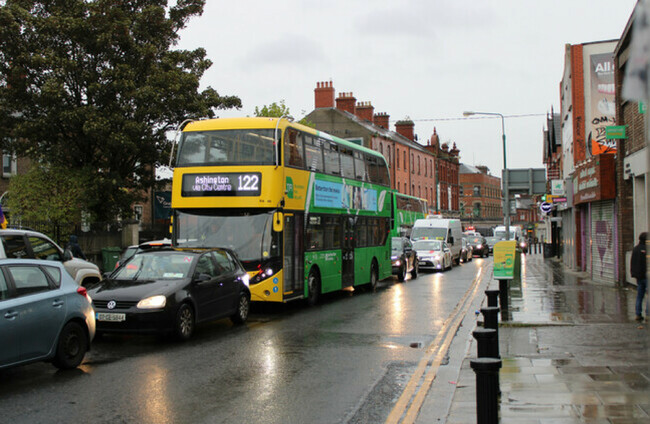
Heavy traffic at peak hours has become a feature of modern life in Ireland’s cities.

BUMPER TO BUMPER traffic at peak hours has become a feature of modern life in Ireland’s cities, with road users reporting ever-worsening gridlock on key routes.

From the Quincentennial Bridge in Galway, to the Dunkettle Interchange in Cork, to the M50 and N7 and other roads around Dublin, along with every other city, commuters can lose hours of their days stuck in traffic.

On the M50, Ireland’s busiest road, any closing of a lane as a result of a crash or debris can result in huge delays. The motorway has seen a 40% increase in traffic on its busiest stretches over the past 10 years. Recently Transport Infrastructure Ireland (TII) stated that it had “done all it can” in terms of works and upgrades to address the gridlock.

Meanwhile, it has not been much better for anyone using public transport, with a senior Dublin Bus official recently citing data that showed traffic in the capital has become slower than London.

Across the country, there are plans underway to revamp the roads network and to expand transport services – but some of these have faced repeated delays, whether due to planning struggles or financing from government.

Most recently Firethorn Limited and Manhattan Peanuts lodged a judicial review against the planned Luas extension to Finglas in north-west Dublin city.

We asked our readers to outline some of their main traffic complaints. Here’s what they said.

Gridlock on the M50

Unsurprisingly, the main issue brought up had to do with traffic on the M50, and the knock-on effect this had on other areas around Dublin.

One reader said he had to drive from Cherrywood to Santry on the run up to Christmas to collect a parcel at a depot. 

“I left at around 4.20pm, but by the time I made it to Santry, it was nearly 6.30 and the depot had closed at 6pm. Two hours to cross the breadth of the M50. The M7 and M4 exits in particular looked awful,” they said.

They tried again a few days later, this time heading from Artane to Santry, what should be a much shorter journey. 

“This time from Artane to the same depot. It took an hour each way. I wish I was joking, but the gridlock was that bad,” the readers said.

“At least I got the package! Perhaps the grim weather was to blame but still, that’s a really long time to cross 3 kilometres as the crow flies.

I was aware that in recent weeks the M50 was at capacity, but this was a new low. I would have preferred to drive in Manila or Bangkok. At least you get to beep your horn more frequently over there.

Another reader, who lives in Ballyfermot, said they had experience multiple traffic jams as result of traffic on the M50.

They were travelling from Smyths Toy Store at Fotnhill Retail Park to their home in Ballyfermot, a journey that would take about 15 minutes in light traffic.

“It took one and a half hours to get out of the carpark and two hours to get home to Ballyfermot. This should have been a 15 minute journey!” The reader said.

On another day soon after that, the reader went to collect her husband at the Hermitage Hospital in Lucan.

“We could not get out of the car park. It took us one and a half hours to get home, we can normally do this trip in 15 minutes,” she said.

The reader blamed traffic on the M50 for having a knock-on effect elsewhere. 

“When there is an incident on the M50 it causes enormous traffic jams in Ballyfermot as drivers drive through their to avoid delays on the M50,” she said.

Liffey Valley Shopping Centre is on my doorstep. I now avoid it as I cannot face the traffic. Palmerstown has become a traffic nightmare also. I have to delay visiting our family grave until after Christmas! The quality of my life has deteriorated with all this traffic madness.

A final reader raised issue with traffic coming into Dublin, comparing their trip into Dublin on the N7 to Merrion Square, to when they drove in London.

“I lived in London for six months last year. My commute to work consisted of driving from Finchley to around Cheshunt, the drive was 24 km and in bad traffic would take 40/45 mins on a bad day during rush hour traffic,” they said.

“On the other hand I drove from the far side of Limerick City last week to Dublin.

“It took me less time to get from Limerick to passing in by An Poitín Stíl (in Rathcoole) which is 195 km, compared to getting from An Poitín Stíl to Merrion Square that took me 2 hours on the dot and is only 18 km away and there were no road closures or crashes… just traffic.”

Galway not much better

Readers also raised issues with traffic coming in and out of Galway City at peak times.

“Traffic gridlock in Galway has been getting worse in the last few years but especially in the last year,” one woman told The Journal.

“The Quincentennial Bridge in the mornings eastbound to the factories in the Parkmore/Ballybrit areas are a constant line of cars.

Likewise in the afternoons, westbound from Terryland Dunnes over the bridge onto Seamus Quirke Road is a bottleneck.

The reader also said that the Dublin Road inbound and outbound are “constant traffic jams any time of day”.

Too many traffic lights not keeping a flow of cars. A bypass in Galway City would alleviate a lot of traffic, especially buses and trucks which I see more of travelling across the city.

A bypass for Galway City – the Galway City Ring Road – has long been planned and debated. An Coimisiún Pleanála is due to make a decision on the road early this year.

Another reader, who “drives daily for a living in Galway” decried the traffic and improper planning in the city, and called for the ring road to be built.

“Galway’s annual descent into gridlock in the weeks leading up to Christmas is often blamed on shoppers, tourists, or poor driving behaviour, but the core problem is structural,” they wrote.

“The absence of a completed ring road means that through traffic — vehicles with no destination in the city at all — is forced to funnel directly through already constrained urban streets. This fundamental planning failure magnifies congestion every December, when traffic volumes naturally rise.”

The reader said that this forced the city to attempt to deal with local traffic and long-distance vehicles, which it fails to do.

“The result is chronic congestion on key corridors, unreliable journey times, and mounting frustration for residents, workers, and businesses alike. Christmas simply exposes the problem at its worst.”

The reader said that the ring road would also help improve sustainable transport options in the city, like public transport, walking and cycling.

“Road space in Galway is scarce, and as long as it is dominated by through traffic, there is little political or practical room to reallocate it.

“A functioning ring road would remove a significant volume of cars and trucks from the city centre, freeing space for continuous bus lanes, safe cycle infrastructure, and improved pedestrian environments. Public transport could become faster and more reliable, active travel safer and more attractive.

In short, Galway’s Christmas gridlock is not inevitable. It is the predictable outcome of decades without essential strategic infrastructure. A ring road is not a cure-all, but without it, ambitions for efficient traffic management and genuine sustainable transport in Galway will remain stuck in traffic, year after year!

Issues in the suburbs and the outskirts of cities

Other readers shared local traffic issues in the outskirts of the cities. One reader who lives on the outskirts of Cork City said their morning commute takes 45 minutes, or 15 minutes with no traffic.

“Nowhere near as bad as Dublin. Despite this as a family I am so frustrated by traffic and the lack of real alternatives,” they said.

“If you look around Carrilgaline, Glanmire, Ballincollig, Maryborough, Lehenaghmore you will find massive newish housing developments with thousands of young families and kids and teens with zero infrastructure  and zero amenities.

“More often than not: No local shop. No crèche for the 100s of kids. No pub. No restaurant. No school. No playground. Nothing for teens to do. No GP. No dentist. No pharmacy. No bike lanes, no active travel supports. Limited bus routes, no bus shelters Zero, nothing, zilch.

“And then we wonder why traffic is so bad?? ‘Cos we have to drive everywhere all the time for everything. Drive into Carrigaline, down to Douglas, over to Wilton. All stuck in traffic all wondering why traffic is so bad all the time!!

If only they could build some infrastructure when new developments are being planned! Nope they won’t and we spend our evenings on Reddit complaining about traffic.

Another reader took issue with traffic in the Dún Laoghaire-Rathdown area of South Dublin, saying that there were now numerous traffic jams “all over the Dún Laoghaire,  Glenageary, Deansgrange, Blackrock areas”.

The reader said the jams were caused by “out of sync lights” and “unused cycle lanes that shut off parts of the road”.

“I have no idea why the council closed off the feeder lanes at colossal expense and disruption,” they said. 

Solutions

As well as the issues raised, some readers raised proposed solutions to the problems. The reader who lived out the outskirts of Cork proposed a variety of responses. These included:

  • new roads and road investment in Cork
  • new investment in public transport, a LUAS for Cork, Bus Connects and rail
  • Investment in active travel like cycle lanes 
  • More infrastructure and fighting against “NIMBYs” objecting to infrastructure projects.

A final reader, living in Kildare but commuting to Dublin every day, said he is “a true believer in public transport but have mostly given up” and that he is “ashamed at how bad we’ve let it become, considering we’re such a small, flat country”.

This readers commutes 30km to and from Dublin today. Where he lives has a direct train line to the city, he he cycles “because it’s faster (75mins vs 90mins minimum) and I can guarantee my arrival time(s)”.

He said the city and surrounding area needed new train and metro lines to get people off the roads; double-tracking existing railway lines; connectivity between orbital train stations adding new stations.

“I’d love to talk more about cycling infrastructure, but we can only properly tackle that once we do the big things properly,” he said.

Readers like you are keeping these stories free for everyone...
A mix of advertising and supporting contributions helps keep paywalls away from valuable information like this article. Over 5,000 readers like you have already stepped up and support us with a monthly payment or a once-off donation.

Close
93 Comments
This is YOUR comments community. Stay civil, stay constructive, stay on topic. Please familiarise yourself with our comments policy here before taking part.
Leave a Comment
    Submit a report
    Please help us understand how this comment violates our community guidelines.
    Thank you for the feedback
    Your feedback has been sent to our team for review.

    Leave a commentcancel

     
    JournalTv
    News in 60 seconds