Sign in. It’s quick, free and it’s up to you.
An account is an optional way to support the work we do. Find out more.
Sign in. It’s quick, free and it’s up to you.
An account is an optional way to support the work we do. Find out more.
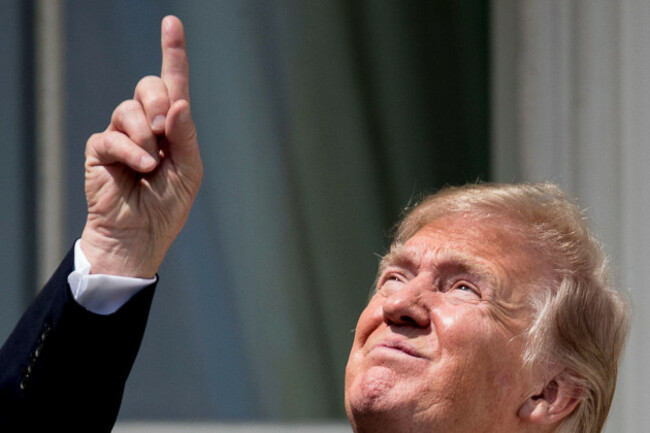
WELL, IT HAPPENED.
US President Donald Trump has caved, for now, on his move to completely upend the world’s trading regime after instituting a 90-day ‘pause’ on the new punishing tariffs on most of the world’s economies.
Just five days after saying his policies “will never change”, Trump yesterday conceded that the “medicine” he has administered has made enough people “yippy” to warrant a change of course.
Saying that people “were getting a little bit yippy” was a gross understatement from a man more known for exaggeration, given that it followed a week of global market panic.
So what exactly took place and why did Trump change his mind?
First of all, WTF happened?
Basically, the new tariffs that Trump announced on ‘Liberation Day’ last week and which came into effect yesterday morning will now instead be ‘paused’ for 90 days.
All except for the tariffs on China, which Trump says will continue.
The move was announced by Trump in a post on Truth Social that was dissected and acted upon by traders in the seconds after it was posted.
“I have authorized a 90 day PAUSE, and a substantially lowered Reciprocal Tariff during this period, of 10%,” Trump wrote in a post on his social media site.
Hours earlier, the first sign that something was up came as markets braced for another brutal session.
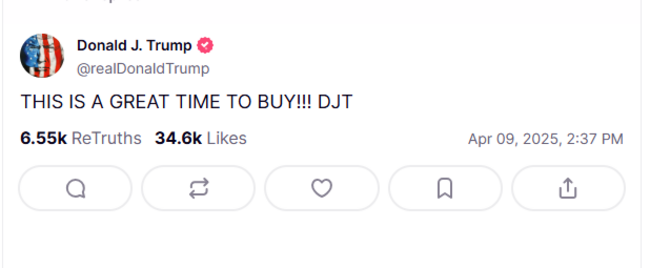
“BE COOL!” Trump urged Americans on Truth Social at 9:37 am in Washington (2.37pm Irish-time) before adding that it was a “GREAT TIME TO BUY!!!”
The post subsequently gave rise to many questioning whether Trump was engaged in insider trading, by encouraging people to buy stocks just before his dramatic reversal on global tariffs.
As Richard Painter, a former chief ethics lawyer for former President George W. Bush, out rather diplomatically put it:
“This is a scenario that could expose the president to accusations that he engaged in market manipulation.”
Others were less generous, with Democratic Congressman Mike Levin saying: “This is market manipulation to help his base profit. How is this legal or OK?”
“Who in the administration knew about Trump’s latest tariff flip flop ahead of time? Did anyone buy or sell stocks, and profit at the public’s expense?” California Democratic Senator Adam Schiff posted on X.
Regardless of the many ethics questions that surround how Trump made the announcement, the consequences were immediate and huge.
After a week in which company stocks traded on exchanges had taken a battering, the rest of yesterday saw stocks climbing to erase many of the losses taken in recent days.
JUST IN: The S&P 500 posts its best day since 2008. pic.twitter.com/uNH10UyeHE
— Brew Markets (@brewmarkets) April 9, 2025
The result was a composite increase in the value of shares on a historic scale.
The main S&P 500 index of leading companies increased by 9.52% yesterday, the third largest daily increase since World War II. The tech-focused Nasdaq rose by 12.2%, its biggest increase since 2001.
Both Apple and Boeing piled on more than 15%t, while Disney, Goldman Sachs and Nike were among the names winning more than 10%.
In summary, the markets were very pleased with the tariff pause.
But Trump and his team had shown little or no concern for the value of companies for the past week, so what was it that prompted yesterday’s change of heart?
The name’s Bonds, Treasury Bonds
Three profoundly ugly charts - stocks down, yields surging, dollar down. Awful awful awful pic.twitter.com/uDvc6vZ8yE
— Mike Bird (@Birdyword) April 9, 2025
Most analysts agree that what forced Trump into a retreat was not the battering company stocks were taking but the impact this was all having on US bond markets.
US government bonds, also known as Treasurys, had been coming increasingly volatile in recent days and a mass sell off could have been catastrophic for the US economy.
The sovereign bond markets are where a country’s debt is traded over a repayment horizon of up to 50 years.
The more risky the debt is seen to be the more its yield may increase and US bond yields jumped in recent days, with the 10-year yield rising above 4.5% before Trump’s announcement.
However, when company stocks are in a downward spiral government bonds tend to look like a safer bet and their yield decreases.
While investors initially flocked to US 10-year Treasurys as the stock market tanked last week and the yield went down, a selloff of bonds in recent days forced it back up, really spooking economists.
Former US Treasury Secretary Larry Summers called it a “highly unusual pattern” that suggested the US could be heading for a “serious financial crisis”.
Long-term interest rates are gapping up, even as the stock market moves sharply downwards. This highly unusual pattern suggests a generalized aversion to US assets in global financial markets. We are being treated by global financial markets like a problematic emerging market.
— Lawrence H. Summers (@LHSummers) April 9, 2025
Ipek Ozkardeskaya, senior analyst at Swissquote Bank, said the “red line” for Trump was a sell off of US government bonds.
“It was the flash sell off of last the couple of days across the US Treasury bonds that made Donald Trump take a step back from his tariffs,” she said.
“He didn’t care about the equity market sell off. He couldn’t care less about the global risk sell off.
He was certainly even happy to see the Chinese assets and crude oil tank but the fire sale of the US Treasuries in a couple of days increased the pressure on Donald Trump to an extent that it apparently became unbearable, even for Trump.
The Art of The Deal
Of course, Trump’s team were on message to claim that the u-turn was nothing to do with market pressure but that it was all part of a plan to bring countries to the table on tariffs.
Current US Treasury Secretary Scott Bessent claimed that Trump’s “strategy” had played out as planned.
“This was his strategy all along, and you might even say that he goaded China into a bad position,” Bessent told reporters at the White House after Trump’s abrupt backtrack.
“Many of you in the media clearly missed the art of the deal,” Press Secretary Karoline Leavitt told reporters.

To embed this post, copy the code below on your site










have your say