Sign in. It’s quick, free and it’s up to you.
An account is an optional way to support the work we do. Find out more.
Sign in. It’s quick, free and it’s up to you.
An account is an optional way to support the work we do. Find out more.
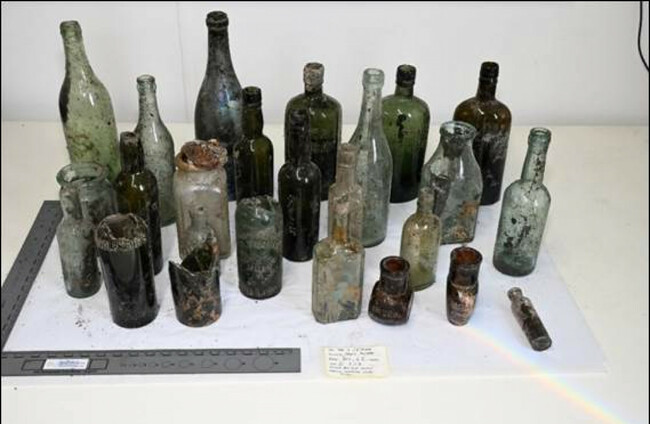
PERSONAL ITEMS dating back to the institutional era of the Tuam Mother and Baby Home and a single adult human tooth fragment have been found in the first six weeks of the ongoing excavation at the site.
No other human remains have been found, but it is important to note that only two sections of the site have been focused on so far (the site of a former workhouse yard and the boundary wall at the eastern side of the site) and existing research has indicated that there is a low likelihood of finding human remains in either of those areas.
However, forensic investigators did find personal items dating back to the institutional period of the site between 1925 and 1961, when it operated as a Mother and Baby Home.
These included shoes, spectacles, and glass baby bottle feeders.
Ancient and unrelated material was also found in the course of the dig including pottery, as well as large amounts of animal bone, which is likely from the kitchens that operated during the institutional and military periods of the site’s use.
Expert osteo-archaeologists have confirmed that a single fragment of a dissociated adult human tooth was found, which is currently being analysed.
A spokesperson for the Office of the Director of Authorised Intervention, Tuam, (ODAIT) said that this find is a “testament to the detailed methods that are being used on the site”.
While further human remains have not yet been recovered, the OPW has entered into an agreement with the HSE that will enable ODAIT to use a part of the HSE’s Toghermore campus outside of Tuam for its mortuary facility.
Works to adapt the facility for this work are currently underway.
In the interim, ODAIT is using a temporary off site facility located in Headford, Co. Galway.
ODAIT is providing updates to families and survivors, and to the media, on the ongoing excavations on a monthly basis.
This dig is happening because research undertaken in 2014 by local historian Catherine Corless indicated that 796 babies and young children were buried in a sewage system at the St Mary’s Mother and Baby home between 1925 and 1961.
St Mary’s was a home for unmarried mothers and their children which was operated by the Bon Secours Sisters, a religious order of Catholic nuns.
Seven years after Corless’s findings were made public, Taoiseach Micheál Martin delivered an apology on behalf of the state for the treatment of women and children who were housed in mother and baby homes across Ireland.
The Bon Secours Sisters also offered a “profound apology” after acknowledging that the order had “failed to protect the inherent dignity” of women and children in the Tuam home.
When the excavation was announced, Corless said: “There was no will to do anything for those babies except leave them there and put a monument over them.
“But this was a sewer system and I couldn’t give up on them. They were all baptised, they deserve to be in consecrated ground.”
Anne Corrigan, a woman who discovered she had two older brothers who were born while her mother was a resident at the Tuam home, visited the site before the dig started.
“These children were denied every human right in their lifetime, as were their mothers.
“They were denied dignity – and they were denied dignity and respect in death.
“So I’m hoping that today maybe will be the start of hearing them because I think they’ve been crying for an awful long time to be heard,” she told reporters on that day.

To embed this post, copy the code below on your site









have your say