We need your help now

Support from readers like you keeps The Journal open.

You are visiting us because we have something you value. Independent, unbiased news that tells the truth. Advertising revenue goes some way to support our mission, but this year it has not been enough.

If you've seen value in our reporting, please contribute what you can, so we can continue to produce accurate and meaningful journalism. For everyone who needs it.

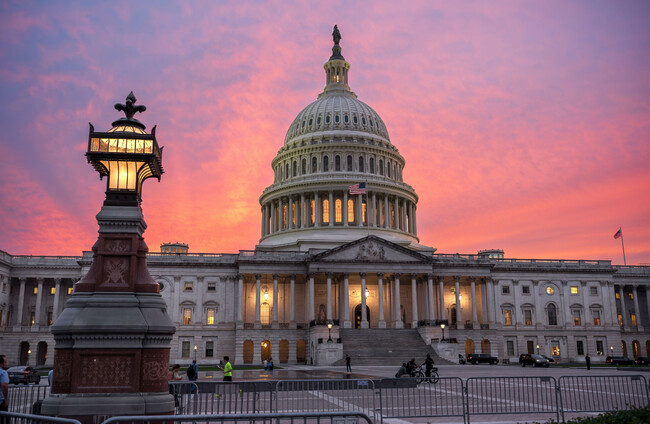
The Capitol in Washington. Alamy Stock Photo

US government shuts down as Republicans and Democrats fail to pass funding plan

Roughly 750,000 federal workers are expected to be furloughed, some potentially fired by the Trump administration.

THE US GOVERNMENT has shut down after lawmakers failed to break a budget impasse during acrimonious talks that hinged on Democratic demands for health care funding.

It is the first shutdown since 2018, which lasted 35 days, and could bring work at multiple federal departments and agencies to a halt, affecting hundreds of thousands of government workers.

Roughly 750,000 federal workers are expected to be furloughed, some potentially fired by US President Donald Trump’s administration.

Trump blamed Democrats over the stalled talks and threatened to punish the party and its voters during the stoppage by targeting progressive priorities and forcing mass public sector job cuts.

“So we’d be laying off a lot of people that are going to be very affected. And they’re Democrats, they’re going to be Democrats,” he told reporters in the Oval Office.

He said a “lot of good can come down from shutdowns,” and suggested he would use the pause to “get rid of a lot of things we didn’t want, and they’d be Democrat things.”

Government operations began grinding to a halt at midnight (5am Irish time), after a frenetic but ultimately failed bid in the Senate to rubber-stamp a short-term funding resolution already approved by the House of Representatives.

Hopes of a compromise had been hanging by a thread since Monday, when a last-gasp meeting at the White House yielded no progress.

The gridlocked Congress regularly runs into deadlines to agree on spending plans, and the negotiations are invariably fraught. But Congress usually avoids them ending in shutdowns.

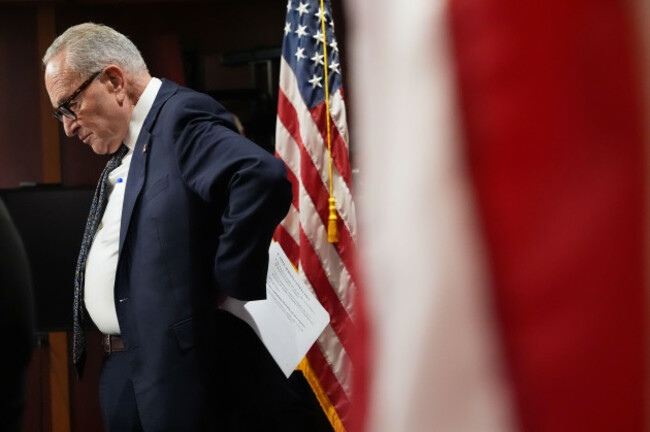
senate-minority-leader-chuck-schumer-of-n-y-listens-as-he-speaks-to-reporters-tuesday-sept-30-2025-at-the-u-s-capitol-in-washington-ap-photojacquelyn-martin Senate Minority Leader Chuck Schumer of New York listens as he speaks to reporters. Alamy Stock Photo Alamy Stock Photo

Democrats, in the minority in both chambers of Congress, have been seeking to flex their rare leverage over the federal government eight months into Trump’s barnstorming second presidency that has seen entire government agencies dismantled.

Trump’s threat of new job cuts added to anxieties in the federal workforce sparked by large-scale firings orchestrated by tycoon Elon Musk’s Department of Government Efficiency earlier this year.

Health care under threat

The 100-member Senate requires government funding bills to receive 60 votes – seven more than the Republicans control.

Republicans had proposed to extend current funding until late November, pending negotiations on a longer-term spending plan.

But Democrats wanted to see hundreds of billions of dollars in health care spending restored, particularly in the Obamacare health insurance program for low-income households, which the Trump administration is likely to eliminate.

Almost all Senate Democrats voted against a House-passed, seven-week stop-gap funding measure hours ahead of the midnight deadline.

It remains unclear how long the shutdown will last.

The federal government has shuttered 21 times since 1976, when Congress enacted the modern-day budget process.

a-fired-government-worker-holds-signs-about-the-looming-government-shutdown-tuesday-sept-30-2025-on-capitol-hill-in-washington-during-a-rally-with-former-federal-employees-ap-photojacquelyn-m A fired government worker holds signs about the government shutdown during a rally with former federal employees on Capitol Hill. Alamy Stock Photo Alamy Stock Photo

Some stoppages have lasted only a few hours – not long enough to affect government operations.

The longest began on 22 December 2018 when Democrats and Trump found themselves at an impasse over $5.7 billion the president was demanding for a border wall during his first term.

Around 380,000 federal employees were furloughed and another 420,000 worked without pay.

Senators can move quickly when inclined by waiving the normal procedures that tend to hold up legislation.

The upper chamber was due back in session on Wednesday, but a House recess lasting all week means it will not be able to rubber stamp any quick deal agreed by the Senate.

The Senate will be out on Thursday for the Jewish holiday Yom Kippur, but will be back on Friday and possibly in session through the weekend.

The shutdown will not affect vital functions like the Postal Service, the military and welfare programs like Social Security and food stamps.

But up to 750,000 workers could be sent home each day and would not be paid until the shutdown was over, according to the Congressional Budget Office.

Additional reporting from © AFP 2025 

Readers like you are keeping these stories free for everyone...
A mix of advertising and supporting contributions helps keep paywalls away from valuable information like this article. Over 5,000 readers like you have already stepped up and support us with a monthly payment or a once-off donation.

Close
72 Comments
This is YOUR comments community. Stay civil, stay constructive, stay on topic. Please familiarise yourself with our comments policy here before taking part.
Leave a Comment
    Submit a report
    Please help us understand how this comment violates our community guidelines.
    Thank you for the feedback
    Your feedback has been sent to our team for review.

    Leave a commentcancel

     
    JournalTv
    News in 60 seconds