We need your help now

Support from readers like you keeps The Journal open.

You are visiting us because we have something you value. Independent, unbiased news that tells the truth. Advertising revenue goes some way to support our mission, but this year it has not been enough.

If you've seen value in our reporting, please contribute what you can, so we can continue to produce accurate and meaningful journalism. For everyone who needs it.

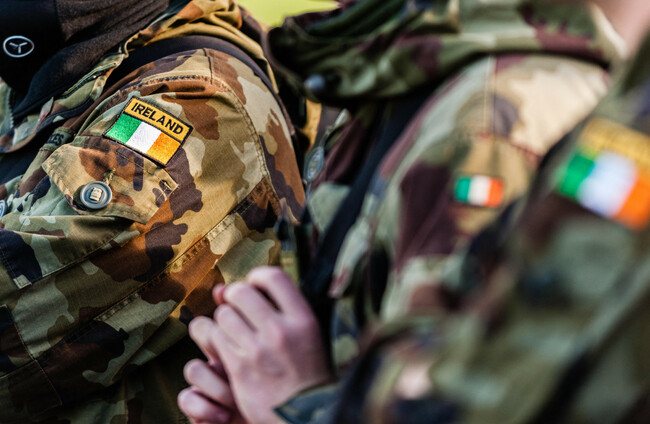
File photo of members of the Defence Forces. Alamy Stock Photo

State requested to attend High Court over tribunal funding for Women of Honour

The Women of Honour have taken a High Court challenge against Defence Minister Helen McEntee, Ireland and the Attorney General.

DEFENCE FORCES RIGHTS group Women of Honour is challenging the State’s refusal to fund their legal teams’ participation in the tribunal investigating how the force has dealt with allegations of bullying, harassment and sexual assaults.

The group has submitted that there is an ‘inequality of arms’ and a fundamental unfairness in circumstances where the State, which is the subject of complaints, is fully funded, while the Women of Honour, who are under no suspicion, are at risk of being denied their costs.

The Women of Honour CLG has taken their High Court challenge against Minister for Defence Helen McEntee, Ireland and the Attorney General, who have been put on notice that they must attend the High Court for the judicial review.

The tribunal began its work this week and is scheduled to continue for 33 days.

At the High Court, Mark Harty SC, for the group, submitted to Judge Sara Phelan that, under law, when assessing costs, the tribunal must first consider the conduct and cooperation of participants in their provision of assistance to the tribunal.

Harty submits that this rationale is “wholly inapplicable” to the applicants, in that the Women of Honour Group is not a respondent, or a party under suspicion.

“Rather, it is a representative body of complainants whose accounts and evidence constitute a central component of the tribunal’s work,” he said.

“They are voluntary participants who have come forward to assist the tribunal in its fact-finding task.

There is no conceivable basis upon which it could be said that they are at risk of being denied costs on grounds of non-cooperation or misconduct,” it is claimed.

Harty submitted that the tribunal’s effectiveness “depends” on the engagement and participation of his clients and that the denial of funding “operates not as a mechanism of fairness but as a structural barrier to participation”.

He further submitted that, by contrast, the Defence Forces and the minister, who are the subjects of complaints “have been granted full legal representation and are funded by the State on an ongoing basis”.

“They are fully resourced, while the complainant group is not,” he said.

Harty said this creates a “fundamental inequality of arms” inconsistent with “basic principles of constitutional fairness”.

Harty added: “The State cannot rely on the limitations of the tribunal as a basis for avoiding its own responsibility to ensure that participation is real and effective.”

In his ex-parte application at the High Court, Harty submitted that any witness at the tribunal may have their credibility, reliability and their personal accounts of events scrutinised, whereby reputational consequences could follow in a public forum.

This, he said, could render the entitlement to representation “illusory”, in that funding could be denied.

“A right which cannot be exercised, is no right at all,” he said.

Judge Phelan put all respondents on notice and adjourned the matter to appear before the judicial review list again at the High Court next week.

Readers like you are keeping these stories free for everyone...
A mix of advertising and supporting contributions helps keep paywalls away from valuable information like this article. Over 5,000 readers like you have already stepped up and support us with a monthly payment or a once-off donation.

Close
JournalTv
News in 60 seconds