TheJournal.ie uses cookies. By continuing to browse this site you are agreeing to our use of cookies. Click here to find out more »
Dublin: 9 °C Sunday 26 May, 2013

347 psychiatric patients received electro-shock therapy in 2010

A debate is raging over whether patients should ever be given ECT against their wishes

Image: Fotos Gov/Ba via Flickr

ELECTROCONVULSIVE THERAPY (ECT) was performed on about 35 psychiatric patients who were either unwilling or unable to give their consent to treatment during 2010.

Overall, 347 patients received ECT in Ireland in 2010.

64 per cent were between the age of 18-64 years old. The average age for females was 59 and 60 for men.

The Mental Health Commission stated that 90 per cent of ECT programmes were administered to voluntary patients who consented to this treatment.

ECT, which involves sending an electrical current through the brain via electrodes applied to the scalp, can have beneficial effects on patients according to The College of Psychiatry. Many mental health campaigners argue that forced use of ECT is a human rights abuse resulting in severe memory loss.

However, the use of ECT has raised issues surrounding human rights, consent and the capacity of patients suffering with mental health problems.

If changes to the Mental Health Act 2001 are introduced, patients who do not give consent to ECT, may not be forced to have the treatment.

Minister of State with responsibility for Disability, Older People, Equality and Mental Health, Kathleen Lynch has flagged a number of aspects of the Mental Health Act that may be changed, namely the article 59b of the act, which states that the ECT can be given to an involuntary person who is “unwilling or unable”.

Currently a patient must consent to the treatment, but if they decide against treatment then that decision can be overridden if two psychiatrists believe it is in the best interests of the patient.

Minister Lynch told TheJournal.ie that she is of the view that in no circumstances should a patient who is  capable of giving informed consent be forced to take treatment against their will, and accordingly, has accepted the recommendation of the steering  group which reviewed the Mental Health Act.

Following their recommendation, the minister said that the term ‘unwilling’ should be removed from  section 59 of the Mental Health Act 2001. This amendment will provide that where a person has the capacity to make the decision, any refusal to accept ECT will be respected.

However there is still some contention concerning the word “unable”. The Minister has stated that in regard to patients  who are ‘unable’ to give consent will need further examination in the  light of the proposed capacity legislation.  She said she is confident that any shortcomings in the 2001 Act which arise because of capacity issues will be addressed by the proposed Assisted Decision- Making (Capacity) Bill which is  currently being finalised by the Department of Justice and Equality.

The purpose  of  the  proposed  Bill  is  to provide a statutory framework governing  decision-making on behalf of adults who lack capacity and will provide for the introduction of supported and substitute decision making for such adults.

David McCarthy from Mad Pride Ireland said that the removal of one word and the retention of another is simply “window dressing” adding that it was all just “semantics”.

She is maintaining the overall ethos of the act that enforces a psychiatrist’s power over the life of a patient. The psychiatrist is still left with the power over the individual. We have the case where a voluntary patient is voluntary up to the point where the psychiatrist can decide that a patient shouldn’t leave, even when a patient wants to, they can sign them over to be an involuntary patient and immediately they lose all their rights. That is still currently the situation and is upheld under the act.

Calling ECT a barbaric act, McCarthy said he was pushing for a full removal of ECT.

Andrea Ryder, External Affairs and Policy Manager at the College of Psychiatry told TheJournal.ie that she disagreed with Mr McCarthy stating “it is not semantics. What needs to be described is what “unable” means. The new capacity legislation will help determine what that is and what deems someone to be lacking in capacity and their ability to make a decision”.

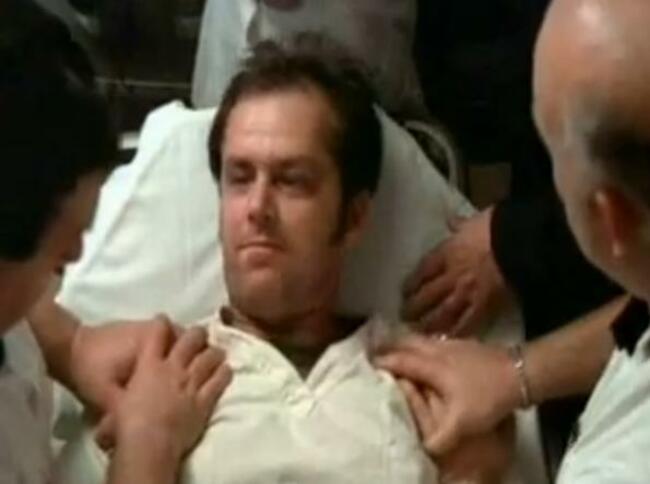
She added that ECT is not the “barbaric” act that many think it is adding that most people think of the film ‘One Flew Over the Cuckoo’s Nest’.

(Image via YouTube/)

It is in no way like the film. It is much more highly regulated. You have to have a nurse, an anaesthetist and consultant psychiatrist. Years ago it may have been different.  Some of the views out there on ECT are based on experiences from 30 years ago and that is not to take away from bad practice then, but like any medical practice, the more time goes on the more we know about it.

Mary Maddock from Mindfreedom Ireland said she totally disagrees that the practice of ECT has changed much.

Speaking to TheJournal.ie, she said was diagnosed with bi-polar disorder and had ECT following the birth of her daughter in 1976. She said while doctors say that ECT is a last resort treatment, she was given the therapy just three days after having given birth.

She had it again in 1983, but said she is not sure how many sessions she received. She believes that psychiatrists are defending the use of ECT by stating that it has changed a lot over the last few years. “I am still hearing of cases where people are being forced to have ECT in the last year,” she said.

The first time I got electric shock therapy I don’t even remember having it. My husband Jim was consulted at the time, but I never gave consent, in fact I was never even asked. I didn’t even know what electric shock was at the time and either did Jim. No one told me what it was. Back then and still today, people give consent to things that are not explained to them. If you don’t have full knowledge of what you are consenting to you should not consent.

Ms Maddock said that removing the word “unwilling” still leaves the word “unable” which she said allows for psychiatrists to make the decision in a time of crisis.  “The easy way for them to ensure that no one has it is firstly to introduce an advanced directive in which you can instruct someone that you never want ECT administered on you, that would be legal. At the moment you cannot make an advanced directive as it is not legal so is not worth the paper it is written on”.

Ms Ryder added that other treatments should be tried on that patient before ECT.

“ECT is a last resort, it should only be used when everything else has been tried, medication and therapy,” she said.

Mr McCarthy criticised the Minister for not being clear while appearing on TV3′s Tonight with Vincent Browne Show recently.

“She initially says that the patient’s wishes ‘will be taken into account’ put when pushed she said the patient’s wishes ‘will prevail’ so which one is it, it is simply a black and white issue.”

He argues that he would question the term “voluntary” in the Mental Health Commission’s figures stating:

The so-called voluntary decisions made for ECT – these patients are on a serious amount of psychotropic drugs. How voluntary that decision was can really be brought into question. If someone is brought into a facility and they are there for 6-9  months then they are on a cocktail of drugs , a psychiatrist comes in and explains ECT to you, and you agree. But then you can’t remember giving consent after. How voluntary those decisions are can be questioned.

The College of Psychiatry state in their position statement on ECT that they understand that ECT can raise people’s anxiety and fear.

They argue that while some people find it controversial ECT “is an important and necessary treatment for various serious psychiatric conditions, most commonly severe depression” adding there are “severely ill patients who will not respond to any other treatment”.

ECT is an “alternative effective treatment”.

Column: My experience in an adult mental health unit>

Read next:

Comments (107 Comments)

  • The article would have been strengthened if it had spoken to someone who had been treated by ECT and felt it helped them. I’d be interested to hear a viewpoint in favour from a patient who has had ECT.

    Reply
  • ECT may have its uses, but what I’d like to see is more resources applied into investigating the causes of depression in the first place. Most depressions have a social context and particularly with the young who have neither the skills nor the knowledge to explain what caused their depression undergo years of medication and ECT (Like myself) and emerge feeling worse seeing the treatment as being administered soley because I wanted to be a normal human being with friends, a job that did’nt isolate me from my peers, make some of my own choices etc.. I believe behind most depressed people is someone in higher authority who attempt to instill their own fears (with some success) on another. Consider the woman in an abusive marriage, an institution which is regarded as the foundation of social learning, who is to some degree coerced into remaining in that relationship between visites to the local psychiatric hospital.
    Since the Industrial Revolution the “Progress” that humanity has made is continually drawing us further away from our basic humanity (and it Hurts) hence the need for either perscribed or illegal drugs. We cannot go back now to that era and in truth humanity has benefitted from progress, but there is always a price to pay.

    Reply
  • It’s good to see this being debated and hopefully the law will be changed so that ECT cannot be given without a patient’s consent. The proposed changes are not about the effectiveness or otherwise of ECT; they’re about the individual’s right to have his or her bodily integrity respected.
    Continent Simian says “there are times when it can help”. This may be true but I’d bet that such cases are where patient’s submit voluntarily. I can’t see how being forced to undergo a phsyical treatment, which involves being restrained if you resist, could help anyone recover from depression. The trauma involved may well negate any benefits.
    The retention of the word “unable” is indeed, just semantics. Readers may visualise a catatonic patient being gently led to the the ECT room, but psychiatrists’ definition of “unable” is quite broad. They decide every day that people are “unable” to decide they’d rather be at home rather than in hospital or, even while in hospital, that they are “unable” to make the decision that they’d rather spend the day in clothes rather than pyjamas.

    Reply
  • Have you reported this hospital?

    Reply
  • Any evidence that this therapy works?

    Reply
  • Then there are people who swear by it, and say it is the only throng that works for them. The medical profession will actually admit that they don’t know why ECT works, but that it can be very effective in treating advanced depression. There have even been cases where some people display signs of addiction to it, of sorts. If someone is catatonic and cannot consent, but ECT might bring them out of it, should it not be used? If it is explained fully to their next of kin.

    Reply
  • Micheal 12/08/12 #

    Geraldine and Aubrey, if you have seen it – you can report the incident to HIQA. You are not powerless.
    Unless you’re reporting it here. In which case, HIQA aren’t going to be commenting under me to find out the particulars.

    Reply
  • This article is irresponsible.

    First of all, the treatment is not electro-shock therapy, it is Electroconvulsive Therapy. Hence ECT, not EST.

    Second, please note, out of 347 patients, 35 were EITHER unwilling OR unable to give consent. Just over 10% of patients who received the treatment were either unwilling or unable to give consent. That is actually quite a low percentage in medical terms. In addition, there is no breakdown of how many were actually unable as opposed to unwilling to give consent. I’d bet that it was a greater proportion unable any day.

    Thirdly, the person who received ECT is not qualified (if she is, it wasn’t mentioned) in medical terms to state whether or not ECT is right or wrong. The fact that she seems to have made a recovery from depression is contrary to her point. Also it has been shown on several occasions that ECT has been effective to treat the snap in kind of depression she seems to have suffered. But in addition to that, her next of kin was consulted, which means a protocol was followed. If she can’t remember how many rounds of ECT she had, she should ask her husband. He would have had to consent each and every time. Maybe if she had to live with depression for her life, she might change her opinion.

    This is shoddy, sensational journalism, designed to put forward a particular point of view. ECT works, it has been proven to do so. There are parades of people who have received the treatment who are living normal, healthy lives. Including the one mentioned in this article.

    In Ireland there is a shrouded veil over mental health. We forget that while someone might be able to appear to function normally, there may well be something going on in the mind. Psychiatry is no different to any other branch of medicine, where there are less desirable treatments, (ECT, medication), and more desirable treatments (one-to-one counselling). The appearance to the general public that psychiatric consultants are barbaric individuals, is wrong, and reading this article, anyone who thought they might have something wrong with them would certainly not present themselves as a result.

    Can we hear about how many patients receive emergency C-Sections, or emergency surgery to prevent blood loss, and how many of them are spouting off about how wrong their treatment was please? Because that’s the exact same as ECT.

    Reply
    • The journal.ie is becoming more and more shoddy & sensationalist with time. They have realised the way to increase website traffic and advertising revenue is to write articles (and opinion columns in particular) in a way that leaves out selective facts in order to polarise readers and get them commenting on the stories. It started as an excellent news source but has quickly succumbed to the lure of money…

      Reply
    • Typical we know what’s best for you attitude here. If you refuse to listen to patients you won’t learn. People are not happy with how their being treated, that is why this topic is being discussed and noone is in a better position to talk about treatment than the people subjected to it.

      Reply
    • Often the very worst people to ask about treatment are the patients. Ask the next person you meet about how well their blood pressure pill works. They can’t answer, because they aren’t aware of its effects and don’t understand it anyway. Ask the trauma patient if it’s a good idea to get the surgeon to fix a leaking artery. They can’t answer because they’re unconscious.

      In a wide range of situations healthcare professionals do know better. Mental health is no different.

      Reply
    • Micheal 12/08/12 #

      Aubrey, I’m listening to the 312 patients who have consent to ECT in 2010.
      Yes, there were many cases of ECT being abused in the past, there is a regulatory body in place. If anyone feels their rights as the patient were diminished they should take up a case with that regulatory body (IMC).

      Reply
    • If you go to the AIMS Ireland website you’ll find many stories – albeit anecdotal – of women who had emergency C-sections that they fee,i n retrospect were necessitated more by mismanagement of labour rather than medical necessity. Irish rates of C section are far above the rates recommended by the WHO.
      Speaking of rates I did read recently enough that your chances of being given ECT vary quite dramatically depending on where in Ireland you are treated. Can’t remember where so apologies for no link, but maby someone else can?

      Reply
    • @drRobotnik: In defence of the Journal they do need to make money to stay in business and pay their staff. The only options for them to do this are a) allow advertising or b) require users to subscribe. Given that the latter doesn’t do very well online (why pay when you can go elsewhere for free?), it seems advertising is the only way. And unfortunately advertisers demand page views…

      Reply
    • Look at the science….. or lack of it.
      Do people not think it strange that theories on ECT are being decided **after** the practice is being used?
      What is massively unfortunate is that people do not seem to be aware of the lack of scientific bases for any of the DSM labels. They are based on subjective opinion, not on test results.
      According to Terry Lynch’s book, Beyond Prozac, the ‘reasoning’ behind the introduction of ECT is that it was considered to be like epilepsy, and they further consider epilepsy to be the polar opposite to depression.
      The underlying issue to all of this that psychological/emotional distress is considered to be medical by psychiatry. Do they have any evidence?…. Nope, but with all the drug-money involved you can bet they are looking very hard.

      Reply
  • Sigh… *thing* wish you could edit comments here. iPhone autocorrect strikes again :/

    Reply
    • If it’s an obvious misspell that people can pick up on judging by the overall edit well then there is no need to correct yourself for grammar nazis! If you’re mixing up their and there, too/to I’d be more inclined to comment.

      Reply
  • Report the unit in question to the various relevant bodies. Get it investigated.

    Unless of course you’re spouting nonsense.

    Reply
  • For the patients involved, nothing else worked. What do the rabble rousing “concerned” idiots want to happen to these ill people?

    As for the bizarre notion of having a “debate” – we don’t let tabloids debate the pros and cons of different chemotherapies or antiinflammatories, so what the almighty &£@% gives people the idea they should decide on psychiatric treatments?

    Line up the consultants in your nearest psychiatric unit, and ask them if they would want ECT should the need arise. The collective answer is yes.

    Reply
    • If I don’t want chemotherapy noone can or should force me. People must be allowed to honestly decide on their own treatment. They will live with the result not a consultant.

      Reply
    • People absolutely should decide their treatment – so long as they are able to make decisions. ECT is an effective treatment for people with depression do severe they cannot make those decisions themselves. The equivalent is rushing an unconscious car accident victim to theatre.

      And if you think consultants don’t live with the consequences of their treatments you’re way off the mark.

      Reply
    • Eoghan, before my experience as a psychiatric patient, I would indeed have put psychiatrists on a par with oncologists or rheumotologists ie as highly-trained experts in their field, who treated patients on the basis of sound, empirical scientific research. As a well-educated, middle-class person I’d have thought anyone who suggested otherwise, well, a bit nuts.
      I now know a bit differently.
      Your analogy of the severely depressed patient with an unconscious car accident victim isn’t valid. Severely depressed people are not “unconscious”. There is also a difference between being able to make a decision and being able to put forward a lucid justification for that decision. Some patients are able to do the former but may be too medicated or exhausted to do the latter.
      I think it is important to debate these issues because most people don’t think about them until it’s too late. Until I found myself on a psychiatric ward I would of course have defended the considered judgement of trained professional against the irrational fears of a confused and unstable layperson. Until I was that layperson myself and I realised that most of psychiatry, at least as practised in Irish hospitals, is just guesswork,

      Reply
  • My dad received ECT two years ago after being in John of Gods for six months. With the state he was in he was in no way able to decide for himself if he should have it or not. It was a decision left up to us his family. All other treatments were taken before hand and were not working. It was a simple decision to make in order to get him better, which thankfully it did. Two years on and he is completely better and nearly off all his meds. ECT is in no way barbaric. Peoples views on it are outdated. Doctors use it as a last resort if other measures are not working and the majority of people who undergo the treatment gain a full recovery from their mental illness. I believe that people who are unable to consent to this treatment at the time would be thankful in the end they received it as the alternative of being trapped in mental illness is a hell of a lot worse. And I don’t think the majority of mental ill people would, like my dad have the ability to make the decision weather to have the treatment or not. My dad was lucky to have a family around him to make the decision. I understand that their are many people who don’t have the support and I am sure that the doctors who care for these people exhaust every other alternative before going down the ECT route.

    Reply
    • If your Dad was helped by ECT then he must be one of the lucky ones, as I have heard many stories about the damage that it did to them eg memory loss. My own father was given this treatment when I was a child and complained of memory loss. I wish he was alive today to ask him his opinion. I have a Psychiatric Advance Directive where I have stated that I do not want to receive this treatment under any circumstances. 4 years ago I developed symptoms of Bipolar disorder while on “anti-depressants”/an SSRI. I was on various drugs for 3 years but when I did my research and saw the lawsuits against the makers + side effects I stopped these damaging drugs (about 1 year ago). I have now learned other ways of dealing with emotional distress but I am still a work in progress. Regarding medication etc, I follow the work of Psychiatrist David Healy, American Peter Breggin, Pat Bracken, Ivor Browne, GP/Psychotherapist/author Terry Lynch and a few others who tell the TRUTH.

      I am an expert on my own mental health. Through lots of reading, research, experience etc When I go to Amnesty conferences we are recognised as experts by experience. That included a conference which was attended by the head of the Mental Health Commission. Unless you have experienced the system you cannot truly understand the damage that the ‘mental health system’ can do to a persons life. You can go looking for help with anxiety or panic disorder and end up with Post Traumatic Stress Disorder. I have had 4 years of a nightmare and 40 years if I truly think about it (because of the way my Dad was treated. He was a gentle man).
      I am lucky to see some light at the end of the tunnel but that is only by connecting to the right people and to other survivors of the system who understand. I did spend one week in a Private hospital, and did not experience that same trauma. I was treated with dignity and respect and had basic human rights. Everyone’s experience is different but unfortunately mine was not a good one. Hoping that others do not have to go through what I went through.

      Never stop any medication or change without consulting a doctor that knows what he is doing (due to withdrawal symptoms, which can be very severe).

      Reply
    • Aine, It’s really depressing to see the lack of knowledge in relation to Mental Health on this page.
      It is so unfortunate that people who have not spent time on the inside, do not know how crazy the mental health system is, and the madness called psychiatry.
      Psychiatry, if put under scientific scrutiny falls apart. They claim to be medical, but have no tests to either prove or disprove their diagnoses. A good actor could fake any of the DSM “mental illnesses” and be able to receive the label their choice. I’d love to see that experiment!!
      The ‘doctors’ experiment with doses – a bit of upper, a bit of downer.
      Hopefully the coming years will see the deserved discrediting of the psychiatric industry. It is based on an unproven no-hope hypothesis and has a dark history. I wonder how many still use leeches to suck out the “bad blood”?
      If the facts seep into the public conciousness psychiatry will surely loose it’s stranglehold of the Mental Health services and a Wellness model will be allowed to flourish.

      Reply
  • Just to be clear, I agree that it is a basic human right to refuse treatment, and that ECT is damaging treatment physically, morally and mentally. But the rationale has to be understood if we are to make progress, that we have to make psychiatrists and the nurses see that it is also of no help to anyone, and cannot therefore be justified. Indeed it is like trying to fix a a television with a sledgehammer. it is inhuman, degrading and of no help to anyone. ECT is abuse of the worse kind, and that it is administered without consent means that it is a violation of human rights, that is quite clear.

    Reply
  • The thing is that there are situations when someone is so depressed that they are a danger to themselves. That us when they are kept on locked wards and rightly so. Ect has a valid place in treatment if it is explained properly and the patient has support from friends or family who can help with the decision. It shouldn’t be forced. However it really can work and is nothing like the perception of it.

    Reply
  • Evidence. Who cares for evidence when n equals 1 and my anecdotal account is all the proof I need.
    Screw randomised controlled trials. I know best. Homeopathy is also the bomb.
    On an unrelated note, I have some magic beans for sale.

    Reply
  • I’ve seen it as a visitor

    Reply
  • As someone who has a family member who has been through a course of ECT treatment, I couldn’t speak more highly of the process and it’s positive effects. The family member in question had spent some time in a psychiatric hospital and was prescribed numerous medications, none of which made him 100% better. If it wasn’t for the ECT, I don’t know how he would be today. The doctors and nurses at this hospital were great at putting myself and the rest of my family at ease about the whole process. I really think it’s important that this bill is not changed. If a doctor is advising it for a patient, he/she is obviously doing so for a reason. It is needed in this country. If a person is unable to consent to this treatment then it shows that they are unfit to decide what is best for them. Therefore it’s only right that the decision should be left to the doctors and the patients family. I for one, am extremely grateful that this non-barbaric treatment still exists and am thankful for it as it gave my family member

    Reply
    • And if you ever found yourself in the situation where this treatment could be forced upon you, by the so called “experts”, how would you feel then? I never want this treatment under any circumstances. But that is my choice and it goes back to choice. If someone is deeply depressed there is usually a root cause or causes. There has to be a better way that shocking them and damaging memory.

      Reply
  • i agree with you mjhint.. pure frustration at a system fail on patients and those who are deemed undesirable or problematic ….

    i wish you all the best and will pray and hope for you to feel positive and know that many of us are not alone no matter how society treats people or looks down at them saying theyre not worth anything..

    stay positive and i hope you are well on the road to recovery…
    it is good to come out of being under a cloud…

    sends a smile and a good wish…

    Reply
  • Mjhint 12/08/12 #

    For those of you interested in whats really going on visit the madpride website. It gives an insight into abuses of mentally ill people. ECT can be effective but it can also be a terrible experience. People like myself with mental health issues feel badly treated even by family members because the truth is mental illness is a very difficult thing to deal with especially for our families. However most people in Ireland cannot deal with it properly. This includes doctors the public our families & friends & we need a new approach. If I was to put down on my CV about the fact I suffer with this how many on this thread would employ me. I know my illness is very difficult for everyone but its just as difficult for me. As people with mental illness we just want a say in our treatment & our lives. If thats too much to ask we are not dealing with this properly.

    Reply
  • There is a lot of misconceptions in the comments left here. ECT has been proven and increasingly so to be not only ineffective but downright dangerous. It belongs, like a lot of psychiatry, to the realm of scientism or pseudo-science. There have been studies (Random Control Trials) since the 1950s to that effect. In the past few years, more studies are confirming the ineffectiveness and dangerosity of this so-called treatment and disproving the discourse of the medial model in this regard yet again. Mary Maddock had put some links already. There are more for anyone who cares to search the Net or who has access to research papers. I am a researcher and I am able to understand this information and I will not be fooled by psychiatrists who tell me it is good for me.
    Besides, the United Convention on the Rights of Persons with Disabilities clearly states that even persons who lack capacities should be properly consulted and supported, under the principle of supported decision making (articles 5 and 12 of the Convention, as a minimum) rather than someone else making the decision making the decision for them. This is a radically different approach to psychiatric treatment and about time it was applied. We may have mental health issues but we also have human rights. And one of those is to say no to treatments we do not want. It is about time too that Ireland ratifies this Convention and thus moves forward towards the recognition of our rights (signed in 2007).

    Reply
  • I’d rather die than have ECT again. It’s not a treatment it’s abuse. As neurosurgeons say, it’s “the equivalent of using a chainsaw to fix a computer”. & btw, you don’t have to be anywhere near depressed for them to use it on you. Actually the reason I was forced to have it is their drugs were making me really really sick. Instead of being observant and realising that they thought they weren’t “working” so started this “treatment” in order to fix the problem that they created in the first place. It didn’t help one bit, only left me with brain damage. This was not that long ago, so all this nonsense about how it’s been improved is just that- nonsense. In fact, the muscle relaxant means that they have to run even more electricity through, so its worse not better.

    Reply
  • We are looking for the human right to say NO to psychiatric ‘treatment’ which we KNOW causes us harm. We want choices if we find we need help. Many of us have found other ways to help ourselves and would like more human ways to deal with human problems. We do not have a disease. There is no doctor who can show us a scan, blood test or other medical test which can prove we have a chemical brain imbalance.

    I was told I had a chemical brain imbalance and I need to take drugs for the rest of my life. I took them for a large part of my life and almost died while I endured a terrible life when I believed this lie. I am now drug free for over 12 years and my life continues to get better. I know many people with similar stories while others who want to become drug free have not got the help to do so. If people are informed and they want to choose drugs or electroshock that is their right but if people do not want to choose them that should be their right also.

    Reply
  • As a child i remember my Sister having Electric Shock Treatment, they said it would help her Epilepsy which it didn’t it terrified her and made her illness worse, my Parents were horrified and refused to allow it again, then they tried to offer her an operation, My Parents said this was a barbaric treatment and kept my Sister away from all these so called Doctors and practices, I am horrified to think 30 years on this still continues, Electric Shock and all these treatments should be illegal under any circumstances….

    Reply
    • ECT is used for severe depression and related conditions. Like most treatments, it was previously tried for other conditions – and didn’t work for them.

      Very telling whenever this subject comes up (several times a year, whenever there’s a slow news day) is that the “concerned” brigade pop up with decades-old anecdotes.

      Ask people about the bowel surgery they got 30y ago and compare it to what’s available today. Ask them about the treatments for RA, or crohn’s, or heart problems.

      We realize it’s ludicrous to discuss issues in modern healthcare in terms of outdated anecdotal experience, and yet it remains commonplace for people to launch empty nonsensical attacks on mental health interventions based on information that has no relevance today.

      Reply
    • Michelle 12/08/12 #

      I’m so sorry to hear about this. Your sister was very lucky to have such a supportive loving family.
      Don’t mind the government shills who log on to public forums to ram their opinions down our throats.
      Congrats to the Journal for giving us a forum where people who have suffered at the hands of the state a place where we can be heard.
      Keep up the good work.

      Reply
  • Shocking stuff.

    Reply
  • You need to report this. If you don’t you are just as bad as the people abusing these poor people.

    Reply
  • Geraldine , do not believe for one minute that happens but if there was even the slightest hint of any form of abuse it’s up to u the witness of it to report it .this abuse u speak of could not happen .

    Reply
  • psychiatry wants to protect its power voluntary means nothing in the system. Many patients in locked wards are voluntary and psychiatrists just change their status when they refuse treatment and change it back again to avoid patients accessing their rights. It is a corrupt system devoid of ethics and will be exposed like the church, banks and other too powerful institutions.

    Reply
    • Citations needed.

      Reply
    • What exactly is your problem Daniel? Is the aggressive over emotional language not a bit over the top. I have seen psychiatry at its worst last summer when a family member was hurt by these people. Power handed to one sector has a very bad history in this country.

      Reply
    • Never met a psychiatrist who wasn’t in the right place in a hospital setting.
      How the state lets them leave at 5 o clock every day is a bit of a mystery though!

      Reply
    • ‘devoid of ethics’ listen to yourself. I know a psychiatric nurse or two currently in the sector and they’ve hearts of gold who’s only intention is to help patients best they can without getting kicked, punched or spat at day to day. They work in difficult circumstances, they don’t do things for power, they do things for the care of the patient and their own safety. Electroshock Therapy does work and is the right course of action sometimes when the patient is in severe distress.

      Reply
    • Are you sure you’re not just describing ‘One flew over the cuckoo’s nest’?

      That was a movie, not a documentary.

      Reply
    • I’m frankly astonished by the aggressive certainty displayed by some if the comments fuelled by the naive assumption that psychiatry, at root, is about anything other than power.
      Psychiatric labelling, which is the cornerstone of psychiatric practice is a biased, gendered, and highly subjective affair. It’s not unusual for someone to pick up 5 or more different tags in a journey through the mental ‘health’ system.
      The idea that ‘mental illness’ exists in the same way physical illness does, is a myth without scientific basis. I’ve seen first hand the damage done by ECT.
      My Grandmother’s experience if it and it’s aftermath differ in no way from my friend’s some 40 years later.
      Severe memory loss, cognitive impairment, concentration problems. Like a chainsaw to a watermelon, some folks report an altered, blank feeling on the immediate aftermath but the original distress or despair invariably returns. It therefore does not ‘fix’ or ‘cure anything’.
      The chemical imbalance hypothesis has also been outed as a flimsy nonsense.
      There are far more honest ways to practice psychiatry and there are a growing number of consultants who have dedicated themselves to working with and for the people who may seek their assistance at a time of crisis. By taking a non pathologising approach to those in distress and seeing them as the experts of their own experience they can be of use and support.
      But its also vitally important to understand that the ever growing number of people worldwide who self identify as psychiatric survivors do so because they have had their dignity and human rights abused.
      If you’re interested in reading the writings of critical psychiatrists/psychologists, there are many to choose from including Pat Bracken, Phil Thomas, Joanna Moncrieff, Lucy Johnston, Sami Timimi, Paul’s Caplan, Robert Whittaker… And the many eloquent voices of survivors like our own Mary Maddock above.
      It really is time we started listening to and believing people when they tell us of abuses in closed facilities in Ireland. Humiliation, belittling, dismissal and bullying are mainstays of Irish psychiatric practice.
      It needs to change. Now.

      Reply
    • I was locked away as a VOLUNTARY patient 4 years ago. The Mental Health Commission (MHC) were not informed. As an INVOLUNTARY patient I should have had a solicitor appointed and a tribunal after 3 weeks. The whole ‘mental health system’ is a sham and a scam. As they push around their “trolley of potions and poisons” (to quote my diary). They got €20,000 from my Private health insurance for the damage they did but I never even got 1 minute of Psychotherapy. The 108 thumbs down versus 77 thumbs up reflect on the POWER and CONTROL of the brainwashing that is Psychiatry, who seem to be brainwashed by the pharmaceutical industry. $$$

      Reply
    • In response to “Sam I am”, I spent 2 months in an Acute Psychiatric Unit (which I now know was a reaction to an “anti-depressant”/SSRI. It is even in the DSM, the Psychiatrists ‘bible’, that those drugs can trigger mania/hypomania. Not that they would bother telling the person what was going on!). I did not see any kicking, punching and spitting. I’m sure things go on in these units but it is a pretty mundane, boring existence. With very little to do and where time drags on forever. I realise there are private hospitals where the facilities are better.

      Reply
  • Barbaric

    Reply
    • It’s not all “One flew over the Cuckoo’s nest”. There are times when it can help.

      Reply
    • Irish people always make me laugh with your ancient ways. “Ah sure, let us have a few beers and it will be grand.”

      Reply
    • @Andrzej,

      You couldn’t come up with a more generalising and offensive comment could you? Little tip for you, racism isn’t a highly sought after trait.

      Reply
    • @Jason, he couldn’t be more right.

      Reply
    • Go drink some Wodka Andrzej

      Reply
    • Mary Maddock’s comment:

      Because the main purpose of’ ECT’ if to produce a grandmal seizure of course it causes harm. Ask anyone who had a seizure how it effects memory. Our memories are our life histories. They are part of who we are, both good and bad. Doctors should want to heal not to destroy. If it is so effective why have there been cases of people thinking it was helpful even when the machines were not working?

      I had electroshock in the 70s and the 80s with an anesthetic the very same way as it is given today. How can it be improved today then? Why is it psychiatric practice to administer ‘ECT’ in all hospitals? Why do some private hospitals such as St Patrick’s have high figures for those who receive ‘ECT’? Why do much more women receive it esp. older women? Why do people get so many induced seizures( ‘ECT’) before it seems to work!? Why don’t doctors know how it works if it does? Why are people in severe distress treated like guinea pigs? Didn’t teachers think it was good to hit their students in the past. Surely real doctors can do better!

      Reply
    • Barbaric, Barbaric, Barbaric! ECT is a barbaric treatment. “One Flew over the Cuckoo’s Nest” is the most realistic film I have ever seen, as reflected by the main actress Louise Fletcher: http://www.youtube.com/watch?v=iNlbhH4FKTI

      Reply
  • Why do supporters of “sensible” (if there is such a thing) use of ECT attack ECT haters without saying very much about why they think ECT is such a valuable “solution” in some complex situations? The one and only argument that I see here in favour of ECT is that a few people can’t get enough of it, but hasn’t this argument been responded to more than adequately my many respondents over and over again? ECT lovers, please improve your standard of argument or go away !!
    Martin Camden, 07734 923194, kr64mobile@gmail.com.

    Reply
  • Systematic human rights abuses.
    Náire na hÉireann.

    Reply
    • Is ECT mentioned in any of the Human Rights texts (i.e. the European or UN ones)? I’ve had a read and can’t find it! I wish people actually knew what “human rights” mean and where the term originates.

      Reply
    • Nope, but what is mentioned is:
      Article 3: Everyone has the right to life, liberty and security of person.
      Article 5: No one shall be subjected to torture or to cruel, inhuman or degrading treatment
      or punishment.
      Both rights are infringed upon, especially Article 5. You surely cannot argue that ECT is not cruel or inhuman when inflicted on an unwilling person.

      The UN charter does also not mention gun, or washboard, or whips, but all can be used to infringe a persons human rights.

      I wish people actually knew what “human rights” mean.

      Reply
    • ECT is actually explicitly mentioned in the “Report of the Special Rapporteur on torture, Manfred Nowak”, which can be downloaded here: http://www.ohchr.org/EN/Issues/Disability/Pages/UNStudiesAndReports.aspx

      “40. Persons with disabilities are exposed to medical experimentation and intrusive and irreversible medical treatments without their consent (e.g. sterilization, abortion and interventions aiming to correct or alleviate a disability, such as electroshock treatment and mind-altering drugs including neuroleptics).”

      “61. (…) In its modified form, it is of vital importance that ECT be administered only with the free and informed consent of the person concerned, including on the basis of information on the secondary effects and related risks such as heart complications, confusion, loss of memory and even death.”

      So, the UN is clear about forced ECT to be a human rights violation.

      Reply
    • Thanks for the link Marian. Good to see the UN is on the side of patients :)

      Reply
  • I do agree with Aubrey. I made several visits to a certain hospital to a para suicidal acquaintance about a decade ago and the attitude of using staff shocked. The nursing staff were petulant and aggressive toward patients and visors, something I’ve never seen amongst general practice nurses. The friend did ask for ECT and they gave it to her, not sure if it helped.

    That said, not a lot is known about ECT and it is does seem to help some. I hav another friend who for some years has been gradually descending into a dark world of delusion and psychosis. Anything that can help stop that slippery slide should certainly at least stay available.

    Ps the one flew over the cuckoos nest comparison is generally wrong, from what I remember the treatment that did the harm was lobotomy, which thankfully is long since fallen out of practice.

    Reply
  • ECT works because it produces a short-lived euphoria, just like any physical shock does. But the euphoria wears off and the patient has to deal with depression again, this time with an impaired brain.
    It may give an opportunity to some to be shocked even for such a short time. But the experience is humiliating and so it cannot be of any benefit in the long term.
    Families often have ulterior motives, or at the best, are relieved to have the problem taken off their hands. A compliant humiliated person is one they can deal with, rather than the unpredictable behaviour which seems to add up to mental illness.
    Damage to the brain can be long-lasting. The absence of trust and the loss of the idea goodness to the person makes the treatment unacceptable.
    Indeed the motivation for prescribing drugs is often linked to financial benefits. The whole profession works in its own self-interest. There are very few, but a few, psychiatrists actually interested in the patient’s welfare.

    Reply
  • Reply
  • ECT — “There are times when it can help” — OMG !! Look, no one can dispute where you are coming from with this one. I have met people who swear that ECT saved their life, as I have met people who swear that various medications have saved their lives. And, if such people (my experience suggests a fair minority) are truly happy, and if they remain truly happy (mental health concerns never again significantly damage the quality of their lives), then I’m all for them receiving as much “treatment” as they like OF THEIR CHOOSING AFTER ALL OF THE FACTS HAVE BEEN EXPLAINED TO THEM CLEARLY (this is called informed choice and consent).
    On a more sinister note, I have met family members who swear by various “treatments” (tried in desperation by “professionals” who have run out of good ideas and can’t be bothered to do the work necessary to come up with some new ones and/or some more sophisticated ones). But, should we not be careful to rush into trusting the judgement of the very parents who f~ck~d up their offspring in the first place by always knowing what is best for their “stupid” child? (And then they place their “stupid” child in the hands of “professionals” who also “KNOW WITHOUT A SHADOW OF A DOUBT what is for the best regardless of what the ‘CHILD’ thinks”.
    And, BTW, I have also met people who have recovered quickly from very serious mental health problems once their once ignorant parent(s) decide to wake themselves up to their own major parts in the poisonous dynamics of their highly dysfunctional family.
    Yes, let’s support informed choice as consent as I, and many others like me, do, but please be careful of colluding with less intelligent “professionals” in making excuses for doing what THEY assume is for the best whenever it suits THEM to do so !!
    Martin Camden, 07734 923194, kr64mobile@gmail.com.

    Reply
  • Okay, 347 patients were treated with ECT in 2010. How many patients were treated by Psychiatric Hospital’s in 2010? 347 patients may seem like a lot but I would guess its less than 1% of the total treated ( I could be totally wrong but something tells me I’m not)

    Reply
  • Because the main purpose of’ ECT’ if to produce a grandmal seizure of course it causes harm. Ask anyone who had a seizure how it effects memory. Our memories are our life histories. They are part of who we are, both good and bad. Doctors should want to heal not to destroy. If it is so effective why have there been cases of people thinking it was helpful even when the machines were not working?

    I had electroshock in the 70s and the 80s with an anesthetic the very same way as it is given today. How can it be improved today then? Why is it psychiatric practice to administer ‘ECT’ in all hospitals? Why do some private hospitals such as St Patrick’s have high figures for those who receive ‘ECT’? Why do much more women receive it esp. older women? Why do people get so many induced seizures( ‘ECT’) before it seems to work!? Why don’t doctors know how it works if it does? Why are people in severe distress treated like guinea pigs? Didn’t teachers think it was good to hit their students in the past. Surely real doctors can do better!

    Reply
  • A visit, a decade ago. Seriously, why is it people think that this is sufficient basis to slur the mental health services? Imagine someone saying Germany is bad because they didn’t like a stopover in Munich airport in the 80s.

    Reply
  • Once again what we’ve got here is quite a number of commenters that fail to ask the crucial question whether at all we’re dealing with illnesses understood in a literal, medical way rather than in a metaphorical one, and therefor fail to see the bigger picture. People are sick, so they need to go to hospital and have medical treatment, right? One would think so reading here. Fact is that science hasn’t come up with one single proof of emotional distress to be due to real, physical brain disease so far. What science has come up with is study upon study that has shown non-medical help like Finnish Open Dialogue to create outcomes for so-called “mental illness” that are greatly superior to anything the bio-psychiatric approach to crises ever has accomplished. Without the use of ECT, widely without the use of psych drugs, and without the use of force. The proof is usually in the pudding, and conducting a simple comparison between the outcomes from every kind of help for people in emotional distress, instead of founding our “knowledge” and arguments on a bunch of arbitrary assumptions, here the assumption that “mental illness” must be “like diabetes”, i.e. a medical problem, should give us as a society pause, and have us indeed ask ourselves whether we really want to help people in emotional distress, or whether we, also in future, would prefer to only serve our own narcissistic needs, and simply shut people up by damaging their brains.

    If society had the humility and self-awareness to look beyond it’s own narcissistic needs, the discussion about the Mental Health Act would be a thing of the past, as there would be no Mental Health Act anymore, only human rights for everybody.

    Reply
    • That all sounds lovely, but anyone who has spent any time with the severely ill and still says mental illness isn’t real is either lying or delusional.

      Reply
    • Funnily enough, it doesn’t actually matter if mental illnesses are organic or functional. All that matters is that they cause suffering, and that the treatments alleviate the suffering. If you agree with those two ideas (both of which are firmly evidence based) then you can call them diseases, afflictions, illnesses or upsets. Do ECT, talk therapy and SSRIs improve how a person feels, if they are suffering from chronic low mood? Evidence says, in general, yes.

      Reply
    • @Eoghan Ryan Nobody questions that emotional crises can be severe. But from that observation alone to conclude that these experiences must be caused by a brain disease is what actually is delusional. Especially since there is no way that a psycho-social approach like Finnish Open Dialogue could cure any medical condition. As mentioned, the proof is in the pudding.

      @Peter Wheen Well, no, that’s not what the evidence shows, since most of it is based on certain criteria, while others, such as quality of life for the person in crisis herself, and, and even more important, long-term outcomes, are regularly left out. What we can observe today is that the bio-medical approach to crisis has worsened the long-term outcomes considerably. Everywhere in the world where the bio-medical paradigm is the predominant one, more people than ever before are “chronically mentally ill”. Cf. Robert Whitaker, “Anatomy of an Epidemic”.

      Suffering, like everything else in life, serves a purpose. It is not here to be avoided at all costs, it is here for us to learn how to overcome it. If we don’t understand this, and from the comments here to judge we’re further from such an understanding than ever, and keep trying to avoid rather than confront, it will only lead to one thing: more and more suffering.

      Reply
    • @Peter
      It matters so hugely whether it is environment or biological. The difference is HOPE.
      I’ve been diagnosed with the most stigmatizing of ‘mental illness’ labels – Paranoid Schizophrenic. When I was awarded that label it ended my life. The psychiatrists do as if they have science behind their confident assertions. They don’t. What’s more – they know they don’t. The DSM process is not a scientific one – both the diagnosis and the original ‘illness’ criteria do not follow the scientific or medical methods. That’s why being Homosexual could simply be deleted as DSM mental illness in 1973.
      My journey to reclaiming my mental health was despite the health system, which offered me a no-hope paradigm. I’ve been medication free for 6 years, during which time I obtained a Level 8 BSc in Software Development (not bad for someone who’s meant to have limited logical capacity.) However, no matter what I do in my life – no matter how normal and healthy a life I lead it from now until my death – I cannot get better in society’s eyes. That matters! I am forever more schizophrenic…. the only people who believe that are the state & it’s agents. My family and friends do not think it fits.
      Eoghan
      You are utterly missing the point. To say that mental illness labels, as defined in the DSM have no basis ***is not the same as saying** that there was no problem. The difference is that I can overcome emotional or psychological problems, but by definition of mental illness labels, I’m not **meant** to get better – that’s despite the fact that people do reclaim full mental health.
      My problems were evident from an early age, but I did not have the help I needed as a child, nor as a teenager, nor as a young adult. That’s is not a sob-story, it’s just fact. I had a very confused and troubled upbringing. What the state did, in the name of health is add to those troubles.
      Have a look at SuperNanny and tell me that well-intentioned parents don’t accidental harm their children. That doesn’t mean either are bad, it just means both end up with a lack of coping strategies.

      Reply
  • #mental health For those who are misfortunate enough to get referred to a mainstream Psychiatrist or to be put on psychoactive medication eg “anti-depressants”/SSRIs, please be aware of the reality of the situation. Mainstream Psychiatrists mainly drug people or as you can see from the link above give them ECT (Electric Shock Treatment). Avoid them like the plague. They will even go on the national airwaves and misleadingly announce that the use of Lithium for Bipolar and the use of “anti-psychotics” (tranquillizers) in the treatment of Schizophrenia, are more effective than the treatment of diabetes. Giving misinformation to the public without
    informing the public of the dangers of these drugs. Their close ties with pharmaceutical companies
    are the only explanation that I can come to regarding this type of propaganda. Some of these drugs can benefit
    people short term but long term other approaches are more effective, in a lot of cases.

    But never stop any medication or change without consulting a doctor that knows what they are doing, due to withdrawal. I admire the work of a few of them who tell the TRUTH: David Healy, American Peter Breggin, Pat Bracken (West Cork) and Ivor Browne.

    Peter Breggin discusses the link between “anti-depressants”/SSRIs and suicide, violence
    and mania. http://www.breggin.com/31-49.pdf

    Making a Killing: The Untold Story of Psychotropic Drugging – Full Movie (Documentary)
    http://www.youtube.com/watch?v=UDlH9sV0lHU&feature=player_embedded#!

    Reply
  • I knew healthcare was bad in Ireland, but Jesus, it sounds like the dark ages over there.

    Reply
  • When a prisoner attempts suicide they are put on suicide watch where they are watched over and offered counselling. Care becomes the priority. How come it isn’t prison policy to force ECT on those prisoners since it is claimed that it can be useful/vital in these life-and-death situations? If ECT is such a good solution surely this would save the government a lot of money as a quick-fix to in-prison suicide-attempts. The answer: Because the prisoner’s human rights are respected by the prison system, possibly due, at least in part, to the potential litigation that might ensue should “medical” or other treatment be given without the prisoner’s permission. The prisoner should of course have his/her rights respected but this means that the average person who has not committed a crime has less rights than someone who has been convicted of a crime.

    Reply
  • U don’t have to go to hospital to get an Electric shock.

    Reply
  • My good friend, Irit Shimrat, says that being hit on the head with a two by four would have about the same effect as electroshock. It would knock you out, frazzle your brain and you would ptobably lose a goo chunk of your memory

    Reply
  • The use of ECT in this day is positively Medi-EVIL. And that goes for Tasers as well – especially in the hands of thugs and people with hidden agendas. SHAME on those that even CONSIDER using this torture.

    Reply
  • I totally agree with Mary Maddock. Why is it necessary to create a grand mal seizure. Why put so many volts of electricity into a brain. I put my hand on a electric wire getting into a field once. I remember the reaction to my body. What on earth does such strong voltage do to the brain. I was given ECT at seventeen years. I was not given counselling, No I was given ECT. Why. I was put on antipsychotic medication for six years. Why. Did they know what they were doing. The medication according to Prof. Ivor Browne, gave me Bipolar Symtoms. I then went on to Lithium. Wow such a package by Consultant Psychiatrists. I ask the question with regard to ECT. No one should be given this Barbaric Treatment. Look at the Wellbeing Foundation Site. The late Dr. Michael Corry had a lot to say on ECT. If ECT is offered to an inpatient of a psychiatric hospital, one has to ask first before the patient agrees to treatment, can the patient make up their mind and give an rational decision when in the first place the consultant will have been prescribing medication. Can anyone on strong medication make a reasoned decision. I say no. . ECT should not be given to any living being.

    Reply
  • “A debate is raging over whether patients should ever be given ECT against their wishes”. Do I smell someone who is not interested in debate? Might they be a psychiatrist?
    Martin Camden, 07734 923194, kr64mobile@gmail.com.

    Reply
  • Although I, personally, am vehemently against the use of ECT in any circumstance (what the Hell happened to “first do not harm?”), I think that, as a first step in the right direction, we may have to create a place for a few “intelligent” people (“intelligent” not “qualified”/”sanctioned by the random mindsets of the day”) overriding the wishes of the “customer” in a very few extreme cases. But, even then I see us being up against the usual avoidance of responsibility and avoidance of accountability problems. I mean, please let’s not put decision-making in the hands of a couple of randomly, or not so randomly, chosen shrinks — insanity giving the impression of reasonableness, and irresponsibility dressed up as responsibility, fooling most people (sob!).
    Why not give real responsibility to the CEO of the Royal College of Psychiatry to choose a few well-balanced shrinks (oxymoron?) to make the kind of decision that most foolish people find so difficult, because then when, as they will, something goes terribly wrong, we will have a real person (the CEO) to lock up?
    Martin Camden, 07734 923194, kr64mobile@gmail.com.

    Reply
  • The issue about ECT is not necessarily that it is inducing a grand mal seizure, which it is, as the evidence irrefutably concludes in a statistically significant and scientifically valid way. What the issue is, is the force of ECT on people who do not want this “treatment”. For those who have been treated by ECT and report favourable results, okay. That is their experience. But what about the rest of the people who are claiming it did harm? Is their voice not recognised? Seemingly not when the mental health act allows psychiatrists to decide who gets shocked regardless of the will of the person. This is a human rights breach full stop. A person needs to be able to decide their own treatment, and to determine their future. Is this not a democratic society?

    Reply
  • the medications prescribed are mostly opiod based when dealing with the after effects from ect hence giving the patient no memory and all altering the patients genetic dna with the opiod based drugs along with other metallics like lithium based treatments which destroy despite the crap they like to peddle…

    its legal, but its a scam always was always will be… the practices are shit and they couldnt care less about the issues as in most of them.. they throw people in with the acompaniemt of the police who go to lengths to avoid the exposure and maltreatment of individuals and protect the establishment and elite and believe me its a global business amongst government and agencies.. theyre experts at protecting their pensions and payouts and paychecks.. how do you think the government makes so much money from the pharma jobs.. the docs kids and the rest all end up in the edu system as lawyers and they work it well to avoid claims set forward by individuals who are left without any hope due to the way the system is run..

    experts at deviousness.. .toss

    now thats a shame.. sick

    Reply
    • Genuinely one of the worst written, evidence-less comments I have ever read on this website. There are just so many inaccuracies. This is more like the conscious stream of someone who has a personal vendetta. Absolute prime example of the importance of medicine being evidence-based, rather than opinion based.

      Reply
  • Awful influx of anti-psychiatry trolls, in a suspiciously short space of time. I smell a “come quick guys, there’s a thread to be hijacked” forum post somewhere.

    Reply
    • Eoghan, I’ve read through the entire thread and your comments are, without exception, very hostile and belittling to those who disagree with your very pro psychiatry viewpoint. In fact your level of aggression is worrying. The majority of very personalised and angry responses are exclusively by male posters while many of those who have received this procedure and been badly harmed by it are female.
      They are not trolls, by any definition.
      Many, often very young men are very badly traumatised by their experiences of psychiatry but seem not to have chosen to add their voice to this discussion. With the kinds of responses you’re giving, I can understand why.
      There are many consultant psychiatrists who don’t believe ECT to be a safe and benign ‘treatment’ and who don’t use the practice in their units.
      Dr Pat Bracken, director of West Cork mental health services is one such clinician. His proposal delivered to Leinster House to delete section 59(B) of the MHA 2001 can be viewed as a PDF Doc online.
      I strongly urge you to read it before continuing to post on this thread as many of your assumptions are incorrect.

      Reply
  • Michelle 12/08/12 #

    Are we the only country in the world that allow family members act as judge and jury as to whether a person should lose his/her freedom just so the medical profession can do the ‘al Johnson’ shuffle, shouting out “they said she was mad, look, clean hands, clean hands”!
    Give a visit to ‘personal issues’ on other Internet forums to see how some family members plan in great detail how to have someone commited.
    Trips to the local G.P., keeping a diary of ‘mad’ behaviour that they can bring as ‘proof’. And if that doesn’t work, a few slaps will sort them out.
    Perhaps the ones that are trying so hard to deprive another individual of their freedom are the ones that need their heads examined!

    Reply
    • You display a great level of ignorance about the process of involuntary admission and the safeguards put in place.

      Reply
    • Yes. Professor Ivor Browne wrote in his book “Music and Madness” that if he ever walked into a room where there was a number of family members, he could never figure out who the “mad” one was. I do not believe that siblings etc should have automatic rights or at least believe that they have. Not all siblings get along and some dislike each other. So why should they have any power? Not to mention what used to go on years ago in this country as highlighted in the “Behind the Walls” RTE documentary.

      As for Eoghan’s comment, in theory it looks like there are safeguards, but in reality Psychiatrists can be cunning enough to work around those safeguards in some hospitals. I unfortunately know for first hand experience. Hence the Mental Health Act 2001 is under review at the moment.

      Reply

Add New Comment