TheJournal.ie uses cookies. By continuing to browse this site you are agreeing to our use of cookies. Click here to find out more »
Dublin: 9 °C Friday 24 May, 2013

A snapshot of the Irish in World War I

The National Archives has digitised the wills of 9,000 soldiers killed in action during the Great War.

Image: National Archives via Website

THE NATIONAL ARCHIVES has digitised and released copies of more than 9,000 wills belonging to Irish soldiers who fought for the British Army in World War I.

Although about 35,000 Irish men died in action, only 9,000 wills have survived. These are the only official documents held in the National Archives which directly concern the soldiers of World War I. There are plans for the English and Scottish equivalents to be put online shortly but the Irish project is the first to be completed.

Archivist Hazel Menton told TheJournal.ie that the project took four years and involved the individual scanning of each envelope and piece of paper.

The British Army provided several alternative ways of making a will, including forms in their service book and separate pre-printed forms. Soldiers were encouraged to make wills because it simplified the settling of their affairs after their deaths.

Included in the collection are 29 wills from soldiers who died in the South African war of 1899-1902. These are quite different from the wills of soldiers of World War I as many are accompanied by letters to their families and loved ones.

The archivists describe them as “newsy, informative missives” from the soldier to his mother, girlfriend, sister or brother that give an insight into the lives of the men fighting in South Africa, their family, home life and concerns.

Most of the soldiers were very young and did not have wives or children, and in many cases the beneficiary was their mother or father, siblings or the friends serving with them.

The poignant moments captured in the letters that have survived give us unprecedented access into the hearts and minds of Irish soldiers who fought during the two wars. The whole collection can be perused here.

Letters and wills

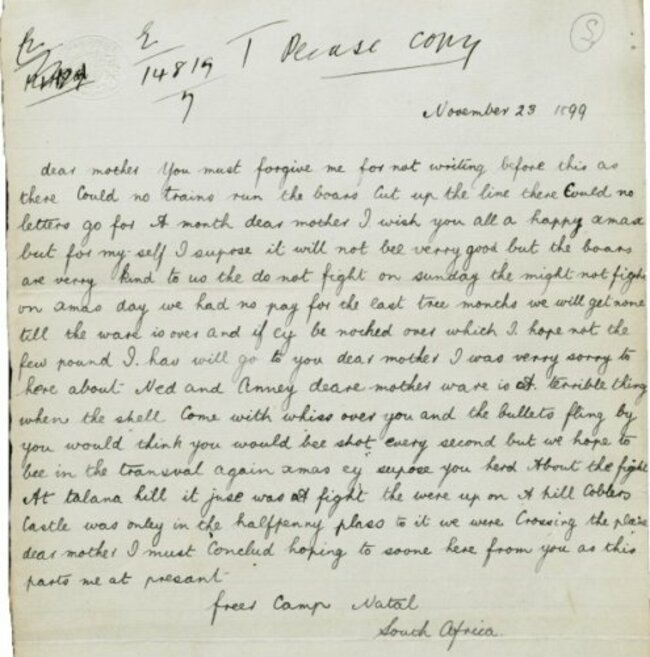
On 23 November 1899, Patrick Campion wrote to his mother to wish her a ‘Happy Xmas’.

…do not fight on Sunday, they might not fight on Xmas day…

He died less than a month later, on 15 December 1899.

Xmas Day

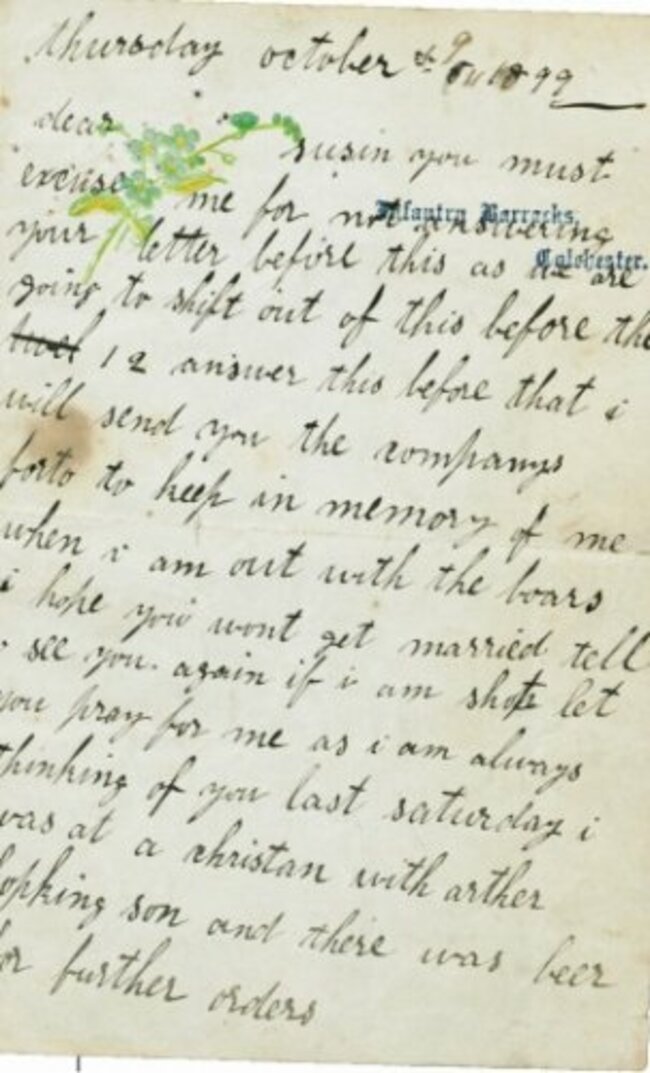
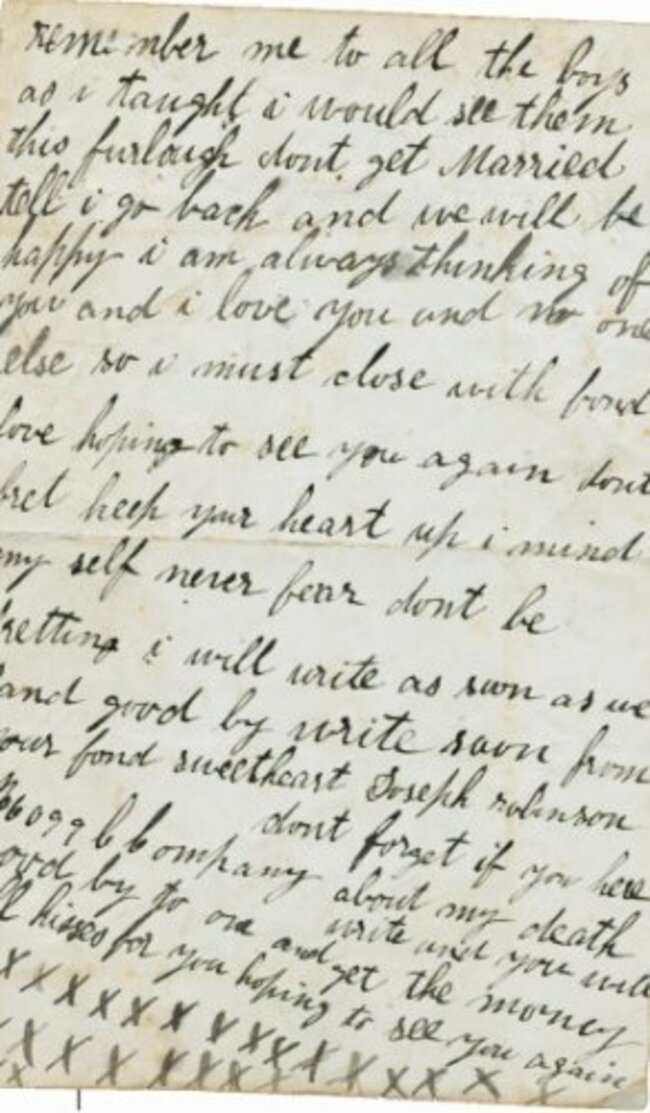
Joseph Robinson died in South Africa on 23 September 1901. In his emotional October 1899 letters to his sweetheart Susan in Virginia, Cavan, he asks her to stay faithful and not to marry until he returns.

Robinson2

He was also fond of marking his pages with x’s (or kisses).

Robinson

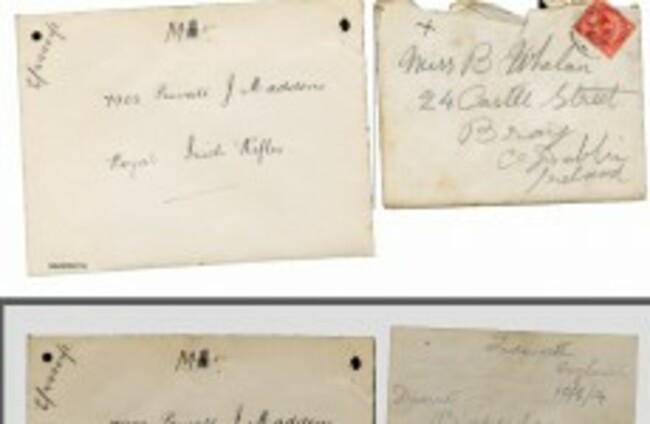
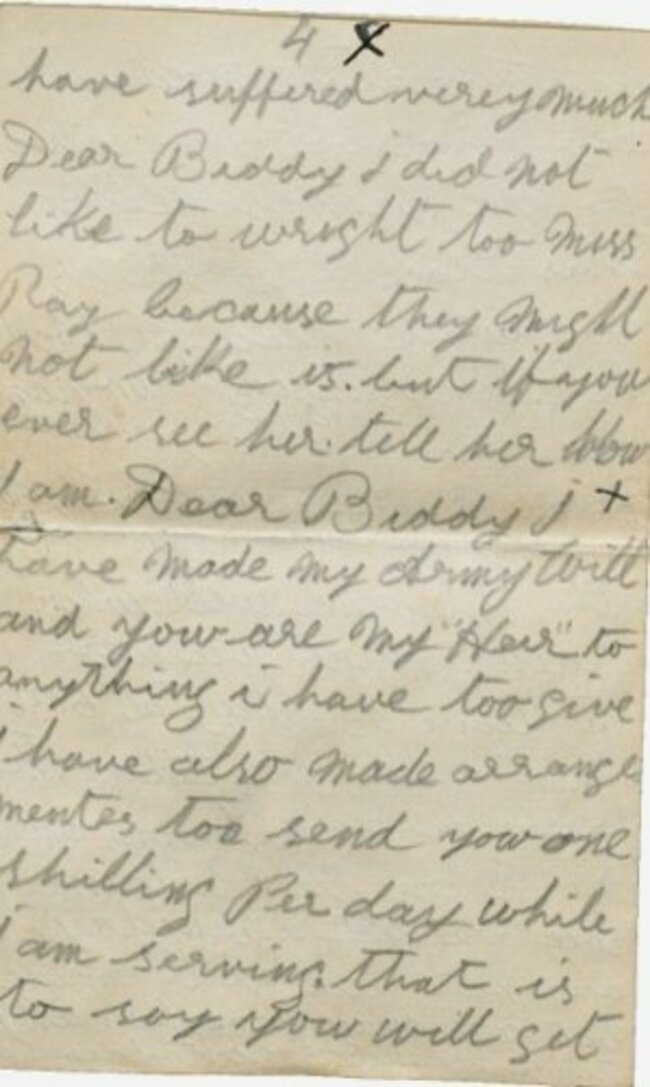
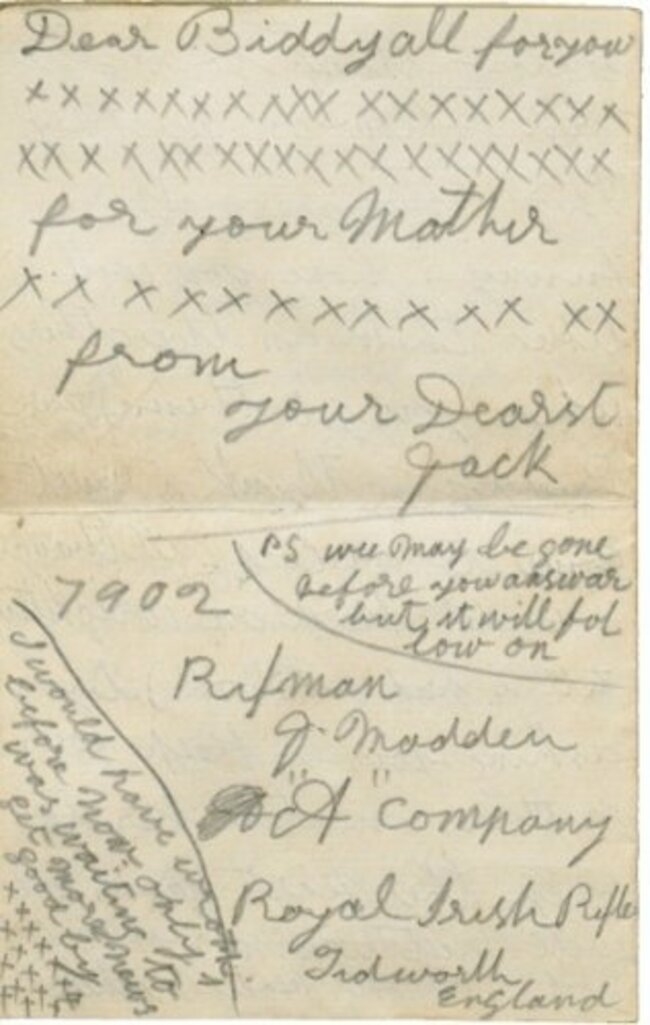
Jack Madden wrote numerous letters to a Biddy Whelan of 24 Castle Street, Bray before his death on 27 October 1914. In one note, he showed his Irish side by telling his love he missed his cup of tea.

Others are more serious as he talks about orders and feeling “much happier” for taking her advice and going to his duty. It is clear from one of his notes that his mother had died and he was not coping with the news.

The page that marks him calling Biddy his “heir” is denoted with an X.

Will

In the next page, he asks her not to think bad of him and that she may as well have the money he earns. He also returned two pawn tickets and orders to “tell the man I am gone to the front and I would not like to lose it”.

In the 12-page run-on letter, he enclosed photos and asked Biddy to show them to his father and tell him to “keep the heart up”. “We will all meet again I hope,” he added.

Biddy I do miss you fighting with me now. No matter we will fight again please god. Biddy don’t forget about what I say about the letter sa soon as you read this don’t forget forget me.

Jack

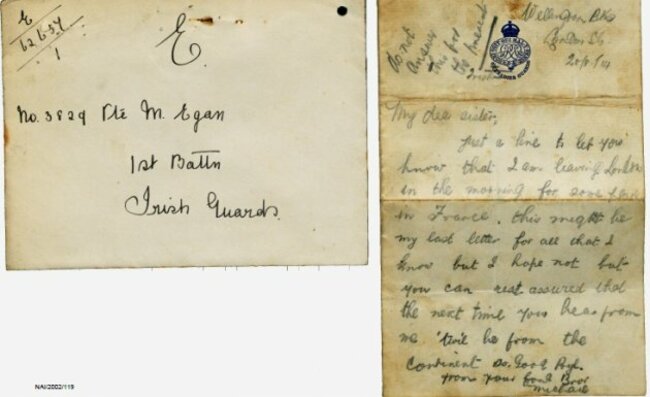
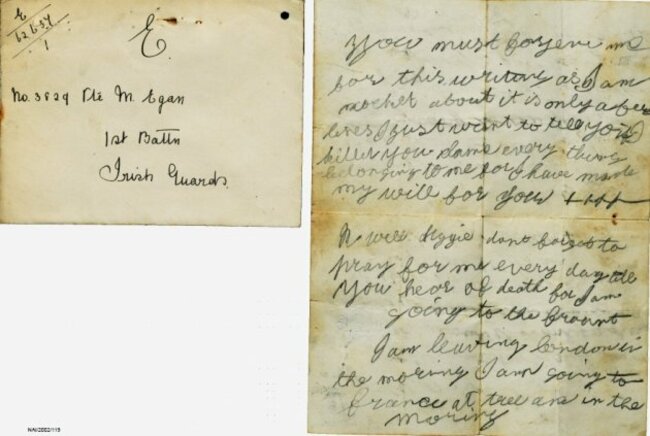
World War I soldier Michael Egan of the Irish Guards 1st Battalion asked his sister to pray for him every day until she heard of his death. “For I am going to the front. I am leaving London the morning I am going to France…”

The handwriting changes on page two and the soldier explains he had “his chum” write the first page.

Egan2

Egan

He was killed in action on 1 November 1914.

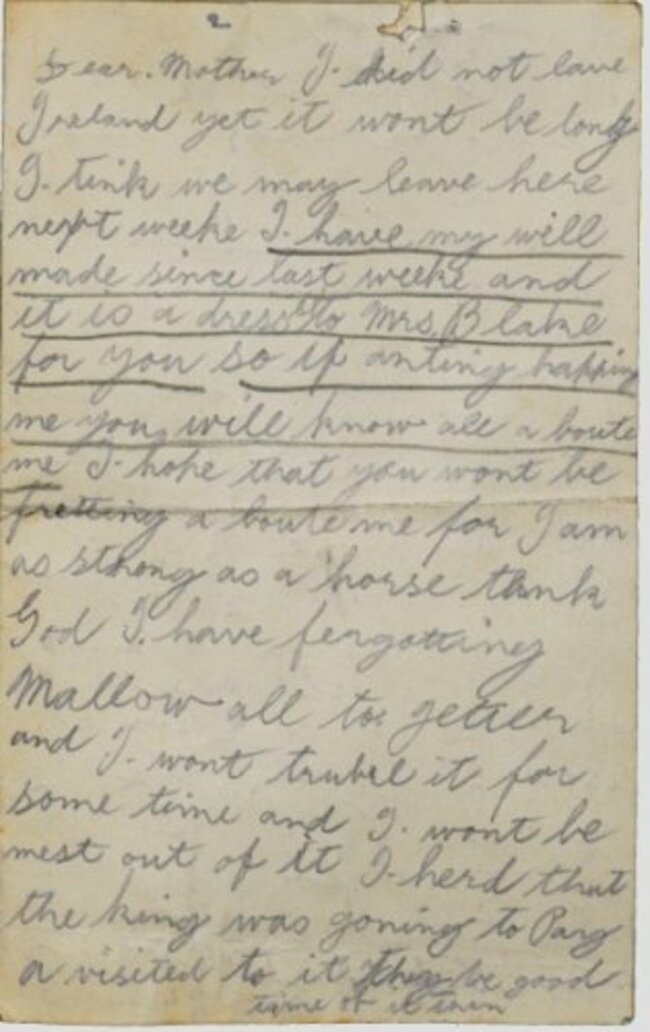
Private James O’Connell, who died on 15 August 1915, wrote to his mother on 20 April of the same year.

I have a nice time of it here nothing dont trouble me and very fond of the army. It would be a lot better for me that I listed years a go if I come home safe…

The ‘will’ part of the letter was then underlined.

o connell

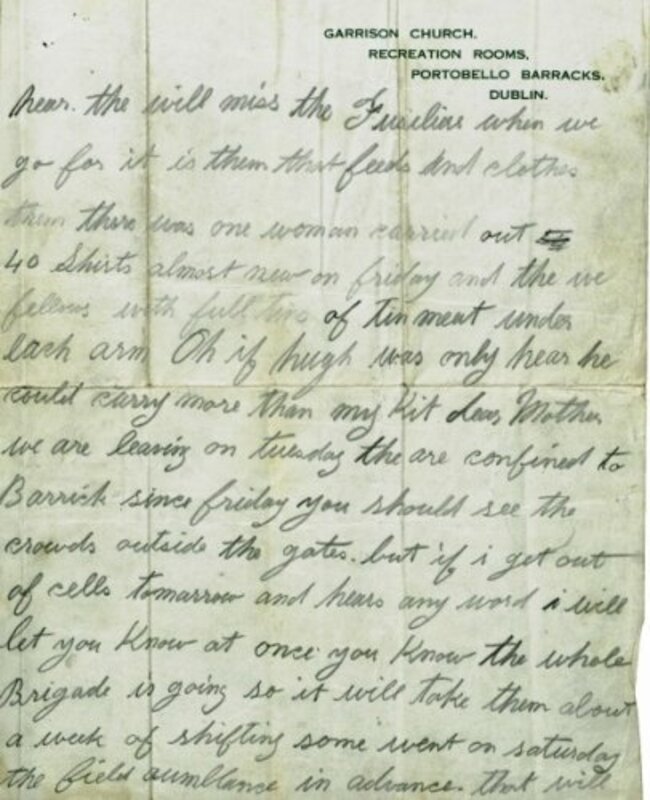
James Purvis gives an insight the process of drawing up wills.

Dear Mother we have got everything ready we have got our field badges sewed into our coats and we have got our small book and the little disks for going round your neck it is about the size of a penny with you…

And in the small book there is a place for making your will so I am making mine out for to leave to you so you can divide it the way you think fit if anything happens to me you would have all the money and clothing that belongs to me.

Purvis, who was part of B Company of the 6th Battalion, Royal Irish Fusiliers, also described the women up in Dublin. He claimed they would miss his company when they left because they feed and clothe them.

Purvis

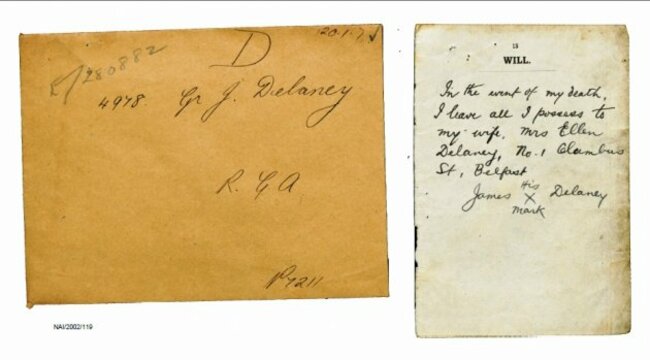
However, most of the correspondence from World War I was more simple, and often, was just a form filled in by soldiers. This will for James Delaney was simply signed with ‘his mark’ X.

James Delaney

Visit the National Archives website of Soldiers’ wills here>

Read next:

Comments (17 Comments)

  • heartbreaking, such a loss of life x

    Reply
  • Great work by the National Archives. I was able to see my great grandfathers will the other day, he was killed in action in 1916 I hope to be able to get out to his grave in France one day. Very proud of him and of all these brave men. May they never be forgotten.

    Reply
  • I cannot express how delighted I was to read this feature today. I only discovered in the last couple of years that my Great Gran Uncle died in the First World War when fighting with the 8th Battalion, London Regiment, of the Post Office Rifles. An online search revealed that he is commemorated on the Menin Gate in Belgium. This was an amazing and moving discovery for myself and members of my family who had no idea of this. Then this morning when I learned from your great article that solidier’s wills were now accessible online, I immediately followed the link and searched for my Great Gran Uncle. I was thrilled to find that his will had been scanned in. I can now see that he wrote his will on the 1st of June 1916 and sadly lost his life just over one year later on the 7th of June 1917. I’m so grateful to the National Archives for the work they’ve done to enable myself and others to discover and learn more about our families which have gone before us. Online access to both the 1901 and 1911 census forms helped me to discover so much, and acted as a jumping off point which lead me to discover even more at the Births, Deaths and Marriages office in Abbey Street. I am so delighted with this morning’s invaluable addition of my Great Gran Uncle’s will, a document written in his own hand, to the intricate web of my family’s story.

    Reply
    • Very happy for you! Fantastic to find a link to your unknown family, and to have been able to find his will. My great- great uncle died off alexandria in 1916… You should be proud . Live in France keep in touch when you come over.

      Reply
    • Thanks Deirdre, it sure is. I am indeed very proud, as I’m sure you are too. It’s marvellous to have been able to access it. I definitely want to travel over to where he is commemorated so I can pay my respects.

      Reply
  • The great forgotten. We will remember them.

    Reply
  • Very sad alright, and the letters highlight another reality, education wasn’t top of the agenda during those times, very difficult to follow some letters. Great piece of work, at least now their memories are bound to last for ever.

    Reply
    • You think emails and Txts sent by modern soldiers wud be better?

      All this shows is that cannon-fodder rarely comes from the upper classes.

      Reply
    • I didn’t want to make reference to the modern day soldier considering the topic at hand. However, you’re wrong to assume that the upper class were not present in this war. Let us assume that any person attending Trinity College at this time was upper class, it would clearly reflect that even the upper class fought, died and simply vanished during this war. We have a memorial to honour some of these students in the museum building next to the long library.

      Reply
  • At long last our society and our institutions of state are recognising that the exploits of these brave men. For so long Ireland didnt even want to know!

    Reply
  • It is great that these have been released as they will give a glimpse into the human side of the Great War.
    My great grandfather was in the war and had to leave his two year old daughter (my gran) with his brother and his wife as his own wife died in childbirth in 1912. There are untold stories of what these men endured personally and emotionally.
    Then of course there was the local civilisation for joining the British Army but for many it was a source of income for a family.
    Anyone with any relative who fought or died in WWI should remember and wear a Poppy tomorrow.

    Reply
  • Regardless of what you may think of WWI and/or why the men who were fighting and being wounded and killed this is an extremely important piece of work carried out by the National Achieves. This is about men who were were in many case writing home to mum and dad or other loved ones unknowingly for the last time. Great work.

    Reply
  • Dermot…..hope you make it out of Afghanistan safely.

    Reply
  • Never forget these great heroes who paved the way for the free and wonderful world we now live in.

    Reply
  • This is amazing, in less than a minute I had found my great Uncle John Quirk, 7th Leinster Regiment, who died on 27th October 1916. I had seen his death on the Commonwealth War Graves website, therefore knew for sure it was him by the date of death and the next of kin details, but to see an actual handwritten will is quite emotional. His brother was born 2 years after his death and named after him – he was my paternal Grandfather and came to England in the 1950s as so many did. Amazing and truly worthwhile project.

    Reply

Add New Comment