Sign in. It’s quick, free and it’s up to you.
An account is an optional way to support the work we do. Find out more.
Sign in. It’s quick, free and it’s up to you.
An account is an optional way to support the work we do. Find out more.
LAST UPDATE | 1 Feb 2021
MINISTER FOR FOREIGN Affairs Simon Coveney has “strongly” condemned the coup staged by Myanmar’s military, in which democratically-elected leader Aung San Suu Kyi has been detained.
The military has declared it had taken control of the country for one year under a state of emergency.
The intervention followed weeks of rising tensions between the military, which ruled the country for nearly five decades, and the civilian government over elections in November last year that Suu Kyi’s National League for Democracy (NLD) party won easily.
Suu Kyi and President Win Myint were detained in the capital, Naypyidaw, before dawn, party spokesman Myo Nyunt told AFP, just hours before parliament was meant to reconvene for the first time since the elections.
“We heard they were taken by the military… with the situation we see happening now, we have to assume that the military is staging a coup,” he said.
Before she was detained, Suu Kyi called on people “not to accept a coup”, according to a post on the official Facebook page of the chair of the National League for Democracy.
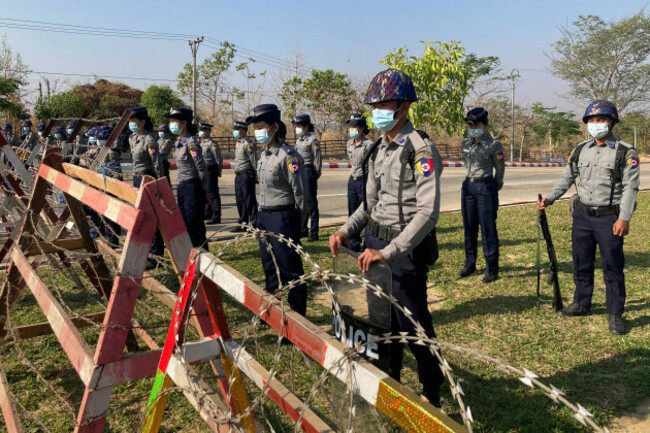
The military then declared, via its own television channel, a one-year state of emergency and announced that former general Myint Swe would be acting president for the next year. All Myanmar banks nationwide were closed following the coup.
It justified the coup by alleging “huge irregularities” in the November polls that the election commission had failed to address.
“As the situation must be resolved according to the law, a state of emergency is declared,” the announcement said.
The military moved quickly to stifle dissent, severely restricting the internet and mobile phone communications across the country.
In Yangon, the former capital that remains Myanmar’s commercial hub, troops seized the city hall just ahead of the announcement, according to an AFP journalist.
Elsewhere, the chief minister of Karen state and several other regional ministers were also held, party sources told AFP.
Swift condemnation
In a statement this afternoon, Minister for Foreign Affairs Simon Coveney said he “strongly” condemns the coup.
“The elections of November 2020 were an important step in the democratic transition of Myanmar and clear expression of the desire of the Myanmar people for a democratic future,” Coveney said.
“The actions last night move in the opposite direction and do nothing to tackle the public health, security or economic issues facing the people of Myanmar,” he said.
Coveney called for “the wishes of the people of Myanmar to be respected by accepting the results of the November 2020 general election”.
“I further condemn the detention of political leaders, including State Counsellor Aung San Suu Kyi and President Win Myint, and call for their immediate release.
“It is important that the response within Myanmar to yesterday’s actions remain peaceful,” Coveney said.
The Minister confirmed the Embassy of Ireland in Bangkok has reached out to registered Irish citizens in Myanmar.
“I would advise Irish citizens in Myanmar to stay safe and avoid crowds or demonstrations,” he said.
Irish citizens in Myanmar with concerns can contact the Embassy on +66 2 016 1360.
Elsewhere, the United States, the United Nations and Australia quickly condemned the coup, calling for a restoration of democracy.
“The United States opposes any attempt to alter the outcome of recent elections or impede Myanmar’s democratic transition, and will take action against those responsible if these steps are not reversed,” White House spokeswoman Jen Psaki said in a statement.
I condemn the coup and unlawful imprisonment of civilians, including Aung San Suu Kyi, in Myanmar. The vote of the people must be respected and civilian leaders released.
— Boris Johnson (@BorisJohnson) February 1, 2021
Australia said the military was “once again seeking to seize control” of the country.
“We call on the military to respect the rule of law, to resolve disputes through lawful mechanisms and to release immediately all civilian leaders and others who have been detained unlawfully,” Australian Foreign Minister Marise Payne said.
I strongly condemn the coup in #Myanmar and call on the military to release all who have been unlawfully detained in raids across the country.
— Charles Michel (@eucopresident) February 1, 2021
The outcome of the elections has to be respected and democratic process needs to be restored.
The election
Myanmar’s polls in November were only the second democratic elections the country had seen since it emerged from the 49-year grip of military rule in 2011.
The NLD swept the polls and was expecting to renew the 75-year-old Suu Kyi’s lease on power with a new five-year term.
Suu Kyi is an immensely popular figure in Myanmar for her opposition to the military, having spent the best part of two decades under house arrest during the previous dictatorship.
But the military has for weeks complained the polls were riddled with irregularities, and claimed to have uncovered over 10 million instances of voter fraud.
It had demanded the government-run election commission release voter lists for cross-checking – which the commission did not do.
Last week, military chief General Min Aung Hlaing – arguably the country’s most powerful individual – said Myanmar’s 2008 constitution could be “revoked” under certain circumstances.
Myanmar has seen two previous coups since independence from Britain in 1948, one in 1962 and one in 1988.
Suu Kyi’s previous opposition to the military earned her the Nobel peace prize.
But her international image was shredded during her time in power as she defended the military-backed crackdown in 2017 against the country’s Muslim Rohingya community.
About 750,000 Rohingya were forced to flee into neighbouring Bangladesh during the campaign, which UN investigators said amounted to genocide.
Suu Kyi went to the United Nations to defend Myanmar against the allegations.
Suu Kyi was only ever de facto leader of Myanmar as the military had inserted a clause in the constitution that barred her from being president.
The 2008 constitution also ensured the military would remain a significant force in government by retaining control of the interior, border and defence ministries.
But to circumvent the clause preventing her from being president, Suu Kyi assumed leadership of the country via a new role of “state counsellor”.
“From (the military’s) perspective, it has lost significant control over the political process,” political analyst Soe Myint Aung told AFP.
© – AFP 2021 with reporting by Hayley Halpin

To embed this post, copy the code below on your site














have your say