TheJournal.ie uses cookies. By continuing to browse this site you are agreeing to our use of cookies. Click here to find out more »
Dublin: 2 °C Saturday 25 May, 2013

Budget 2013: The speculation so far

Lots of speculation but no firm indication of what lies ahead this December. We round up what measures have been in the news and speculated on so far.

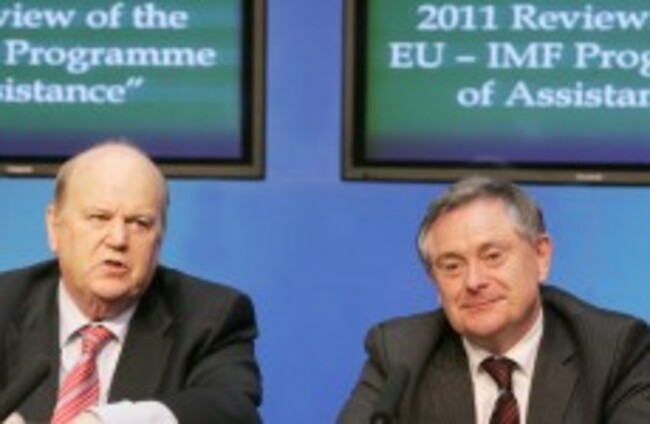
Finance Minister Michael Noonan and Public Expenditure and Reform Minister Brendan Howlin
Image: Sam Boal/Photocall Ireland

THE BUDGET IS five months away but already speculation has begun as to just what kind of budget measures we are facing in December.

The government has maintained the official line that budget matters will not be discussed in public and that nothing has been decided yet anyway.

But that hasn’t stopped various ministers ‘kite flying’ and suggesting the kind of measures that will be announced in the last week or so.

In some cases Ministers will make public statements or brief journalists about possible measures in order to gauge public reaction to these measures.

This is a well-worn tactic which the government freely admits backfired last year when measures were speculated on that weren’t actually announced in the budget.

What we do know is that the budget for this year requires an adjustment of €3.5 billion which will involve €2.25 billion of spending cuts and €1.25 billion of tax increases as outlined in the latest EU-IMF memorandum of understanding.

That memorandum also sets out measures that we are likely to see announced in December among them the replacement of the household charge with a graduated property tax - the details of which are not yet known – as well as reforms to motor tax and a “broadening of the personal income tax base”.

Beyond that we had various government ministers talking about budget measures last week with Communications Minister Pat Rabbitte suggesting to RTÉ that he wanted no “red lines” in discussions.

His view was backed up by that of Public Expenditure and Reform Minister Brendan Howlin who told the Sunday Business Post that he did not want to be “prescriptive” when it came to discussions with the cabinet.

That set off a firestorm of speculation about the changes afoot in income tax rates and social welfare rates given the government had committed to protecting both when it formed a coalition last year.

On income tax, the stated position in the programme for government is that the coalition will “maintain the current rates of income tax together with bands and credits. We will not increase the top marginal rates of taxes on income”.

On social welfare, the programme says simply: “We will maintain social welfare rates”

As if to underline this and go against the hopes of no “red lines” from the two Labour ministers, party colleague and Minister for Social Protection, Joan Burton indicated at the weekend that she will resist any attempts to cut social welfare benefits.

But when it comes to taxation, the minister appeared to indicate a hope to target the more wealthy citizens of the country as she noted the “wide variety of tax reliefs which continue to exist to enable the wealthy to sustain an effective level of taxation far lower than the headline top rates.”

Could this conceivably lead to the introduction of a third band of income tax? It is something which would please the Labour grassroots and of course those on the far left but it would be something hard to see coming from a Fine Gael finance minister in Michael Noonan.

All that said, in answers to parliamentary questions Noonan has not been equivocal on the issue, answering a question about a possible 80 per cent tax on earnings above €80,000 per year with a stock answer that it was not practice to comment on “tax matters that might be the subject of Budget decisions”.

On PRSI contributions, Burton was doing her own kite flying at the weekend, in the same speech referenced above she suggested that contributions from employers and workers could be increased.

The programme for government’s view on this is that there will “be no increase in the standard 10.75 per cent rate of employers PRSI”.

Finally – for now – the various social supports for the elderly such as electricity and gas allowances, free TV licence, free travel on public transport and telephone allowances could be targeted in Budget 2013.

The Irish Examiner reported last week that a European Commission document stated that the increasing number of over-65s in Irleand was putting pressure on these sorts of allowances which account for 0.3 per cent of GDP annually.

While it is unlikely that all of these would be targeted in one budget it gives an indication of the type of measures that government will be looking at implementing given how much needs to be cut and how much already has been in the last few budgets.

Read: Fine Gael HQ assures TDs: No decisions made about Budget 2013 yet

Poser: Does the government comment on its Budget plans?

Poll: Should income tax be protected in the Budget?

Read: 11 things to know about the IMF’s latest Irish review

Read next:

Comments (53 Comments)

  • mel 02/07/12 #

    Here’s a few suggestions benchmark our politicians pay to an equivalent sized EU country such as Denmark. Only Pay Pensions to politicians when they reach retirement age
    But it won’t happen!!

    Reply
    • 80% tax rate above €80,000? This “Tax the rich” idea that’s constantly thrown around as the solution to this countries woes is simply not a solution. In theory it makes sense of course, however when all the most highly qualified professionals in this country leave, it will be clear that in practice such taxation makes no sense at all.

      Such a new tax rate may not effect you directly, but let’s say you, your partner or child becomes ill. Specialist medical care is needed. But the most experienced hospital consultants have gone to Canada, UK, US, Australia, etc, where the pay, research oppertunities, and conditions are far superior to Ireland.

      What now?

      Reply
    • Sorry mel, that was supposed to be a standalone comment!

      Reply
    • @Mel,

      Danish salaries are by and large comparable to here (albeit with a higher cost of living).

      http://www.thedanishparliament.dk/Publications/~/media/Pdf_materiale/Pdf_publikationer/Informationsark/Engelsk/Remuneration.pdf.ashx

      It would appear that Danish members, ordinarily resident in Denmark itself (not Greenland or Faroes) are paid a basic salary of 650,000 DKK or 87,000 euros, only about 5k less basic (before expenses) than TDs.

      I’d say if the TDs were offered this, locked in until 2016 they’d bite your hand off ;)

      Reply
    • Ronan, great link:

      I really dont see any member of FFg/FF/Labour going for this.
      The link you gave says that you dont get a pension, if you have any other source of income. This makes perfect sense, but the likes of Enda and all the other teachers in teh Dail would go nuts if they tried to introduce that here.

      Also, the link states that TDs/Minsters etc only get a pension at age 65, and its set at 48k per year, and up to 60k per year, if you have 20 years parliament service.

      This type of approach would devastate the likes of Mary Harney, Bertie Aherane, Biffo etc etc … as well eas Eamon Gilmore, Enda Kenny etc.

      Never in a month of Sundays, would these thieves go for something as fair, open and transparent as this in Ireland.

      Reply
    • David Killeen:

      Raising taxes on the wealthy creates the political will for reforming the workforce for highly qualified professionals to come here. Without that political will, labor market reform doesn’t happen. If we taxed all earnings over €80k, it would close this year’s deficit. The Fine Gael and Fianna Fail Tax Cuts for the Rich created the recession. By increasing taxes on the rich, we can restore proper funding to teachers and for infrastructure to meet the economic demand and create more jobs.

      Reply
  • I am of the opinion that articles such as these are unhelpful to the people of this country.

    There are a number of reasons for this.

    1. It introduces uncertainity.
    2. It introduces fear to those in the coping class and below.
    3. Has a negative impact on local economy as people stop spending and save more based on points 1 & 2 above.

    The book of estimates is publised in October every year (i think it is October), it should be then and only then do these articles appear. Not 5 months before hand when the Dail is about to go on summer break and news feed dries up.

    Far too much speculation, wait till October till the facts are released, then debates the issues and put forward recommendations.

    Reply
    • In fairness the article only mentions comments brought into the public arena by our esteemed leaders and can be reported on. If the politicians don’t want people or news agencies to comment on what they say maybe they should keep quite?

      Reply
    • Hi Clive,

      You make a fair point but it should be noted that the article is not attempting to speculate itself on the budget merely pointing out and pulling together everything that has already been said publicly and speculated about by Ministers.

      Thanks,

      Hugh

      Reply
    • I agree with you 100% Clive. TheJournal.ie write articles like that a lot of the time. In my opinion, it is to coax people into getting angry/worried/upset (choose your emotion) which will spark lively debate. That, and what you said in your points. It could possibly be a tool, to prove to potential advertisers how worthwhile it is to use their website as an advertising platform.

      Reply
    • @ Hugh –

      I understand that your article is a collection of speculations made by govenment members to date and not by you personally.

      I have nothing against the article, it is the timing of said article that my concerns are with.

      The context of the article has no relevance to the here and now.

      What the politicans are doing is very irresponsible.

      As you are providing these irresponsible politicans with a medium or vehicle for expressing their speculative budget measures they will continue to “kite fly” them, for what ever personal and political motivations they may have.

      I find Journal.ie’s blog type reporting excellent to read, and many articles are very well put together, but in my opinion you should withdraw this article.

      Reply
    • Hi Clive,

      First of all the article does have relevance to the context of here and now precisely because members of the government have been speculating about the budget in their public comments over the last week.

      Second, I cannot be responsible for government ministers who you consider to be “irresponsible” I can only report what they say and the reality is that when a government minister says something significant in relation to public policy then the media do and should be reporting it.

      The idea that we refrain from reporting any of these “irresponsible” comments and only report the responsible ones goes against the idea of a free, fair and balanced media. If a politician engages in irresponsible, ethically wrong or criminal behaviour do we refrain from reporting that too?

      The article stays up.

      Hugh

      Reply
    • I’m not spending a dime until that garbage in the Dail is voted out.

      Kenny for Ex-Taoiseach 2012

      Reply
    • In all my time on Journal.ie, I have never seen so many people animated about a story running. Are these commenters, mouth pieces for the Government? Why are they so worried. Hugh, you did a great job rolling up all the comments, and do not listen to those who do not agree with you freely writing articles like this. As you said, you did not give opinions, you only rolled up and republished what was already available to the public. The Government and their supporters would love to see the likes of Journal.ie shut down, as they currently have no control of its Journalists. Long may you guys remain impartial and honest when reporting any stories. Look what the current and previous administrations turned the Indo into… A biased farce of a tabloid, spewing out anything the Government tell them to do.

      Reply
    • Clive, who are the coping class you refer to, I’m not being a smart ass I’ve just not heard that term so interested it who exactly falls into it.

      Reply
    • I agree with your points wholeheardedly Clive and your criticisms of the author and imo editor (media of course chooses what to focus on and what not to focus on). Just one thing though ‘the coping class’?!?!?! This is a meme initiated by right wing media to water down the consistent and abject poverty some people are living in now. Depression, suicide and homelessness have skyrocketed in the last three years due largely to government and troika policy since the bailout, and children with disabilities and their carers are all but abandoned with very few to stand up for them. These people are not ‘coping’, they are fighting for their lives.

      Reply
    • ….and you have forgotten to mention that the first of ”the letters” were delivered today ….. But I agree thay it is verty disheartening and upsetting to see this kind of speculation/ propaganda instigated by the media ….

      Reply
    • Hugh, Collated speculation is still speculation.

      Reply
  • we’ll probably hear about it through another leak from the euro zones…

    Reply
  • Who cares-can’t take blood out of a stone!..next subject…

    Reply
    • That’s why they need to tax the rich.

      Per the 2012 Index of Economic Freedom,
      Ireland, population 4.5 million, Income per capita $38,550/year
      Italy, population 60.3 million, Income per capita $29.392/year

      Reply
    • What has the population of a country go to do with its per capita income, why do you think taxation would reduce that income – its gross income for Christ’s sake – and why are you favouring Ireland getting poorer on average. These are median incomes.

      Reply
  • All this does is spooks folks and that growth they are looking for wont return. How about tax breaks and incentives. Everyone has their own personal debt to look after so we need less taxes not more. We are paying a heavy price to live on this wet island already.

    Reply
    • Fine Gael recently gave tax breaks to wealthy businessmen to bypass the immigration paperwork. Fine Gael also gave immigration status to anyone who has €500,000 or more to come live in Ireland.

      Reply
  • I wonder do people in power read all these comments, I hope they do but doubt it. In case I am wrong, I suggest that TDs and top paid public workers take a lead and take a 40% cut in the cost to the state before asking anyone to suffer a further loss of disposable income. If an article such as this awakens the government to see how little credibility they have as fair leaders, let’s have one every day.

    Reply
  • I really hope in these 5 months that the government see sense and dont increase taxation, we need the country spending and taxation is not the way to do it. I could easily garner 3bn out of the budget by cutting social welfare and civil servants pay alone, those are the areas to target, not taxing the already stretched employed population.

    Reply
    • Church,

      Incomes in Ireland are among the least taxed in the entire world. For example, a basic salary in Ireland is considered €40,000. The Euro-zone average is €25,000. Any income above €70,000 needs to be taxed much higher because it creates more jobs by enabling the government to invest in infrastructure and public transport. The rich don’t like it because they are running out of places to hide. Ireland needs to become more competitive and taxing higher earners will help. I’m not sure if your comment is meant to be sarcastic, but the government would sooner cut a high earner on €70,000 than they would to a jobless person on €10,000 a year.

      Reply
    • Tim Jackson I wonder how many people you would drive into mortgage arrears if you hit every one earning between say €70k €100k with a 80% tax rate?

      Reply
    • €70,000 is not rich, during the boom you could have got subsided housing on it were you a couple. The rich earn millions not thousands, and you can be sure that they won’t declare, or get some avoidance scheme, or leave the country, or change their domicile legally while living here half the year

      . Professionals will leave for good, or not come, if Google cant really pay managers enough to come over here they won’t. If Google cant get top level managers or technical people they will leave. And comfortable plumbers and the self employed in general just won’t declare. We had this kind of nonsense in the eighties.

      The only people being caught will be the PAYE sector anyway, as always. Taxation of 80 percent would mean getting 2K a year for every 10K added to a salary, a jump you might expect when moving up to a more important position. This is worthless, it’s about forty pound a week. Nobody would care about any raises past €70K, so nobody would take any job with more hours, or responsibility. People already on higher wages would see a drastic drop in take home income. A reasonable 50% would be accepted and wouldn’t cause an outflow, a reasonable 55% above 150k could then be added, to placate the mob.

      But you can absolutely be guaranteed that the managers of multinationals in Ireland will flee, and take their technical workers and operations with them, if this is brought in. Good bye Ireland’s – admittedly imported – industrial base.

      Reply
    • Tim, I’m afraid not. I have a target that I wish to save every month. If the government taxes me by an extra 100 per month in budget 2013, I will be taking that 100 straight out the economy.

      For example:
      - I spend 15.50 a week on coffees (2 per day), roughly 62 euro per month when you discount 4 weeks holidays per year. I will most likely switch to one per day and drink water, so that’s 30/month saved. (I already bring sandwiches to work – lunch being discretionary expenditure I cut out during previous cuts).
      - My last work night out I took two taxis for 45 euros. Cut my pay in the budget and I will ensure I go out earlier, make the walk to the Dart, and probably take the last train home instead of staying out a while. That next night out will take out 2 taxis and a few pints out of the economy.

      I have already pared back stuff to protect what I save each month. What do you think happens when you raise taxes? That money comes straight out of discretionary expenditure – and discretionary expenditure is what drives consumer spending in this economy. Everyone in my company cutting back on coffees and sandwiches at work will probably cost a job.

      I’m not advocating cuts over taxes here, or anything like that. I just want you to realise that whether it’s cuts or taxes, that money will be pulled out of the economy. There isn’t a great money tree of undertaxed individuals, waiting to produce 10billion per annum out of their back pockets and save the economy.

      Reply
    • “€70,000 is not rich”

      Mr. Norris, I’m sorry to burst your bubble but it happens to be a massive salary compared to other countries in the Euro area. In those countries, anyone earning €70,000 is taxed very heavily. We are a very low taxed workforce in Ireland. Income taxes were already indirectly raised and did that damage? No. We are now growing.

      Reply
    • Tim, Its not my bubble, I don’t earn near that and I live in the UK anyway, can you point to an 80% tax rate past 70k anywhere in Europe, if so do?

      Actually here they are:

      http://en.wikipedia.org/wiki/Tax_rates_of_Europe.

      Ireland has one of the highest marginal rates, at 55%, only Sweden and Demark are higher, and just barely. This rate that includes the USC. I forgot the USC in my previous comments. That, and PRSI, would be a marginal of 94%.

      Also feel free to answer why you think will happen with the managers in multinationals who will be unable to pay their mortgages will stay around? Or even top level technical workers. Remember, if somebody is earning that on his own, or her own, and keeping a family its the same as a household with two workers on 35k. Pretty normal. And what most European countries do to tax the rich is tax high end property with property taxes, inheritance taxes and wealth taxes on stagnant wealth – i,e large deposits in banks. I see no proposal on that from you, you are intent on screwing the PAYE sector worker.

      You are confusing the fact that European countries take more money from their citizens in non-PAYE tax, the very taxes that the Shinners tend to oppose as double taxation. Only in Ireland are left-wingers obsessed with PAYE, a tax on labour, rather than wealth.

      Is this Shinner policy? Or just some supporter on the internet talking rubbish?

      Reply
    • Germany’s highest rate of tax is 45% which is applied on taxable income of €250,730 ($501,460 for married couples). Someone earning €70,000 in Germany will be taxed at 42%. They have some other taxes yes as do Ireland. So not such a difference.

      Reply
    • Eoin Norris:

      The price paid for your reckless and heedless ideological faith in greed… Austerity does work IF a country has a competitive private sector. In Ireland there is only hope if the economy are turned upside down and remade into a competitor. Unlike other troubled euro-zone economies, however, Ireland still has an uncompetitive wage scale and a vastly undertaxed income system.

      Per the 2012 Index of Economic Freedom,
      Ireland, population 4.5 million, Income per capita $38,550/year
      Italy, population 60.3 million, Income per capita $29.392/year

      Reply
    • Stephen Church:

      Do the math before commenting. Your analysis is faulty.

      Reply
    • Again Mr. Norris,

      If class warfare is the only thing you have to run on, you must obscure broad revelation of the many examples of corruption and failed, misguided policies. If there was a minimum tax on on wealthy earners over €70,000, this would be progressive taxation. At present, that isn’t happening.

      The tax rate on the wealthy has been declining since the 80s with more and more of the tax burden falling on the middle class (who can’t afford lobbyists). Seems to me there’s been a long standing assault on the middle-class by the wealthy. Now, when some start saying “maybe a tax rate is to low for someone with millions in income”, ya’ll flood the press with this class warfare cra.. er, stuff.

      Norris, sorry to pop your greedy fantasy bubble, but the average effective tax rate paid by the top 50% of adjusted gross incomes in 2009 was only 20%.

      Reply
    • Again Mr Jackson.

      1) €70k is not a rich salary. In terms of households it would be common i.e. two on 35K
      2) You didn’t answer my question on what you expected to happen when Irelands multinational bosses see an massive drop in wages, and their technical workers too, and/oe anybody who aspires to good pay in these organisations.
      3) You didn’t answer on the questions I had regarding other forms of tax rather those on PAYE incomes.
      4) I listed all the countries in Europe with an income tax lower than Ireland, Ireland is in the top three.

      Here it is again, I like brining facts to the party.

      http://en.wikipedia.org/wiki/Tax_rates_of_Europe
      Click on this link and try and work out what is going on. Ireland is 3rd highest in Europe for taxation on the PAYE sector. It has a low total take in spite of, not because of, its high tax on the PAYE sector.

      Only in Ireland is a tax on the PAYE considered the mainstay of “progressive” taxation. I did suggest we look at capital, and property taxes, we could also look at capital gains, or dividend taxes, or inheritance taxes – all much less than PAYE taxes, but Mr Jackson seems to want to put it on all the PAYE sector rather than everybody else. I wouldn’t suggest corporate taxes, although they are too low, as that might harm the industry here.

      So the argument from Irish “socialists” seems to be screw the worker, not capital. Nice to know.

      Mr DALT – you seem to want gross income to decline, not to increase taxes as you point to Italy having a lower wage structure. All this will do is increase profits, and reduce income. Not only has this point nothing to do with taxation, it increases the power of Capital, not the opposite. Of course Ireland does need to be competitive too.

      Reply
    • @ Mark Dalt

      explain how, our social welfare spending was over 20 billion at last count, finding 3bn there without having too large an impact is quite achievable.

      All of the people replying here begging for a ‘wealth tax’ or ‘taxing the rich’ I really dont think you understand that they allready pay far more tax by amount than most of us ever will, and theyre the people who have the power to create jobs , or the power to leave Ireland – we need to make the rich spend again to create growth, not punish them for doing a good job and making money.

      Reply
    • Slow down Eoin – you are jumping from one point to another without any credible substance apart from Wiki.

      I am talking about €70,000 per person – NOT between two people.

      Anyone earning €35,000 each is a middle income earner who already pays the lions share. I wasn’t talking about these group which you strangely brought into this thesis.

      But I understand Mr. Rich’s need to continue with the false equivalence that is found everywhere in the media and your post seems to be the latest example of this. Are the rich any better? Yes, undeniably so compared to the rest of Ireland but whereas one has always been rich, the other one has only recently become poorer. And let’s also not pretend that there is a vast difference between the wealth of €70,000 and €35,000.

      Reply
  • Budget will split government parties. Watch out for whip resignations and expulsions. Some TD’s will do what is right for them not what is right for country. Just look at SF/ULA/ so called Socialists who oppose everything because it keeps them in the public eye.

    Reply
  • Hopefully people stop voting for FG, FF and LAB. Ireland needs a new government led by a combination of independents, sinn fein and the socialists.

    Reply
    • That will be the Stalinist bliss we have been seeking.

      Reply
    • Is there a special keyboard combination that produces “FG, FF and LAB”. It seems to be commented at least once on every article?

      Reply
    • D.A. Molony,

      Not really. They would invest in much needed public transport like modern buses, trams and proper trains. Under FG and LAB, the country is cutting basic services to pay bondholders. Kenny’s party has always been pro-EU. Taxing the rich over €70,000 would help close the deficit.

      Reply
    • Pierce, you said on a response to a question on Friday last week, you are a member of the Green party. Why are you so defensive of FFg/Labour/FF? You do make a lot of comments in support of them, and i have never seen any comments from you about Green issues. Not that i doubt you, but it does seem curious????

      Reply
    • Correct again, I am a card carrying member of the Green party. So thank you again for telling me what I should support or defend. I shall in future keep my comments to best way to make elderflower wine and wind farms. I think I will give “FG, FF and LAB” my second, third and fourth votes next time around, you have convinced me of that at least.

      Reply
    • Tim Jackson
      People wont stop being stupid BUT I reckon that enough of us have seen the light and will vote in a way that will keep the FFGLab shower out of power .

      Reply
    • Tim I think you need to seek some help…urgently!

      Reply
  • Dung article

    Reply
  • The rich must pay their fair share. Of course they will target high earners in the budget. Some of the posters on here are constantly trying to use parlor tricks and misconceptions on the impact of raising taxes to mislead to voting public. I get very disappointed that it works so well. I posted some of my own thoughts on what his budget and tax plans will actually do employing some historical reference. €70 K is rich since it is more money than what a person needs.

    Reply
    • They live in a fantasy world where they believe they’re entitled to a salary over €70,000 without paying any income taxes.

      Since the 2010 budget the top 1% paid just €400,000 in taxes to the state.

      Nothing generates as many comments as an article on taxes. Here are mine: We don’t have a revenue problem; we have a wealth problem.

      Reply
    • Mark, you have no idea who the rich are, and what they earn and how they earn it. By and large, they don’t earn PAYE.

      Reply
  • 6 super-rich people who say ‘tax me more’:

    http://thedailyedge.thejournal.ie/6-super-rich-people-who-say-tax-me-more-436415-May2012/

    Raising taxes on rich would help reduce deficit. Any sane government will enact new taxes on the wealthy, restructure the tax code and approve short-term spending measures as part of a budget plan aimed at boosting job growth and helping the middle class. It’s interesting to see some of the comments by greedy monopolists on here.

    Reply

Add New Comment