TheJournal.ie uses cookies. By continuing to browse this site you are agreeing to our use of cookies. Click here to find out more »
Dublin: 6 °C Thursday 23 May, 2013

Deal reached to avoid tax hikes for middle-class America

Is that the end of the ‘fiscal cliff’ talk then? Maybe. But the debt ceiling chat is back.

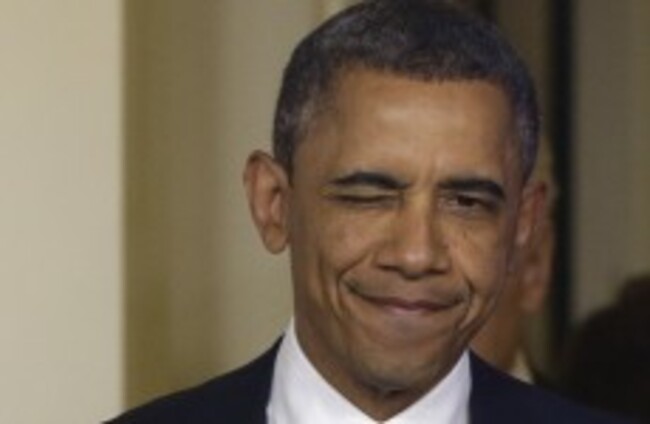
President Barack Obama winks as he arrives to make a statement regarding the passage of the fiscal cliff bill.
Image: Charles Dharapak/AP/Press Association Images

LEADERS FROM BOTH the Republican and Democratic parties in the US Senate and House of Representatives came together yesterday to pass the fiscal cliff bill to avoid a significant tax hike for middle America.

With a vote of 257 to 167, the Republican-controlled House of Representatives approved the deal.

Speaking in the White House, President Barack Obama said the “overwhelming bipartisan support” for the agreement will protect 98 per cent of Americans and 97 per cent of small business owners.

“This agreement will also growth the economy and shrink our deficits in a balanced way – by investing in our middle class, and by asking the wealthy to pay a little more.”

Although he noted that millionaires and billionaires have been asked to “pay their fair share for the first time in twenty years”, he admitted that neither Democrats nor Republicans “got everything they wanted”.

However, he said the changes for the super-rich would be immediate and permanent. They include tax rate increases and reduced tax benefits.

“I will sign a law that raises taxes on the wealthiest 2 per cent of Americans while preventing a middle-class tax hike that could have sent the economy back into recession and obviously had a severe impact on families all across America,” he said.

Other measures included in the tax agreement include the permanent extension of middle-class tax cuts (for households earning up to $450k), as well as the retention of emergency unemployment insurance benefits for two million people.

The deal extends Obama’s expansions of the child tax credit, earned income tax credit, and implements the new American Opportunity Tax Credit, which helps families pay for college.

Renewable energy incentives were also extended for businesses through the end of next year.

The deal will see $620 billion extra revenue raised by restoring the top 39.6 per cent rate for high-income households and re-instating the Clinton-era levels of capital gains rates.

The agreement raises the tax rate on the wealthiest estates – worth upwards of $5 million per person – from 35 per cent to 40 per cent, in contrast to Republican proposals to continue the current estate tax levels.

Despite reaching a deal, Obama wasn’t all-positive on the developments. Describing negotiations as “a lame duck session of Congress”, he said the failure to provide a larger agreement came at a cost “as the messy nature of the process over the past several weeks has made business more uncertain and consumers less confident”.

The President also raised the issue of the debt ceiling, an issue that caused major headaches for the administration in 2011.

“While I will negotiate over many things,” said Obama, “I will not have another debate with this Congress over whether or not they should pay the bills that they’ve already racked up through the laws that they passed. Let me repeat: We can’t not pay bills that we’ve already incurred. If Congress refuses to give the United States government the ability to pay these bills on time, the consequences for the entire global economy would be catastrophic — far worse than the impact of a fiscal cliff.”

People will remember, back in 2011, the last time this course of action was threatened, our entire recovery was put at risk. Consumer confidence plunged. Business investment plunged. Growth dropped. We can’t go down that path again.

Last night’s vote brings an end to the 112th Congress. The 113th Congress begins on Thursday.

US Senate strikes deal on ‘Fiscal Cliff’, two hours after deadline

Explainer: What is the ‘fiscal cliff’ and why does it matter?

Read next:

Comments (20 Comments)

  • I love how you can be earning up to $450k in the US and still be considered middle-class.

    Reply
  • I know Davy its a complete joke. It could be in the next budget if you earn €65,000 here you will be hit for high earnings.

    Reply
  • There problems make Irelands problems look like a piece of cake. America can only kick the can up the road so far and eventually Americans are going to be hit alot harder.

    Reply
    • At least they are trying to put their citizens first and not just themselves.
      Watch the majority of Irish government ministers retiring on enormous pensions at the next election after destroying this country, traitors!

      Reply
    • @Ciaran . I am not sure if they are trying. It looks like a half ass attempt due to Republicans blocking . There problems are so massive the measures outlined above is so small it wont have practically any dent on the national debt.

      Reply
    • SnappyJ 02/01/13 #

      @ Ciaran – put their citizens first?! Ha! Do some research and look at the tax breaks Goldman Sachs, NASCAR, Disney got from this ‘deal’. Payroll taxes went up 2% – that affects the poorest. American politicians care about the corporations that pay them

      Reply
    • MVM 02/01/13 #

      Yous do know if America falls so will we

      Reply
  • He looks pissed in the photo lol.

    Reply
  • That deal will protect 98% of their population. I wonder what % of people here will be hit hard in budget in April?

    I think it will be the opposite with the working stiff being hit again.

    Reply
  • B Lowe 02/01/13 #

    Interesting that nothing is ever said about the US budget allocation for the military. The US is spending much more now on military than it did at the height of the cold war and Americans are paying for it with reduced services/benefits and higher taxes. The funny thing is the vast majority of Americans would have no qualms with reducing the military budget.

    Reply
    • B Lowe, do you know anything about anything?! The pentagon budget does come up.

      Reply
    • B Lowe 02/01/13 #

      Declan, turn on CNN or Fox News or the likes and just watched and listen anytime debate re economy and taxes comes up. Everything comes up for discussion from Education to Food Stamps to Health but the military budget is not touched. You are seem as unpatriotic if you start talking about it. Both main parties in the US are two sides of the same coin.
      Even after all the recent calamities in US financial sector in recent years the Military budget just keeps on going.

      Reply
    • The reason is the amount of ‘pork barrel’ subsidisation of military/industrial jobs keeping Congressmen and Senators elected.
      This will effect the military budget slightly(they got $631bn allocated Christmas week, how merry for them).
      Romney wanted to jack them another $2 trillion, so small mercy country. Lotsa lard for spreading.

      As Eisenhower warned it would, the military/industrial complex that mushroomed(unintentional but apt) during WW II has hollowed out the civil economy and made the US as dependent on war economics as 40s Germany was.
      Prognosis unhealthy.

      Reply
  • I’m happy there has been a solution found, though seeing as how President Obama appears happy with it too, I have to assume the Republican Media Machine will now begin furiously spinning how their side somehow got one over on him…

    Reply
  • Shows the republicans in the USA are the same mindset as Irish Tory Party aka FG and British conservatives in that the poor pay for the mistakes of the rich and the rich just keep on earning more money.if austerity like espoused in Ireland,Spain,Portugal or Greece was enacted in the USA.we may see a 2nd civil war in the USA with the preference to bear arms at any chance a high probability.

    Reply
    • There just aren’t the insane levels of public expenditure to cut in the US as there are in Europe. They are, and always have been a low tax, low public expenditure country. As a result, they’ll never end up in the kind of big-government mess that we are in.

      Reply

Add New Comment