Sign in. It’s quick, free and it’s up to you.
An account is an optional way to support the work we do. Find out more.
Sign in. It’s quick, free and it’s up to you.
An account is an optional way to support the work we do. Find out more.
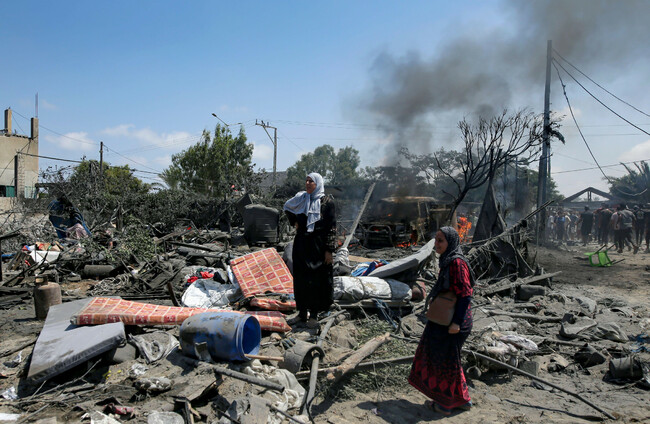
A SENIOR HAMAS official has said that the militant group is withdrawing from talks on a ceasefire in the Gaza conflict because of Israel’s “ongoing massacres against unarmed civilians” and its attitude in negotiations.
Another Hamas official said the group’s military leader Mohammed Deif was “fine” and working despite Israel’s huge bomb attack on a southern Gaza camp that it said targeted the wanted Hamas commander.
Gaza’s health ministry said the attack left 92 dead.
Hamas political leader Ismail Haniyeh told international mediators Qatar and Egypt of the end of the talks on a ceasefire plan first outlined by US President Joe Biden in May, according to the senior official.
The first phase of the deal would have seen a six-week ceasefire with the exchange of most hostages taken in Hamas’s 7 October attack on Israel for Palestinian prisoners in Israeli jails.
Haniyeh said Hamas would “halt negotiations due to the occupation’s (Israel) lack of seriousness, continued policy of procrastination and obstruction, and the ongoing massacres against unarmed civilians,” according to the official.
“Hamas has shown great flexibility to reach an agreement and end the aggression and is ready to resume negotiations when the occupation government demonstrates seriousness in reaching a ceasefire agreement and a prisoner exchange deal.
Israel and Hamas have engaged in months of indirect talks via Qatari, US and Egyptian mediators to reach a still elusive truce and hostage release deal.
Israeli President Benjamin Netanyahu continues to insist that any deal must allow Israel to meet its war aims – destroying Hamas as well as bringing home all the hostages.
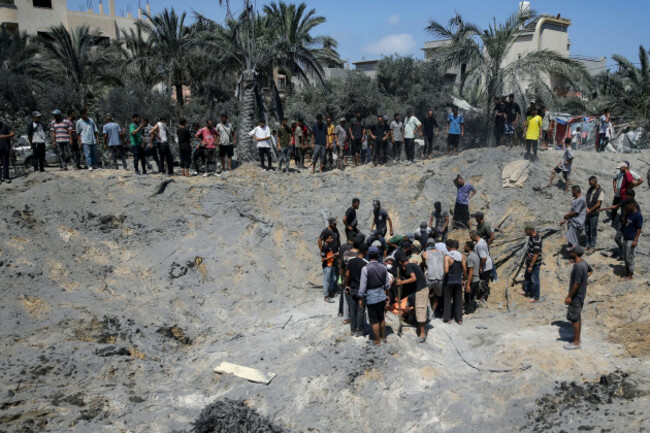
Haniyeh said in a statement late on Saturday that he had called the mediators and other countries to urge them to put pressure on Israel to halt the attacks.
Israel said Deif, who it considers one of the “masterminds” of the 7 October attacks, was the target of the strikes on the Al-Mawasi camp in southern Gaza where tens of thousands of displaced Palestinians from other districts have gathered.
But Hamas, without confirming that Deif was at the camp, said he was alive and working.
“Commander Mohammed Deif is well and directly overseeing Ezzedine al-Qassam Brigades and resistance operations,” the official said, referring to Hamas’s armed wing.
Israel in May had told Palestinians to move to a designated humanitarian area in Al-Mawasi as its troops moved into the nearby city of Rafah.
Since then, Israel has been accused of killing civilians in attacks on or near Al-Mawasi, including one in May which was blamed for starting a fire in a tent city that killed 45 people.
Philippe Lazzarini, head of the UN agency for Palestinian refugees, UNRWA, described the area as “a sandy 14-square-kilometre agricultural land, where people are left out in the open with little to no buildings or roads”.
“The claim that people in Gaza can move to ‘safe’ or ‘humanitarian’ zones is false”, said Lazarini on social media site X.
The UN human rights office in a statement said Israel “continues to choose weapons with wide area effect in densely populated areas”, suggesting “a rampant disregard for the safety of civilians”.
An Israeli security source, speaking on condition of anonymity, said the strike showed Israel “will continue to target senior Hamas leadership” even as it “pursues negotiations for a hostage agreement”.
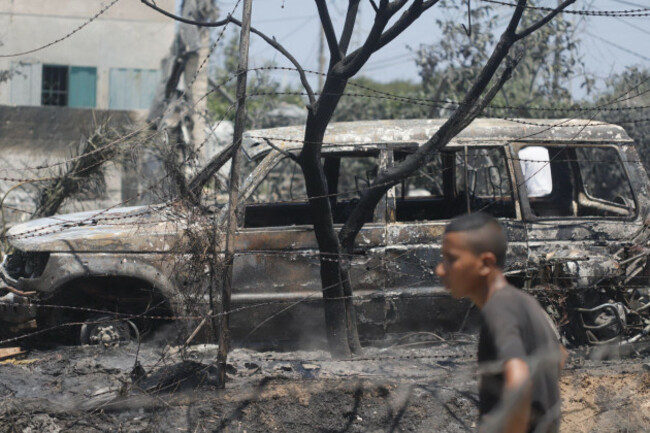
Gaza’s civil defence agency said heavy fire was preventing its teams from reaching the “many bodies” scattered in the streets.
“Every time people tried to get close to rescue others, they would strike,” said Palestinian man Mahmoud Abu Akar.
In Israel, anti-government demonstrators again rallied on Saturday to demand a deal to free hostages still held in Gaza, with a four-day protest march from Tel Aviv reaching Jerusalem.
Hamas’s 7 October attack on southern Israel resulted in the deaths of 1,195 people, mostly civilians, according to an AFP tally based on Israeli figures.
The militants also seized 251 hostages, 116 of whom remain in Gaza, including 42 the military says are dead.
Israel’s retaliatory offensive has killed at least 38,443 people in Gaza, also mostly civilians, according to figures from the health ministry in Gaza.

To embed this post, copy the code below on your site













have your say