Sign in. It’s quick, free and it’s up to you.
An account is an optional way to support the work we do. Find out more.
Sign in. It’s quick, free and it’s up to you.
An account is an optional way to support the work we do. Find out more.
THERE ARE VARIOUS attempts to find solutions to homelessness, with varying levels of success.
Some initiatives look at raising money, others want to provide practical solutions aimed at making life easier for homeless people – and hopefully having a knock-on effect.
But then there are the ‘solutions’ that were criticised for perhaps even contributing to the marginalisation of people without their own home.
Homeless people don’t always have easy access to fresh water and bathing facilities, even toilets. So Lava Mae took an old bus and converted it into a space with two showers and toilets in San Francisco.
This mobile shower unit travels around the city – and it’s hoped that by helping people to stay clean, this could help them in the search for jobs and housing, by boosting their self-esteem.
This project takes place in Seattle, and “brings together Seattle’s housing advocacy community and service providers with the best minds in technology and innovation”.
Our goal is to design and build solutions to all forms of homelessness, from the homelessness we see on the streets to the hidden problem of family homelessness.
The organisers say they believe the technology industry can and should be a force of good. The sort of projects that were worked on included new social networks, data visualisation, and internal IT needs. Practical – but not in the way you might think.
Find out more at Hack to End Homelessness.
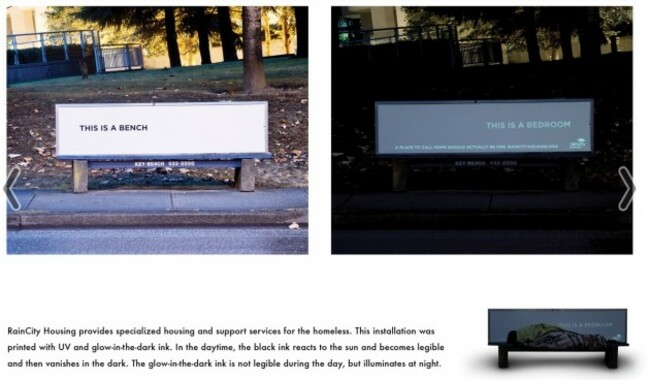
These bus stop benches, which were designed by RainCity Housing and Spring Advertising agency, turn into billboards – and shelters.
The blackboards can be lifted to turn into a shelter with a bench underneath, and some of them lit up at night. They also light up to show the contact details of the centre, directing people towards help.
The company MyPad, run by Timothy Payne of Forest YMCA in London, imports shipping containers to the UK, and turns them into studio apartments.
It’s hoped these can be used as cheaper transitional housing – although they’re not aimed specifically at homeless people.
Artist Gregory Kloehn goes dumpster diving, and uses his finds to make homes for those in need.
Could this reusing of otherwise ‘useless’ items and giving the homes to homeless people be one green solution?
A scheme by Community Solutions sees communities identifying people in need in their local area, and working to help them find a home.
It’s across a number of US states and has helped to house thousands of people over the course of four years. It’s all about thinking outside the box.
And it’s a project that’s really working:
See 100khomes.org for more
These appeared in some locations in London in an attempt to prevent homeless people from sleeping outside a block of flats on Southwark Bridge Road.
They also were photographed outside a Tesco on Regent Street.
The spikes were widely criticised on Twitter, and The Guardian reported that homeless charities said the studs were not a new concept.
London’s Mayor Boris Johnson said:
The spikes also appeared in Toronto outside a bookstore, but were removed after the city’s mayor tweeted about them.
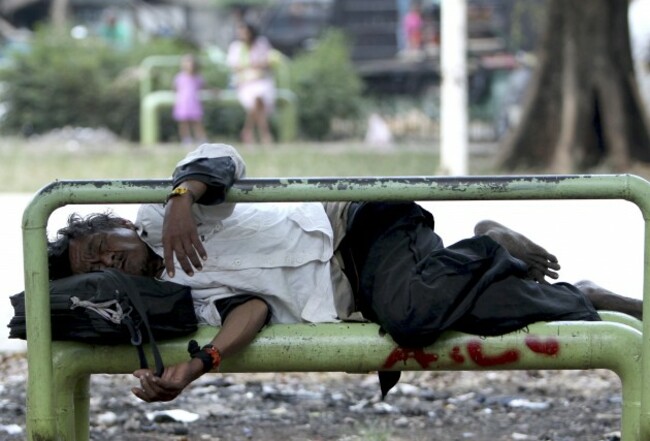
These appeared in Kuala Lumpur, where the City Hall installed green dividers that prevented homeless people from sleeping on benches.
They were also found on the benches at bus shelters in St Louis, where homeless people also said they were no longer able to sleep in spots they used to frequent.
A Metro spokesperson told STL Today that this wasn’t the primary reason for the dividers, but a “factor”. One homeless man told the paper:
“This will stop you from sleeping on the bench,” Camp says of the brown dividers, about four inches high. “I sleep on the ground where it’s colder. At least I have a backpack and mat. Not everyone who’s homeless has that.”
Uncomfortable benches were are also common in Tokyo. One writer commented:
I would like to make it clear that I do not believe homeless people (or anyone else) have the right to occupy park benches day and night. At the same time, though, I do not believe the growing unfriendliness of Tokyo’s park benches can be left to go on unchecked.
Often, these types of bench dividers are brought in to turn people off loitering in an area.
But critics warn that it can be detrimental to those who have no home. Instead, they force people to move on to somewhere else, and that other place might not be very safe.
Pic: Andrew Bennett via Flickr/Creative Commons

To embed this post, copy the code below on your site















have your say