Sign in. It’s quick, free and it’s up to you.
An account is an optional way to support the work we do. Find out more.
Sign in. It’s quick, free and it’s up to you.
An account is an optional way to support the work we do. Find out more.
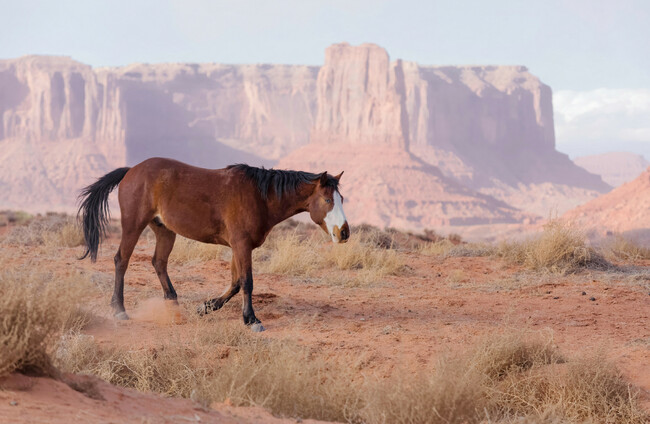

A RECENT REPORT in the New York Times drawing attention to a legal loophole that allowed hundreds, possibly thousands, of wild horses to be rounded up and funnelled into a ‘kill chain’ has triggered a furore in the US amongst animal rights activists and wild herd advocacy group. Which has in turn ignited a firestorm of online outrage.
It’s the modern-day equivalent of an epic letter-writing protest that started seventy-five years ago and almost certainly saved America’s wild herds from extinction.
This US’s Bureau of Land Management (BLM) oversees the maintenance and protection of an estimated 85,000 mustangs that currently roam 27 million acres of federally owned lands, across a ten-state southwestern arc that runs from Montana to Arizona.
The agency’s stated goal is to reduce their number to just 27,000, claiming to the incredulity of wild herd experts and advocacy groups an ideal ratio of one wild horse to a thousand acres of forage space.
In fact, the BLM, which is part of the Department of the Interior headed by Doug Burgum, one of Trump’s most craven Cabinet members, is succumbing to pressure from lobbyists for the beef and fossil fuel industries.

Each is determined to expand their federal grazing and exploration grazing rights and are pushing for the removal of mustang herds, which they regard as a nuisance consumer of valuable water and grazing resources.
The controversy is new but it’s an old story. During a fifty-year extermination campaign that began in the early 1900s wild mustangs were poisoned and shot, run off cliff edges by their thousands or weighted down with tractor tires and chased until they died of exhaustion.
Congress was forced to act in 1971, spurred by the biggest protest letter writing campaign in US history. It was orchestrated by Velma Johnston, a feisty secretary from Reno, who happened upon a blood-soaked truck crammed with dead and dying mustangs on her way to work one day.
By the time Congress finally passed legislation to protect the herds in 1971, two million mustangs had been slaughtered. Fewer than 15,000 survived.
More than half a century later, the New York Times has alerted Americans to the latest threat to the descendants of herds that have roamed the vast Western prairies and deserts for five hundred years.
Trump era policies have ratcheted up the threat to the federally protected herds, but moves to legalise their slaughter preceded his return to office.
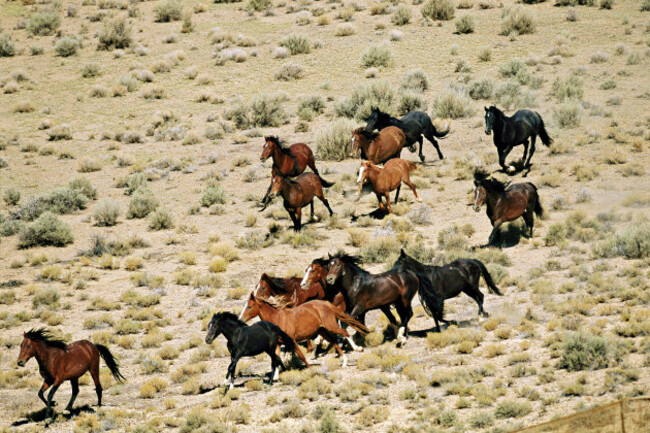
I first wrote about the mounting threats to America’s wild horses in 2022, after a visit to Wyoming, where most conversations seem to take place in bars. Over beers with ranchers, talk invariably turned to the wild herds.
Wildfires and floods in the region have soared over the past decade, destroying grasslands and causing the price of hay and alfalfa to soar.
Unwilling to admit that climate change might be a factor, local ranchers blame the wild herds for their shrinking profit margins. They regard competition for federal grazing rights as a zero-sum game; the more wild herds consume, the less that’s available for their cattle.
Some of them muttered about poisoning wells where the wild herds got their water, a tactic outlawed half a century ago. Others blamed the BLM for failing to round them up and remove them to off-range holding pens, where 60,000 wild horses are already corralled, unable to move beyond cramped metal-fenced pens or forage for food or water.
The Wyoming legislature tried to circumvent federal law and to allow their slaughter in 2022, but it soon became clear that the ranchers held something of a minority view.
There’s no shortage of conservationists in Wyoming; even in this most unsentimental of states, these free-roaming mustangs are regarded as the living embodiment of the ancient Western spirit, magnificent relics of a bygone era.
Ranchers scoff that most of the ‘hug a mustang queers’ (to quote one Dubois cattleman) are wealthy Californian implants who can afford the luxury of sentiment. But most non-ranching locals have a fierce affection for the herds and are well aware that their presence boosts Wyoming’s share of tourism industry dollars.
In the bars of Buffalo and Cody, wildlife photographers regaled us with stories of tracking herds through the freezing Wyoming winters, risking frostbite and hypothermia as they braved blizzards and snow blindness in search of the perfect shot.
Veteran snappers have such intricate knowledge of the wild herds’ roaming patterns they can pinpoint their locations on a day-to-day basis.
Initially, they were unwilling to share this intel, but after several whiskies one of them pushed what looked like a scavenger map across the bar in my direction. It showed where one of the last existing herds of purebred conquistadors were grazing. “Go see ‘em,” he urged. “It might be your last chance.”
There are fewer than 3,000 of these purebreds left anywhere on earth and fewer than 250 in Wyoming. With the BLM planning to round up two thirds of their number, he was probably right.
We set off at dawn the next day on a bone-rattling ride across the snowcapped northeastern section of the Pryor Mountain range that straddles Wyoming and Montana.
We continued on foot for several miles, through plains ablaze with orange and red poppies and yellow wildflowers, so captivated by their brilliance we didn’t see the herd until we were almost upon them.
The conquistadors stood there, in complete stillness as they observed us; almost two hundred of every colour and marking, with about two dozen foals in tow. Then abruptly, they turned and moved as one across the plain.
It was a heart-stopping moment, witnessing these magnificent creatures, untamed and untouched by human hands for centuries.
We watched for hours, mesmerised. They grazed and galloped, the hierarchies and family bands apparent. Mares nurtured their foals while colts swaggered and raced and bickered for the attention of a group of young fillies.
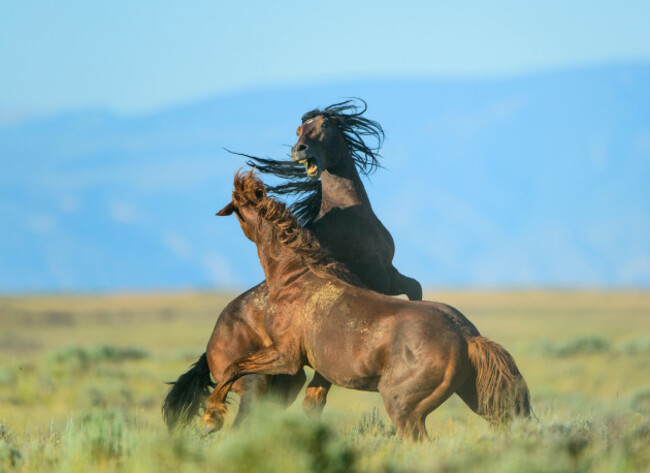
A fight broke out between two stallions vying for the affection of an exquisite Palomino. They reared up on their hind legs, manes flying as they snorted and flailed, kicking, biting and slamming into each other in a spectacle that was both terrifying and awe-inspiring.
The deliberate destruction of these uniquely beautiful creatures, so integral to the American West seems like an affront, a wanton assault on nature.
Advocacy groups like the American Wild Horse Conservation (AWHC) point out that recent moves towards deregulation and slaughter are wholly unnecessary. They concede that herd sizes need to be managed but point out that fertility control is the most humane and cost-effective way of achieving that goal.
AWHC volunteers dispense PZP, an immunocontraceptive vaccine invented by a Montana conservationist in 1980. PZP prevents breeding without disrupting the mare’s reproductive cycles, protecting their status within the herd.
It’s administered by dart gun and costs around $200 (€170) per horse per year, including vaccine and labour costs. It’s a lot cheaper than the $2500 (€2,000) a year the BLM spends on feeding horses it rounds up and removes from public lands – not to mention the millions paid out to the helicopter contractors.
But logic is no match for the BLM’s obduracy. They claim they can’t afford to embark on an extensive fertility control programme because $100 million (€86.3 million) of their current annual budget of $142 million (€122.6 million) goes on feeding the 60,000 mustangs whose births could have been preempted by a fertility control programme.
Most of the remaining budget goes to paying helicopter contractors who carry out the round ups. Last month alone, BLM paid two Utah-based helicopter round up contractors $4 million (€3.4 million) to round up around 1200 horses.
Only Colorado is bucking the trend, placing its wild herds under the direct control of its Department of Agriculture, embarking on a widespread fertility control programme and designating 25,500 acres as a permanent refuge for 500 mustangs.
Trump budget cuts mean next year’s BLM allocation will be slashed by a third.
Something’s got to give and instead of decelerating herd growth, the BLM is planning to crank up the sales of captured horses, reducing adoption opportunities and holding auctions where mustangs can be bought for just $25 (€22) each to unscrupulous dealers who sell them onto middlemen who funnel them to slaughterhouses in Canada and Mexico, where they’re processed into horse meat and pet food.
Despite the humane alternative, the BLM seems to pursue a path that maximises both expense and herd trauma. America’s great regression continues unchecked.
Marion McKeone is an award-winning journalist, writer and documentary maker.
To embed this post, copy the code below on your site














have your say