Sign in. It’s quick, free and it’s up to you.
An account is an optional way to support the work we do. Find out more.
Sign in. It’s quick, free and it’s up to you.
An account is an optional way to support the work we do. Find out more.
Updated 8.15pm
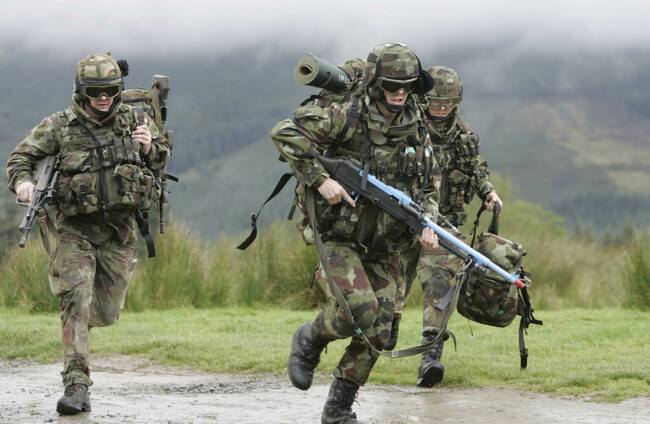
THE IRISH DEFENCE Forces are to participate in the German-led EU Battlegroup in 2020.
Minister of State with Special Responsibility for Defence, Paul Kehoe today brought a memo to Cabinet on the proposed participation due to take place from July to December 2020.
It’s expected that between eight and ten members of the Defence Forces will join this group.
Other members of the battlegroup are Germany, Austria, Czech Republic, Croatia and the Netherlands.
This particular group will be on standby with the EU for any intervention it may want to carry out relating to “peacekeeping, conflict prevention and assistance to humanitarian operations”, said a government spokesperson.
EU battlegroups
EU Battlegroups are multinational, military units which are part of the European Union’s military rapid reaction capacity. The group, made up of about 1,5000 personnel, are dispatched to emerging crises and conflicts around the world. No battlegroup has ever had to deploy.
Ireland has previously participated in the Nordic Battlegroups in 2008, 2011 and 2015 and the UK-led EU Battlegroup in 2016. Ireland participated in a German-led group in 2012 and 2016.
There was some controversy over the last two missions, with the then Defence Minister Simon Coveney defending the move to send troops to participate in 2015, stating that Ireland’s neutrality would not be compromised by joining the Nordic Battle Group.
He told the Dáil at the time that Ireland would not have to come to the aid of countries in the group if they were attacked.
There was also a heated debate about Irish troops being deployed in 2016, with a number of parties opposing the participation in a Dáil vote.
It’s understood that following Cabinet approval today, in the next year a memo of understanding will be drawn up between Ireland and Germany regarding the group.
While it was previously thought that due to memo on a German-led operation having already been approved previously by a Dáil vote, that a repeat vote would not be necessary.
Dáil vote
However, it is now believed that due to the operational details being somewhat different, the memo will go to the Dáil for a full debate and vote on the matter.
The government maintains that participation in EU Battlegroups has enhanced the Defence Forces’ ability to work with other nations, enhances its reputation as a provider of a credible military capability for peacekeeping operations under UN mandates, and provides troops with the opportunity to train with other armies and to learn new skills.
A government spokesperson outlined that should deployment be requested, Ireland’s participation in a specific operation would, as always, be subject to the usual ‘Triple Lock’ requirement.
The ‘Triple Lock’ means Irish troops will only serve on missions if three conditions are met: a government decision, Dáil approval and UN authorisation.
Today’s decision will enable the department and Defence Forces to plan for participation in the battlegroup in 2020. Nearer the date, this will come back to Cabinet.

To embed this post, copy the code below on your site














have your say