Sign in. It’s quick, free and it’s up to you.
An account is an optional way to support the work we do. Find out more.
Sign in. It’s quick, free and it’s up to you.
An account is an optional way to support the work we do. Find out more.
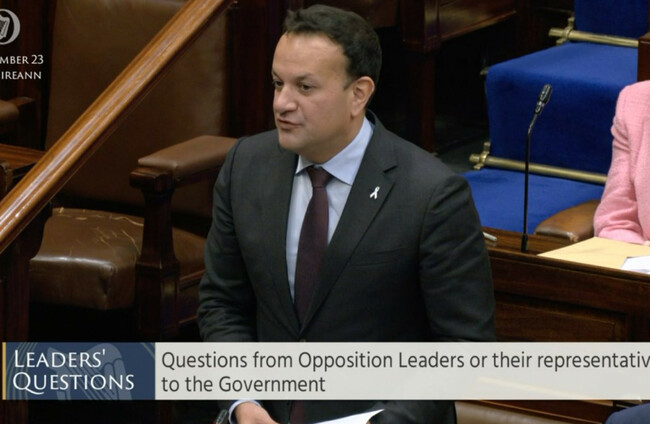
THE EU HAS been “far too passive for far too long” in its efforts to secure a lasting peace settlement in the Middle East, the Taoiseach has said.
Leo Varadkar said he will use next week’s meeting of the European Council to urge fellow EU leaders to agree a joint call for a renewed ceasefire and for them to press harder for the “two-state solution” peace model for Israel and Palestine.
His comments came as Israel continued its assault on the Gaza Strip following Hamas’s 7 October attacks on Israeli civilians.
Labour leader Ivana Bacik insisted Ireland should be doing more to ramp up pressure on Israel to stop its bombardment.
“We want to see a stronger response from Ireland, pushing at EU level to ensure that other EU member states can be brought on board to seek that crucial goal of a permanent humanitarian ceasefire,” said Bacik.
Varadkar told the Dáil he will use his role as Taoiseach at the European Council next week to press for the European Union to adopt wording calling for a ceasefire in Gaza, and calling for the European Union in particular “to take a much more active role in pushing for a two-state solution and Palestinian statehood”.
He said the “European Union has been far too passive for far too long when it comes to this conflict”.
Taoiseach says the situation in Gaza is 'deplorable'.
— Jane Matthews (@janeematthews) December 6, 2023
Says he will ask the EU to take a 'much more active role' while in Brussels next week & confirms he will push for calls for a permanent ceasefire & 2 state solution.
EU has been 'far too passive, for far too long', he says. pic.twitter.com/TRbiL7BVPe
Bacik said it would be a “brave and bold” step for Ireland to officially recognise Palestine as a state in his own right.
Varadkar said such a move would be ineffectual if Ireland acted alone.
“We don’t believe that the best way to do it is unilaterally – that will be dismissed,” he said.
“It will be ineffectual and will be seen as an outlier acting unilaterally at a European level.
“What we would like to do is do it as part of a group of European countries, and I think that will be a more significant statement.
“And we don’t just want it to be a statement – we want it to be part perhaps of an agreement to end the violence that’s happening at the moment and to put in place a new administration in Gaza for the day after.
“And that’s the kind of conversation that we’re having at the moment, for example with Spain, which has a similar view to ours, and some other countries as well.”
With reporting by Jane Matthews

To embed this post, copy the code below on your site











have your say