Sign in. It’s quick, free and it’s up to you.
An account is an optional way to support the work we do. Find out more.
Sign in. It’s quick, free and it’s up to you.
An account is an optional way to support the work we do. Find out more.
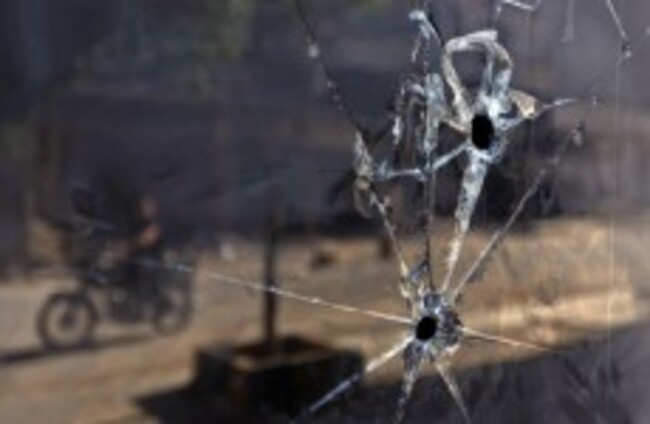
MORTARS RAINED DOWN on a crowded marketplace in a Palestinian refugee camp in the Syrian capital, killing at least 20 people as regime forces and rebels fought nearby, activists said.
The attack on Yarmouk camp may well have been connected to a two-day long skirmish in the nearby Tadamon neighbourhood, which has been repeatedly shelled by government troops. On Friday smoke could be seen pouring from the neighbourhood.
Many residents from Tadamon and other nearby districts wracked by fighting have taken refuge in Yarmouk camp and are staying in schools or in people’s houses, said camp resident Sami, who only gave his first name out of fear of reprisals.
Families separated
“The Palestinians think that the reason they were bombed is because they shelter those refugees,” Sami said. “Their situation is very hard. They came with nothing — some left in their night clothes. Some of the children are barefoot. Families have been separated from one another.”
The UN agency running Palestinian camps confirmed that at least 20 people had died in the shelling of Yarmouk. The Britain-based Syria Observatory for Human Rights, which first reported the deaths, said the mortars hit as shoppers were buying food for the evening meal. The group declined to speculate over who had fired the mortars.
The state news agency blamed the bombardment on “terrorist mercenaries” — a term the government uses for rebel fighters — and said they had been chased away by security forces.
The incident highlights the precarious situation of not just Palestinian refugees but all civilians in Syria who are increasingly getting caught in the crossfire of this bloody uprising that has claimed 19,000 lives since it erupted in March 2011. Every day hundreds of civilians are uprooted by the violence, according to the UN, which estimates that 1.5 million people have been forced to abandon their homes but remain in the country.
Neighbourhoods sympathetic to rebels
An online video of the immediate aftermath of the Yarmouk attack showed bleeding and burnt bodies with people rushing about amid the smoke and sounds of screaming.
Government troops have in the past attacked the camp, home to nearly 150,000 Palestinians and their descendants driven from their homes by the war surrounding Israel’s 1948 creation. Palestinian refugees in Syria have tried to stay out of the uprising, but with Yarmouk nestled among neighbourhoods sympathetic to the rebels, its residents were eventually drawn into the fighting.
The camp’s younger inhabitants have also been moved by the Arab Spring’s calls for greater freedoms and have joined protests against President Bashar Assad’s regime— and have died during demonstrations when Syrian troops fired on them.
The situation of the Palestinian refugees is particularly sensitive because Syria has long cast itself as the principal champion in the Arab world of the Palestinian struggle with Israel. Palestinian President Mahmoud Abbas, whose government has a strict policy of neutrality regarding the Syrian conflict, condemned the Yarmouk attack.
“The presidency demands an immediate end to all murder and destruction in the refugee camps, and protection to its inhabitants,” Abbas’ office said in a statement carried on the official Palestinian news agency.
The militant Palestinian group Hamas also called the killing a “crime,” and condemned the involvement of Palestinians in the Syrian conflict. “We emphasise the need to refrain from pushing the sons of our Palestinian people and the refugee camps into the Syrian crisis,” said a statement from the Hamas movement.
After the mortar attack, camp residents demonstrated against the government, chanting slogans against Assad and praising the opposition Free Syrian Army, according to online videos. The content of the videos could not be independently verified.
Hopes of diplomatic solution fading
With the civil war in Syria getting increasingly vicious, chances for a diplomatic solution to the conflict were fading after the resignation Thursday of Kofi Annan, the UN-Arab League envoy to Syria. Annan cited divisions within the Security Council preventing a united approach to stop the fighting.
Syria’s ally Iran, blamed the US and its allies for Annan’s resignation, saying it was their insistence on Assad’s removal from power that had undermined the six point UN peace plan, which was never implemented.
“Annan’s six-point plan was accepted by Syria,” said Foreign Minister Ali Akbar Salehi Friday. “It was Western countries and some regional states that didn’t want Annan plan to succeed.” He also accused the US and its allies in the region of contributing to the instability, saying they were supplying the Syrian rebels with weapons and equipment.
The UN General Assembly was preparing to vote Friday on a new Arab-sponsored resolution condemning Syria’s use of heavy weapons to crush the uprising that has killed an estimated 19,000 people since it began on March 2011.
The resolution — which like all General Assembly resolutions is unenforceable — is expected to denounce Syria for unleashing tanks, artillery, helicopters and warplanes on the people of Aleppo and Damascus, and demand that the Assad regime keep its chemical and biological weapons warehoused and under strict control.
Pockets of resistance
UN observers had confirmed Wednesday that they witnessed Syrian warplanes firing rockets and machine guns.
Syria’s civil war, which had spread across much of the country, only came to the capital and northeastern city of Aleppo, Syria’s main commercial hub, in July.
A rebel assault and revolt in Damascus two weeks ago was vigorously crushed by government forces, but pockets of resistance and sympathetic neighbourhoods remain.
Clashes and shelling also continue in Aleppo, especially the opposition bastion of Salaheddine as rebels and government forces hold different parts of that city. On Thursday, the rebels even deployed a captured tank against the regime and briefly shelled an air force base outside Aleppo.
In a briefing on Friday, the UN refugee agency said “terror is gripping the population and humanitarian aid is desperately needed.” It sighted the Syrian Red Crescent as saying that 45 schools and six dormitories in the city are hosting 7,200 refugees, with an unknown number sheltering in mosques.
The UN peacekeeping chief Herve Ladsous warned of a major government assault on Aleppo in the coming days to retake the rebel-held neighborhoods.
“The focus is now on Aleppo, where there has been a considerable buildup of military means, and where we have reason to believe that the main battle is about to start,” he told reporters in New York late Thursday after briefing the Security Council on his trip to Syria.

To embed this post, copy the code below on your site










have your say