We need your help now

Support from readers like you keeps The Journal open.

You are visiting us because we have something you value. Independent, unbiased news that tells the truth. Advertising revenue goes some way to support our mission, but this year it has not been enough.

If you've seen value in our reporting, please contribute what you can, so we can continue to produce accurate and meaningful journalism. For everyone who needs it.

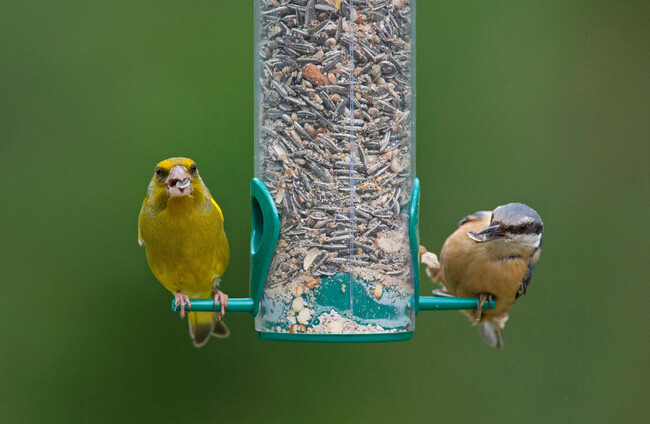
Greenfinches at a bird feeder, but the advice between May and October has now changed Alamy Stock Photo

Public urged not to feed birds in their garden between May and October

The change in advice is the result of an increase in a disease that impacts on finches in particular.

THERE’S BEEN A major change in advice for those with bird feeders in their garden, with the public now being urged not to feed birds between May and October.

The change in advice is due to a disease called trichomoniasis, which impacts greenfinches, chaffinches, goldfinches and other finch species.

The disease causes swellings in the throats of the birds and means that after a while, the birds can no longer swallow and starve.

There is no treatment or cure for the disease.

Niall Hatch of BirdWatch Ireland noted that up until now, “people have been doing the right thing”.

“BirdWatch Ireland’s advice has always been that feeding birds year-round is okay,” Hatch told RTÉ’s Morning Ireland.

“But we’re changing that advice now because of the presence of trichomoniasis”.

Hatch said the disease is spread by the saliva of birds and that when food in feeders gets contaminated, the disease can spread.

He said studies from BirdWatch Ireland have shown that over of course around 10 years, the Greenfinch population has declined by around 50%, while around 30% fewer of them are coming into gardens.

Hatch said it’s now realised that garden feeders are a “vector” for the disease, particularly during the warmer months of the year when the weather allows the disease to “survive and pass the infection on”.

“It’s got to the point where we’re now saying, between May and October, feeding birds in the garden is thought to do more harm than good, but outside of that period, it’s still okay to feed them.”

Hatch said it has taken BirdWatch Ireland some time to come to this decision and that he has been monitoring the disease over the past two decades.

“In the last few years, the numbers of Greenfinches have plummeted in many areas of Ireland and this disease is responsible for it,” said Hatch.

“There’s no cure for it so the advice now, unfortunately, because of the prevalence in garden feeders, is to stop feeding them.

“We still recommend people feed from November through winter months and into April, but it’s important not to put food on flat surfaces like traditional bird tables.”

Hatch instead advised people to use hanging feeders that are kept “half full, sanitised, and move around frequently”.

However, he said a more effective way to help birds and gardens is to “plant native plant species that support the different seeds and fruits and berries and insects that those birds thrive on”.

“That’s a really good way to provide even greater benefits for the birds in the garden.”

Hatch meanwhile noted that the “most important time to feed birds is during the very cold months of winter and feeding then does a lot of good”.

He said that at this time of year, food from garden feeders “makes up a tiny proportion” of a bird’s diet.

“At this time of year, there’s plenty of natural food around, and there’s also longer daylight hours, so there’s more time to find that food they need and birds are probably consuming far less than people think during summer and late spring.

“We know a lot of people enjoy feeding birds in the garden and I know it will be a surprise for a lot of people that were changing our advice on this, but it’s for the bird’s own benefit.

“We know the reason people feed birds is because they want to help them, so the best way to help them is to follow this advice and not feed them now until around November.”

Meanwhile, Hatch noted that the disease is “no threat to humans or any mammals”.

Hatch added that it is “not related to bird flu, which is a completely separate disease”.

Readers like you are keeping these stories free for everyone...
A mix of advertising and supporting contributions helps keep paywalls away from valuable information like this article. Over 5,000 readers like you have already stepped up and support us with a monthly payment or a once-off donation.

Close
63 Comments
This is YOUR comments community. Stay civil, stay constructive, stay on topic. Please familiarise yourself with our comments policy here before taking part.
Leave a Comment
    Submit a report
    Please help us understand how this comment violates our community guidelines.
    Thank you for the feedback
    Your feedback has been sent to our team for review.

    Leave a commentcancel

     
    JournalTv
    News in 60 seconds