Sign in. It’s quick, free and it’s up to you.
An account is an optional way to support the work we do. Find out more.
Sign in. It’s quick, free and it’s up to you.
An account is an optional way to support the work we do. Find out more.
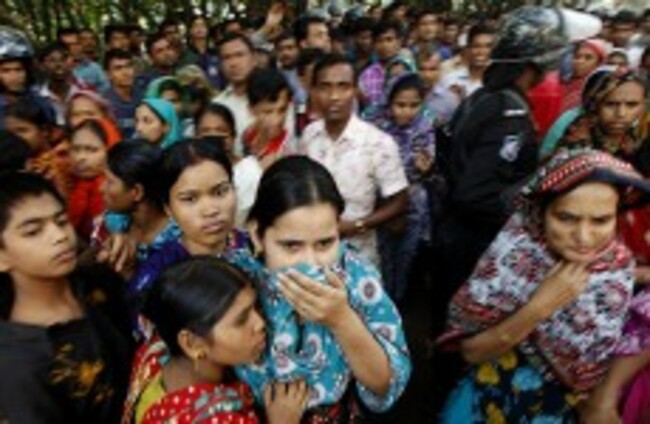
GARMENT WORKERS ARE staging mass protests today in Bangladesh to demand the end to “deathtrap” labour conditions after the country’s worst-ever textile factory fire.
Ahead of the first of a series of mass funerals for the 110 victims, survivors of Saturday night’s blaze joined several thousand colleagues to block a highway and march in the manufacturing hub of Ashulia.
“Workers from several factories have left work and joined the protest. They want exemplary punishment for Tazreen’s owners,” said Dhaka police chief Habibur Rahman, referring to a plant near the capital where the blaze broke out late Saturday.
Police said Ashulia’s more than 500 factories who make apparel for top global retailers such as Walmart, H&M and Tesco declared a wild-cat “holiday”, fearing that the protests could worsen and turn into large-scale unrest.
“Most workers are in shock. They want to see safety improvements to these deathtrap factories,” Babul Akter, head of a garment union, told AFP.
The protestors chanted a series of slogans, including a demand for Tazreen’s bosses to be brought to justice.
“We won’t spare anyone”
Local police chief Badrul Alam said officers had opened a murder investigation as a result of criminal negligence. Two government inquiries and the police investigation are trying to establish if the owners were to blame for the fire.
“We won’t spare anyone,” Alam promised as the Prime Minister Sheikh Hasina announced a day of mourning for the dead, many of whom stitched clothes for international brands. All factories will also be closed tomorrow.
Dozens of workplace fires have killed more than 600 employees in Bangladesh’s booming garment industry since 2006, but none of the owners have so far faced prosecution for poor safety conditions.
Firefighters battled for several hours to contain the weekend blaze, which broke out on the ground floor of the nine-storey Tazreen Fashion plant 30 kilometres north of Dhaka, trapping over 1,000 workers.
Witnesses told how panicked staff, most of them women, cried for help and several leaped to their deaths from upper floors as they tried to escape.
Preparations have been made for the mass burial of the bodies of 59 workers who cannot be identified.
Their remains, most of which were burnt beyond recognition, will be laid to rest at a state graveyard in a southern suburb of Dhaka.
“We are keeping the DNA samples of the dead workers so that we can identify their relatives for compensation,” said Dhaka district police commissioner Yusuf Harun who said the death toll was now 110.
“New scenes of panic”
Even before the first burials, a new blaze at a 12-storey building housing four factories sparked new scenes of panic as workers rushed to safety.
The latest fire caused widespread damage at the plant on the outskirts of Dhaka, but no casualties were reported after rescue teams searched the building for workers feared to have suffocated in toxic black fumes.
“Most workers broke grilles in the upper floor and escaped to a safe location at an adjacent building,” Dhaka district deputy commissioner of police Nisharul Arif told AFP.
Bangladesh has emerged as the world’s second-largest clothes exporter with overseas garment sales topping €14.7 billion last year, or 80 per cent of national exports.
The sector is the mainstay of the poverty-stricken country’s economy, employing 40 percent of its industrial workforce, but work conditions are often basic and safety standards low.

To embed this post, copy the code below on your site












have your say