We need your help now

Support from readers like you keeps The Journal open.

You are visiting us because we have something you value. Independent, unbiased news that tells the truth. Advertising revenue goes some way to support our mission, but this year it has not been enough.

If you've seen value in our reporting, please contribute what you can, so we can continue to produce accurate and meaningful journalism. For everyone who needs it.

Alamy Stock Photo

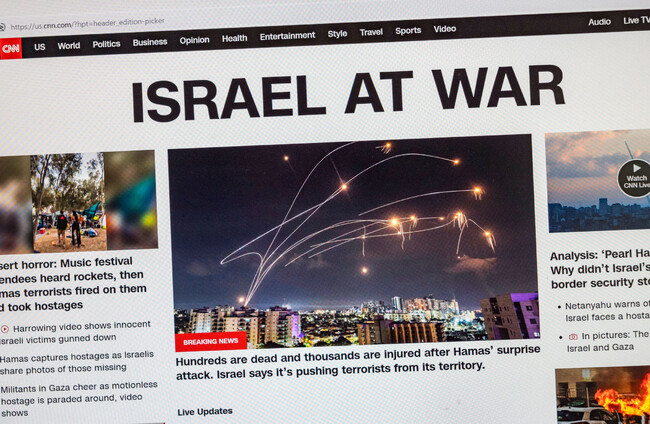
Balance and fairness Have global media outlets accurately reflected the true horror of Gaza?

Robert Grant examines how global events are portrayed in the media and how philosophy can help us think critically to assess what we see.

PHILOSOPHY OFFERS LITTLE consolation amid the relentless stream of horror coming out of Gaza.

What use are abstract theories of justice and morality when we see the horrors play out day after day in the region? What help, when the concrete evidence compiled by South Africa at the International Criminal Court is failing to halt the destruction of life in Palestine?

Something philosophy can provide, however, are tools for analysing how these events have been presented in our public discourse.

While most of the atrocities committed in Gaza have reached us via social media since this war began, what we know as ‘traditional’ media – RTÉ, BBC, The Irish Times, CNN – still wield considerable influence over how issues get framed in the public imagination.

This legacy media provides an editorial lens that refracts positions along a spectrum of what is ‘acceptable’ to what is ‘extreme’. Through these editorial choices, linguistic norms are established that shape how events get labelled and described.

Context matters

Philosophical analysis is useful here because it cultivates a keen eye for examining background assumptions and spotting flawed reasoning. In philosophy, reasoning errors are known collectively as ‘logical fallacies’, and they typically occur when a claim is supported by an inappropriate premise. The danger of logical fallacies – and the reason philosophers have been cataloguing them for thousands of years – is that they make bad arguments appear convincing, and the media’s treatment of events in Gaza provides a case study in their use.

In reports on Gaza, the ‘conflict’ is usually described as having been ‘caused‘ or ‘started’ by the Hamas attacks of October 7, 2023. While there is no doubt that these attacks were brutal in nature, it’s often reported as if a terrorist attack was carried out from nowhere, setting in motion an inevitable but unfortunate chain of events. In philosophical terms, this is known as ‘causal simplification’: when a single cause is posited to explain an event, while in truth, the causal history is more complex.

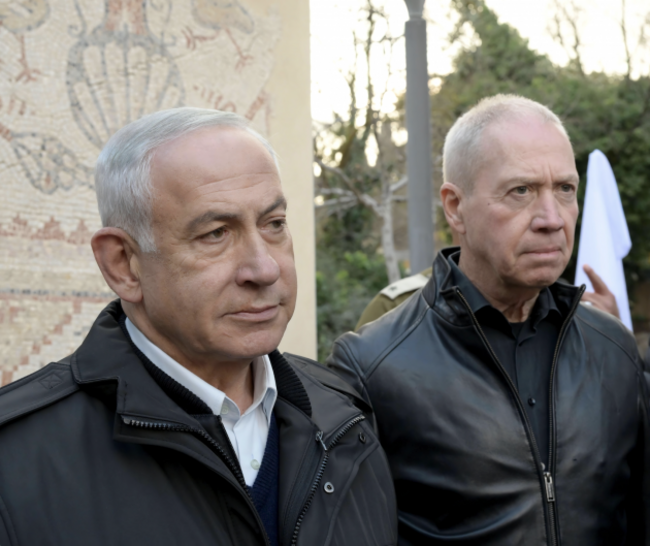
Screenshot 2025-07-09 at 13.32.29 Israel's Netanyahu and his far-right Likud party colleague, Yoav Galant. Alamy Alamy

This recent onslaught in Gaza is the latest in a long series of Israeli violence against Palestinians. Since 2006, when it enacted a complete blockade of land, sea and air on Gaza, Israel has launched five separate wars as part of a policy they call “mowing the lawn”, during which they have killed thousands of civilians. This is to say nothing of the violence, humiliation and racial and legal segregation that have been part of daily life for Palestinians, nor the historical context of the ethnic cleansing of hundreds of thousands of Palestinians in 1948.

The power of deflection 

To state that the current round of destruction ‘started’ on October 7th is disingenuous, and serves to position Israel as the reactionary victim, justified in defending itself.

Anyone who points this out gets counter-accused: “Well, do you condemn Hamas?” Having a conversation about the moral standing of Hamas’ actions is perfectly legitimate – and should happen – but consistently bringing it up as a way to avoid accounting for Israel’s actions is insincere. This is known as the ‘tu quo que’ (or ‘you too’) fallacy.

It is designed to deflect from an accusation by immediately turning the accusation back on the accuser, without addressing the relevant claim in the first place. It is a rhetorical tool used to stifle conversation and shut people up (as is happening to Kneecap). It implicitly absolves the accused – in this case, Israel – of responsibility by reinforcing the assumption that there are two equally culpable sides involved.

This ‘bothsideism’ is by far the most insidious influence that some of the media has had on this issue. Using military terminology to describe what is essentially the bombardment of a civilian area with sophisticated weaponry suggests that this is a war between two sides.

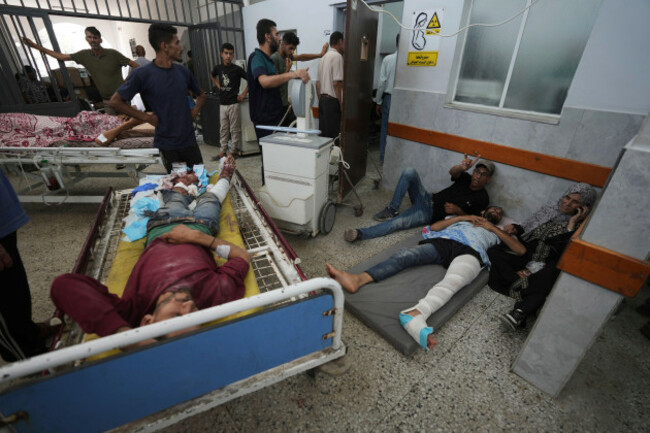
wounded-palestinians-are-brought-to-shifa-hospital-in-gaza-city-after-being-injured-while-on-their-way-to-an-aid-distribution-center-thursday-july-3-2025-ap-photojehad-alshrafi Wounded Palestinians are brought to Shifa Hospital in Gaza City after being injured while on their way to an aid distribution centre, 3 July. Alamy Stock Photo Alamy Stock Photo

Countless reports in our media have announced the loss of dozens of civilian Palestinian lives, while describing how Israel “seized new territory” by “targeting a command centre” as it “expands its ground operations”. Simultaneously, “Hamas-run” gets amended to the health ministry’s casualty figures (which are most likely a significant undercount). This is a ‘false equivalence’, which occurs when two things are wrongly presented as being morally, logically or factually the same.

As of June 2025, somewhere between 55,000 and 85,000 people have been killed in Gaza – 70% are estimated to be women and children – versus approximately 1,700 Israelis. No loss of life is acceptable, but this is clearly not a conflict of equals.

Israel has attacked all 36 hospitals in Gaza, they have bombed schools, universities, and killed hundreds of journalists, doctors and aid workers. They have used starvation as a method of punishment. This is not a war; it is an occupying force using high-tech weapons to destroy life in an impoverished and imprisoned population in an area half the size of Louth.

To be fair to media outlets, it should be noted that the Israeli government has refused to allow international journalists to gain access to Gaza throughout, while the work of aid NGOs in Gaza has also been severely restricted. However, insisting on ‘two sides’ only legitimises bad faith actors who exploit the media’s irrational commitment to balance. 

The cult of centrism

The sinister nature of this false balance lies in its promotion of a stultifying and unthinking form of centrism. Centrism names a range of political beliefs that are defined, not by any specific principle or world-view, but by their position relative to the ‘extremes’. It’s a seductive heuristic – a cognitive shortcut – that promises to conveniently solve all your political and ethical decisions.

The centrist never really has to think through the merits of an issue: just look left and right, note the ‘extremes’, and plant yourself ideologically in the middle, wherever that happens to be.

Centrism rests on a fallacy called the ‘argument to moderation’, which assumes that when presented with two sides of a debate, the truth always lies somewhere in the middle. There is no logically necessary reason for this to be the case, but it does make the centrist an easy target for manipulation: simply bait them with a more extreme version of your view, legitimise it through the media as ‘the other side’, and watch as the centrist makes their way to the middle (where you wanted them all along).

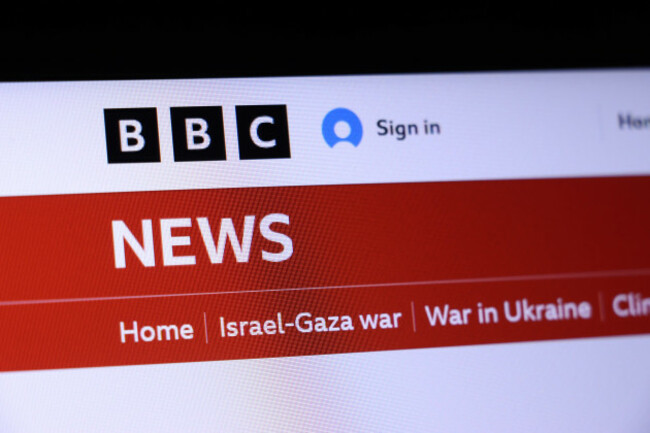
bbc-website-homepage-featuring-news-on-israel-gaza-and-ukraine-conflicts Alamy Stock Photo Alamy Stock Photo

As long as the media keeps presenting this as the Israel-Hamas war, as opposed to a genocide against a minority people, many people will default to the centre, acknowledging that while tragic and complicated, there are wrongs on both sides. Centrism neutralises the moral outrage required for a population to demand of their government the radical action required to pressure Israel to stop the genocide.

Sometimes things are not as complicated or nuanced as we are told. Sometimes there is a true and a false, a right and a wrong, and it is the media’s responsibility to expose it where it exists.

And while recent weeks have brought a shift in tone from most media and Governments as they can no longer avoid the truth of what is happening, it will always have been far too late.

Rob Grant has a PhD in philosophy from Trinity College Dublin and is the co-founder of the community-based philosophical dialogue project, HearListen. Rob is the author of a children’s philosophy book and is currently working on a book exploring the role of logical fallacies in contemporary public discourse.

Readers like you are keeping these stories free for everyone...
A mix of advertising and supporting contributions helps keep paywalls away from valuable information like this article. Over 5,000 readers like you have already stepped up and support us with a monthly payment or a once-off donation.

View 91 comments
Close
91 Comments
This is YOUR comments community. Stay civil, stay constructive, stay on topic. Please familiarise yourself with our comments policy here before taking part.
Leave a Comment
    Submit a report
    Please help us understand how this comment violates our community guidelines.
    Thank you for the feedback
    Your feedback has been sent to our team for review.

    Leave a commentcancel

     
    JournalTv
    News in 60 seconds