Sign in. It’s quick, free and it’s up to you.
An account is an optional way to support the work we do. Find out more.
Sign in. It’s quick, free and it’s up to you.
An account is an optional way to support the work we do. Find out more.

LAST UPDATE | 10 Mar
US DEFENCE SECRETARY Pete Hegseth has said that today will see the “most intense” airstrikes on Iran, a day after President Donald Trump said the war was essentially over.
“Today will be yet again, our most intense day of strikes inside Iran, the most fighters, the most bombers,” Hegseth told a news conference at the Pentagon.
As for a timeline for the war, he said that Trump “gets to control the throttle. He’s the one deciding”.
“It’s not for me to posit whether it’s the beginning, the middle or the end,” the Pentagon chief said. “Our will is endless,” he said, while also adding: “This is not endless.”
Yesterday, Trump said the war was “very complete, pretty much” and claimed the US had destroyed Iran’s navy and air force, although Iranian strikes have continued.
Stated war aims and justifications from the US government have varied since the assault on Iran began.
US officials, including Trump and Hegseth, have said the objectives include destroying Iranian nuclear sites, toppling the Islamic Republic regime, eliminating Iranian proxy forces and destroying Iran’s military capacity altogether.
“We will not relent until the enemy is totally and decisively defeated,” Hegseth said today.
Hegseth referred to the Iranian government today as “barbaric savages” who have “murdered” US soldiers through proxy forces in the Middle East.
He said the Islamic Republic was “desperate” and accused Iran of firing missiles from schools and hospitals, without presenting evidence.
He said the US was “laser-focused” on its operation, which he said would not end until Iran was totally defeated.
All available evidence points to the US being responsible for destroying a primary school on the first day of the US-Israeli assault, which reportedly killed more than 170 people.
Hegseth closed his remarks by quoting a passage from the Bible.
“God bless our troops and this nation,” he said.
Asked what the plan was when the war ends, Hegseth said: “Ultimately, the aftermath is going to be in America’s interests.”
About 140 US military personnel have been wounded in attacks since the start of the war, the Pentagon said this evening.
“The vast majority of these injuries have been minor, and 108 service members have already returned to duty,” Pentagon spokesman Sean Parnell said in a statement.
“Eight service members remain listed as severely injured and are receiving the highest level of medical care,” he added.
The United States’ energy secretary deleted a video on X in which he said the US Navy had escorted an oil tanker through the Strait of Hormuz. The White House later stated the US Navy had not escorted any tankers through the strategic Gulf passage.
Iran’s Revolutionary Guards said no US Navy vessel has “dared” approach the strait, which they have virtually closed in retaliation for US-Israeli strikes that killed the country’s supreme leader.
International Energy Agency member countries met for crisis talks today to assess security of oil supply and the potential release of emergency stocks.
Pete Hegseth reads some scripture and says, "Amen" pic.twitter.com/2uhxwzRmPY
— Aaron Rupar (@atrupar) March 10, 2026
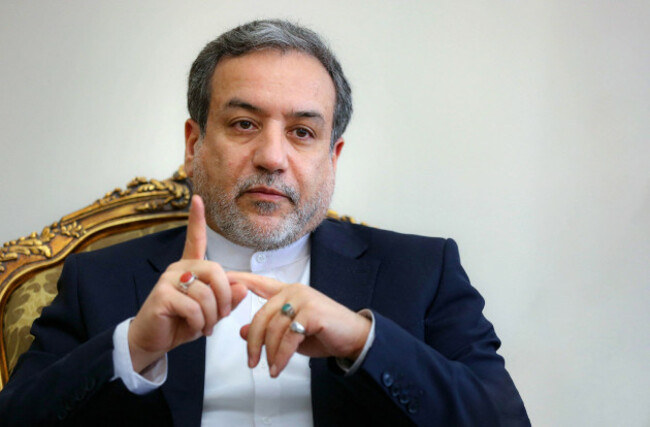
Meanwhile, Iran’s foreign minister Abbas Araghchi said today that his country would keep fighting as long as necessary.
It comes as Iranian forces have said that they will not allow the export of oil from the region to the United States or its “partners” in the Middle East as long as the war continues.
Araghchi also ruled out negotiations with the US, as Tehran yesterday launched a new wave of attacks on US-allied Gulf nations hours after Trump’s assurances of a swift end to the rapidly widening conflict.
The Iranian minister said that in the past Iranians had “a very bitter experience of talking with Americans.”
Trump’s comments helped reverse the stock market slumps and soaring oil prices.
“We’ve already won in many ways, but we haven’t won enough,” Trump said.
“We took a little excursion because we felt we had to do that to get rid of some people. And I think you’ll see it’s going to be a short-term excursion,” Trump said in a speech.
Trump: "We took a little excursion because we felt we had to do that to get rid of some evil. I think you'll see it's going to be a short-term excursion. Short term. Short term!" pic.twitter.com/PvuBBGiMJV
— Aaron Rupar (@atrupar) March 9, 2026
He threatened an attack of “incalculable” size if Tehran blocks oil supplies, which it already has.
Iran’s Revolutionary Guards also responded to Trump, saying that they would “determine the end of the war”.
Recalling previous US attacks during earlier negotiations, Araghchi said: “I don’t think talking with Americans anymore would be on our agenda.”
Early this morning, Iranian attacks again targeted Gulf nations.
The United Arab Emirates said it was “currently responding to incoming missile and drone threats from Iran,” while in Bahrain citizens were told to take shelter as sirens sounded.
Both Saudi Arabia and Kuwait also said they had intercepted and destroyed drones.
“There would be catastrophic consequences for the world’s oil markets the longer the disruption goes on, and the more drastic the consequences for the global economy,” Saudi oil giant Aramco’s president and chief executive officer Amin H. Nasser told journalists.
“It’s absolutely critical that shipping resumes in the Strait of Hormuz.”
In Iran, local media reported fresh attacks in the capital and Khomein, and Israel said it had struck an Iranian missile launcher shortly after an Iranian barrage that triggered warnings in several parts of Israel.
‘WE'RE WINNING DECISIVELY’: Secretary Pete Hegseth gives a fiery update about the direction of Operation Epic Fury.
— Fox News (@FoxNews) March 10, 2026
“This is not 2003. This is not endless nation-building… Those days are dead. Instead, we're winning decisively with brutal efficiency, total air dominance, and… pic.twitter.com/zWNDTkQSVG
The war has spiralled far beyond Iran’s borders, dragging in not only its Gulf neighbours but also Lebanon, where Israel carried out fresh strikes yesterday.
Lebanese authorities said today that Israeli attacks since 2 March have killed at least 486 people and wounded at least 1,313.
Lebanon was drawn into the Middle East war when Iran-backed Hezbollah attacked Israel after the killing of Iranian supreme leader Ayatollah Ali Khamenei.
I was informed today by Aidan O’Hara, Ambassador of Ireland to Egypt and non resident Ambassador to Lebanon, of the announcement by Ireland’s Department of Foreign Affairs and Trade allocating three million euros in humanitarian assistance to Lebanon.
— Youssef Raggi (@YoussefRaggi) March 10, 2026
I expressed our gratitude…
Israel had continued to hit Lebanon with airstrikes despite a nominal ceasefire agreement following fighting stemming from the October 2023 Hamas attack on Israel and the genocide in Gaza, Palestine.
Lebanese president Joseph Aoun has accused Hezbollah of working to “collapse” the state, while the head of the group’s parliamentary bloc said it had “no other option… than the option of resistance.”
Israeli strikes and ground incursions have pushed hundreds of thousands of Lebanese from their homes, with more than 660,000 registered as displaced, according to government figures.
Today Lebanon’s foreign minister, Youssef Raggi, thanked Ireland for the allocation of €3m in humanitarian assistance.
“I expressed our gratitude to Ireland and the Irish people and reaffirmed the Lebanese government’s commitment to pursuing all avenues to halt the Israeli escalation and to ensure that Hezbollah’s weapons are placed under the authority of the state and that its military and security activities are banned, in implementation of the recent decision of the Council of Ministers,” he said in a post on X.
With hostilities intensifying, UN High Commissioner for Human Rights Volker Turk deplored the extensive attacks in residential areas, on health facilities, schools, cultural property and water and energy infrastructure.
“This apparent tit-for-tat dynamic, involving essential infrastructure with extremely significant civilian impacts, will only increase risks for civilian populations more broadly, with potentially dire consequences across the entire region,” he warned in a statement.
Turk stressed that “under the laws of war, civilians and civilian infrastructure must be protected at all costs”.
“All parties are bound by these rules, and must be held to account if they do not,” he said, warning: “the world is watching”.
The UN rights chief warned that “strikes against vital civilian infrastructure in the Middle East, as well as the widening geographic spread of strikes, are further increasing risks for populations across the region, and beyond”.
He pointed to strikes on a water desalination plant and fuel facilities in Iran over the weekend, igniting fires and reportedly disrupting water access for dozens of villages.
With reporting from AFP
Need more clarity and context on what is happening in the Middle East? Check out our FactCheck Knowledge Bank for essential reads and guides to finding good information online.

To embed this post, copy the code below on your site
















have your say