TheJournal.ie uses cookies. By continuing to browse this site you are agreeing to our use of cookies. Click here to find out more »
Dublin: 9 °C Sunday 19 May, 2013

Column: Irish labour costs making us uncompetitive? Hardly.

We’re told that wages need to be cut for Ireland to compete internationally – but the figures don’t bear this out, writes Jimmy Kelly of Unite.

Jimmy Kelly

THE CENTRAL BANK recently claimed that Irish labour costs are too high. They implied we needed wage cuts of up to 10 per cent to ‘restore competitiveness’.

They did not put forward any evidence or data to justify their claim. This is understandable. Because they are wrong.

UNITE has put together the true picture of Irish labour costs by using data from the EU Commission’s data agency, Eurostat. We examined the private sector (or what’s called the ‘Business Economy’). What does this picture look like?

Ireland ranks 10th out of the EU-15 countries, right at the average. Nine other countries have higher labour costs. However, this graph doesn’t tell the full story.

  • When Irish labour costs are compared to those of EU-Core countries (excluding the poorer peripheral countries), Ireland falls 11 percent below average, ranking second to last.
  • And when compared to economies with a similar structure as our own (small and open, heavily reliant on exports), Irish Ireland falls 18 percent below average, ranking last.

This hardly justifies the Central Bank claim that we are somehow ‘overpaid’.

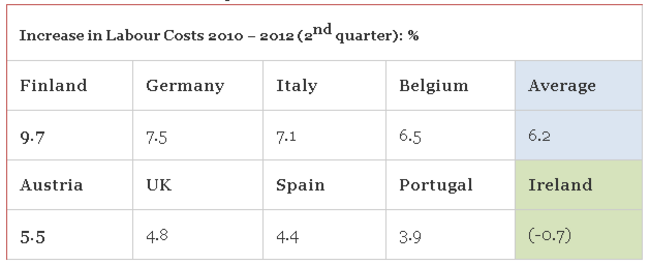
The EU Commission data only goes up to 2010. However, they provide provisional data for labour costs growth between 2010 and mid-2012. This shows Irish labour costs falling even further behind EU averages.

chart

With the exception of Greece, where wages are in free-fall in many domestic sectors, Ireland is the only country where labour costs are actually falling. In other countries wages are rising.

UNITE also compiled data on each of the economic sectors. I would like to draw special attention to the main low-paid sectors. Low-paid workers’ wages and conditions have been under attack from employers and the Government (in their recent ‘reform’ of the Joint Labour Committees). You’d think, listening from the propaganda, that Irish labour costs in the low-paid sectors are exorbitant in comparison with the EU-15. Here is the real information.

In the hospitality (hotels and restaurants) and wholesale & retail sector, Irish labour costs are seven to eight percent below the average of other EU-15 countries. When compared with EU-core countries this falls 16 to 18 percent below average. And when compared to similar small, open economies this falls a staggering 26 to 27 percent below average. That puts the propaganda in context.

Deformed economy

There’s this idea that driving down wages will somehow restore our competitiveness. Never mind that other small open economies in the EU have much higher labour costs – and are ranked as some of the most competitive; the fact is that the Irish economy has always been highly productive. Forfas looked into this issue recently and found that, even when adjusting for the accounting practices of multinational companies, Irish productivity was high by EU-15 standards.

In pre-recession 2007, Irish workers were still producing more per hour than their counterparts in the EU-15 – and that’s with a sizeable proportion of the economy involved in construction, a relatively low productivity sector. It is certainly true that Government policies deformed the economy through pump-priming the property boom – but Irish workers still went on working and producing at very high levels.

The situation has improved since 2007 – especially as we have become less reliant on construction activity. The gap between Irish and EU-15 productivity has grown. According to Forfas:

Irish productivity growth rates have averaged 2 percent per annum between 2007 and 2011 (with particularly strong growth recorded in 2009 and 2010). This compares with 1.3 percent in the US, 1 percent in the OECD and 0.4 percent in the Euro area.

In fact, labour costs are not even an important consideration in our major export sectors. Again, according to Forfas, labour costs make up less than 14 percent of overall operating costs in our exporting sectors. In the Chemical/Pharmaceuticals and Computer Services sector – which makes up 60 percent of all our exports – labour costs make up eight percent of operating costs. We could slash and slash wages and it would make almost no difference to the competitive bottom line.

So we have average to below-average labour costs and high productivity (with labour costs playing little role in in our export sector) – why has the Central Bank ignored these important facts?

Maybe for the same reason that they didn’t estimate the damage that their cut-wages policy would have on workers and the economy. For a low-paid worker (let’s assume a single person on €25,000) a policy of cutting wages by 10 percent would mean a loss of over €33 per week. For a worker on €50,000, the loss would come to €46 per week.

This is bad enough – driving down people’s living standards, forcing more into arrears and debt. But the Government is a big loser as well. For the low-paid worker, the loss in tax/PRSI revenue would be €20 per week, while for the person on €50,000 the loss to the Government would be €60 per week – even greater than the loss to the employee. And none of this counts the losses in VAT and Excise due to lower consumer spending.

In short, the Central Bank’s proposal would drive down people’s living standards, increase the deficit and collapse domestic demand with all the impact that would have on unemployment and business closures. The Central Bank’s proposals would make a wasteland of the Irish economy.

The Central Bank should clarify their comments. And this clarity should be based on evidence, not on an ideology that is costing us jobs, prosperity and our next generation’s ability to live in Ireland.

Jimmy Kelly is Regional Secretary of Unite Ireland. Byline photo by Mark Stedman/Photocall Ireland.

Read next:

Comments (52 Comments)

  • Managers are paid the same now in east Europe and in china I could earn more than I do here (and don’t give me ‘why don’t u F off there then posts)… All I am saying its not the labour cost is the problem it all he other costs, heat, light, insurance, certifications, fuel, transport rent rates, the list goes on….but it ain’t the labour……sure if company’s get a chance to drive this cost down then they will, it all goes to driving down overall cost…

    Reply
  • I just purchased a quantity (12) of a product from a hardware chain.
    The everyday price in ROI is €43 each. The everyday price in NI is £21 each..
    That’s not wages or VAT or insurance. It’s greed.

    Reply
  • Some of the highest costs we encounter are imposed by the state any chance of driving these down first.Or is it easier to attack peoples income?

    Reply
    • You’re right Norman Labour costs are really only an issue in the Tourism and Retail related business.
      For the productive economy it’s the huge weight of the Government that makes us uncompetitive. In order to finance their prodigious spending the burden is loaded onto non wage costs like duties and levies and commercial rates. In order to justify their prodigious spending they must appear to be productive so they introduce additional regulations which further add to the un-competitiveness of Irish business. The lack of business acumen amongst our Politicians and our public service department managers augers badly for any improvement

      Reply
  • bigmac 18/10/12 #

    They said the same thing here in spain and eneacted a brutal labour reform with the excuse that it will stimulate the economy and the results are more unemployed people without redundancy and 27% of employed people are living on the edge of poverty the new wages are slave wages while companies are still making huge profits (but not like before)

    Reply
  • The phrase “poorest peripheral countries” jumped out at me. It seems that our government want us to undercut the “poorest peripheral countries” in a race to the bottom.

    Reply
  • As far as competing against our neighbour/s Well I always felt that we were at a disadvantage being an Island.I imagine the low tax for companies helps attract business and the pool of talent is there.But are our salaries really out of step with the rest of Europe or is it the current climate that requires them to be better to attract talent shortfalls.With the mortgage bomb still ticking away and the Government and bankers in denial,while the final touches are put to the property tax and water charges just around the corner.We may not look to good for some of the talent that we would hope to attract long term.The solutions to the finance crisis is causing us to be less attractive a place to come and work.There could be light at the end of the tunnel ,or maybe its the bailout train coming with the second delivery of national pain.

    Reply
  • I wouldn’t mind a cut in wages only with the amount of taxes and charges that have come in and due to come in soon, how are people meant to get by on what they have?

    Reply
  • This is a welcome piece by Jimmy Kelly & exposes the ideological nature of the Central Bank – purely representing the interests of the financial elites who have caused the whole mess in the first place.

    This whole agenda of ‘competitiveness’ is nothing more than a race to the bottom. An opportunistic gambit to lower even further the returns to Labour & funnel them to financial elites – the top few percent.

    Little known in Ireland is the fact that German wage levels have been systematically lowered from the beginning of the Euro currency – the ‘Hartz’ ‘reforms.

    There was no reason for this. Productivity throughout Europe & the US has increased steadily. Returns to wages, in real terms, have not increased. The gains have all gone to the top. This is why, besides the housing Ponzi in a minority of countries, consumer debt has increased dramatically to a point beyond sustainability.

    Spending is ultimately the source of jobs and income. Wages in the EU need to rise to rebalance returns away from the financial hoarding & speculation of the wealthy few percent that has brought economies to their knees.

    Reply
  • Increase in income tax and alike are making us uncompetitive to attract the best talent from abroad to the country, and that is even more worrying…

    Reply
    • Typical of goverments filling us with s**** to save thier own pockets,sure what do we know eh.

      Reply
    • So people employed in a sector where income is protected at all costs,want income cut in other sectors where the same level of protection does not exist.So no problem there so.

      Reply
    • If people in this country saw how employee’s are treated in the countries that are bailing us out. We have a significantly worse deal than those countries. They do pay as much Income tax as us but they get world class services in return and 80% of their wage in dole payments etc etc etc etc.

      The people that are always complaining about the costs here will not be happy till you are working for the bread line. Not that they will take any cuts.

      Look at the extortionate rates that Lawyers, accountants and Doctors charge in this country. HR managers on 70k a year. How do they justify it. They don’t, they just demand that everyone take the beating to allow them to rake it in. They are exactly like senior managers in the Public service, me, me, me, everyone else pays and takes the pain but them.

      Disclosure: I’m self employed.

      Reply
    • censored 18/10/12 #

      This is more complex than either the Central Bank or Unite want to admit. Ireland is a high cost economy, and we all know we’re not getting value for money. The issue is probably more about skill sets – especially with the collapse of the construction industry do we have the right skills base to attract/create jobs for these people? At the very least we need to reskill.

      Reply
    • Tommy C 18/10/12 #

      Patitas, Ireland needs to keep our own people here so we dont need so many from abroad.

      Reply
  • In relation to a “talent pool” this is becoming a bit of an Irish myth at this stage. It might have been true once upon a time but not anymore…it needs a big overhaul of our education system to become more then a falsehood.

    Then in regards to the current tax policies…it’s not that you can’t raise taxes and still have positive growth and positive domestic demand it’s that currently we don’t have an “effective” tax regime combined with a functioning governance structure.

    The point then is to have a functioning system to restore a level of economic growth and competitiveness. We have a successful export sector it’s the domestic economy that is really struggling and here is where we restore our competitiveness through “effective” governance and policy. However we currently have a government lacking in the creativity, willingness and coherence to achieve this.

    Reply
  • Good piece. Every time I hear words like ‘competitiveness’ (lower wages) and ‘flexibility’ (deteriorating working conditions), etc., I want to scream. And now this corporate propaganda coming from the same CB that encouraged -under Patrick Neary’s stewardship – virtually no regulation during the Celtic (paper) Tiger years? Pimps for big business, nothing more. When nations/governments put business interests ahead of the well-being of their citizens, you’re heading for plutocracy.

    banking sector,

    Reply
  • This coming from the same central bank that pay’s millions to unsecured bondholders, millions in ‘bonus payments ‘ to bank executives who fiddled and got us into this mess, millions to speculators and property barons who they employ as advisor’s despite the fact that these same people are either bankrupt or owe a fortune to the banks that will never be repaid. typical of them to blame the ordinary man or woman struggling to meet all the extra tax’s and cuts that the banks reckless behaviour has brought about . we should of let the lot of them crash and burn!

    Reply
  • If wages are to drop. Everything that wages are used to purchase will have to drop at the same time. Houses, cars, food and all services. Easy to say wages are less in other countries, but in those countries cost of living is less than here. What we are left with in Ireland is the legacy of an overheated economy which was driven primarily by cheap credit and poor regulation. It is important to remember that cost of living in larger countries can be lower as a result of huge demand for goods and services. Smaller margins for the seller of goods and services with a high turnover. In Ireland smaller demand and higher margins to cover costs = more expensive to live. Simple economics really. Hard to turn back the clock now.

    Reply
  • What positions are uncompetitive, the management and owners paying themselves too much?

    Reply
  • “Lies, Damn Lies and Statistics”!

    Reply
  • If past behaviour by Irish unions is anything to go by, every shop steward in the country will gladly agree to a new wage agreement for new workers, while protecting the wages of existing employees.

    As for the minimum wage, that’s long been thrown out with schemes like SlaveBridge. Why aren’t the unions hopping up and down about companies getting away with paying interns nothing? Ah, it doesn’t affect existing members. I see.

    Reply
  • All i can say is Stephen Church you are an idiot and people like you are a disease upon society, you sit there and state that the most vunerable in society shouldn`t be protected by a welfare system and that the lowest paid shouldn`t be protected either, i dont see how you can justify such a statement but i would like you to suffer like thousands of people are suffering now due to greedy corrupt people at the top of the food chain who`s very policies have led to the distruction of our economy and society…SHAME ON YOU

    Reply
  • Assuming you’re telling the truth Jimmy. Why are international companies not coming here in their droves? I mean between the low labour costs, the low corporation tax and the huge grants they can secure from the IDA and other government agencies. Then when you take into account that such employers can use agencies ( thanks to union inaction) to hire staff, therefore making it even cheaper to employ people. It makes Ireland even more attractive to set up shop in. There’s something else going on here.

    Reply
    • But don’t forget same or similar benefits for corporations other countries offer too. Poland gave Dell some couple years tax exemption or low tax profile anyways and also pumped in region of 100 million euro to prepare infrastructure for them (new road links etc.). So in the end it’s brutal calculation what makes better deal for them. Lower wage in Poland and ability of using agencies too must prevailed…

      Reply
    • Should we fear becoming a low wage economy if it was to give large numbers of people work,I do not think so. Given the level of debt that is being carried it would hardly be of help to the revenue and to the retail sector at large.Throw in rents and house prices.Low wage is not the future…we cannot afford to go down that road.If we did we would never get out of debt.

      Reply
  • eoghan 18/10/12 #

    What you pay is what you get that’s what they need to be advertising we can compete with Eastern Europe

    Reply
    • Rob 18/10/12 #

      I dunno, those Dell PCs have got a lot tidier lately..

      Reply
    • I wish that was a case, but it’s not quite truth. What you pay is what you get only works in the local micro economy (same area). When we talk different countries then what you think is a bad pay here it could mean dream pay for them over there. Only educated workforce, technology and modern infrastrucfure is a way to compete. For Ireland big plus factor is also this is english spoken country.

      Reply
    • That’s not true. Never has been. American workers have been bleating that same nonsense for years yet productivity gains of 10% year on year in China for the last 7 or 8 years vs. 1-2% in the states is the reason companies have sent production there. I’ve seen no evidence that Irish workers are faster or better than Poland or other emerging economies. The cost of living rise very rapidly in Ireland and therefore do did wages. We’re a small export-driven economy and we have to be competitive or it’s game over.

      Reply
  • I am afraid Jimmy has missed the point. Our competition is not in Europe when it comes to inward investment – its global. Why does he not compare us to Singapore, China, Malaysia, Costa Rica etc.. When Jimmy says that labour costs are low in Pharma / Chemistry sector its true but that is because all the labour intensive jobs have left already just as the electronics jobs have gone. I would also hazard a guess that the percentage of third level qualification is rising in these companies. All this means it is the less well off and less well educated, the people Jimmy is supposed to represent, that are being squeezed out of the jobs market. If we want to attract these jobs back to Ireland we need to compete for them and understand who the opposition is.

    Reply
    • Your right Barry.We chose to loose manufacturing jobs to become a so called high skilled economy.That gives us two problems (1) it assumes everyone is capable or educationally qualified to do these jobs (2) we have the facilities and infrastructure in place,on both these counts we fall short.From 2002 we lost manufacturing costs by the thousand and did nothing because we were concentrating on R and D and other areas of high tech and the service sector.An average R and D facility will employ less than a hundred people so to replace The jobs lost a Dell Limerick you would need a hundred companies .furthermore R and D and manufacturing are interdependent.
      Germany the economic power house of Europe has retained its manufacturing alongside up skilling into other areas.In Ireland the best paid jobs are in accounting ,marketing and consultancy,in Germany it’s engineering in other words the people who make things to sell and export.
      Britain made the same mistake as we did fifteen years ago and lost manufacturing jobs saying they could not compete similarly the USA.Both are now desperately trying to rectify this as unemployment remains stubbornly high.we need a mixed economy which means some labour intensive industries to employ people.We should focus on our unit cost of production of which wages is only one element.people working and contributing to the economy is considerably cheaper than paying unemployed and of course it reduces indebtedness.

      Reply
  • I think both the Central Bank and Unite are both probably right. Wages are falling relative to rest of EU but we started at a higher base.

    Reply
  • The Central Bank is lying. This country is simply rotten to the core with corruption, cronyism and out of touch politicians.
    We have the most inefficient and most expensive health care system in the EU. We still have to pay to go to a GP Our private health insurance costs have spiraled totally out of control.
    Why ????
    Specialists,Doctors other health care professionals do not want all that cash they collect going through the books.
    Lawyers/solicitors can charge what they want regardless of their service. The real black economy is not the plumber doing a job on the side it is the select few shoving millions up each others arse and pointing fingers at the rest of us.

    Reply
  • “banking sector” is a typo.

    Reply
  • Abolish the minimum wage and cut welfare rates and well get competetive

    Reply
    • Of course drive down people’s income.Of course no affect on their ability to pay their debts and will work wonders for the domestic economy.

      Reply
    • Abolish the minimum rate , what rate would you suggest paying then ??

      Reply
    • Abolishing the minimum wage puts back the lower rungs of the ladder and creates jobs for unskilled and young people. You could not justify a level of 8.65 an hour for some jobs and so these jobs become an extension of somebody elses.

      If you think abolishing the minimum wage would lower everyones income , you must have a horribly low opinion of a lot of jobs

      Reply
    • The question is this Stephen, what in your opinion should the minimum rate be ??

      Reply
    • Not a low opinion of jobs,just a low opinion of some employers.You didn’t address the point if wages are driven down,how do people service their debt and the slight problem of futher decline in the domestic economy.You are aware of a downward spiral affect I presume?

      Reply
    • On the dole – it should be the same as job seekers allowance – non existant.

      Every job has a fair market value , somebody wont be assistant manager of a shop for 2 euro an hour, but they might sweep floors for 2 euro an hour , this would create enough jobs that any of the bad employers simply wouldnt have staff. Look up a video ‘edgar the exploiter’ on youtube

      Reply
    • Damn right.
      Bring back slavery so we can compete with Asian sweatshops and ensure financial growth for the parasitic layer of extractors.

      And stop eating; then we can export more agribusiness output.

      Reply
    • Stephen: Do you think that someone earning a hypothetical €2 an hour should have their income subsidised by the government or should that be their sole income (assuming they’re not working elsewhere?)

      Reply
    • A government subsidy, such a thing shouldnt exist.

      If the minimum wage was abolished , a lot of people could start part time work at 15-16 , get experience, work through college and come out in a position to earn a decent wage, unlike our current system where you have people leaving college with 0 experience and expecting to land a high paying job straight off

      Reply
    • Stephen you are correct but unpopular :( A lack of minimum wage would extremely good for the economy, the market would set the wage rate, obviously everyone is terrified that a more productive person would under price them.

      It would mainly affect ‘unskilled no-experience needed’ jobs because people will give more to make sure a job is done properly.

      Minimum wage is an incredibly bad idea, it wasn’t their when older generations grew up and they survived.

      People used to go house to house offering to do odd-jobs, when out of work, people knew how to cope. Now people are dependant on hand-outs.

      Often the unpopular decision is the correct one, hence politicians won’t do the right thing they’ll just bide time.

      Reply
    • I would agree that the welfare system needs reform and government has overreached itself in many areas, but I must remark that it’s quite sad that you value the contemporary idea of “competitiveness” greater than the idea of people not having to struggle through life.

      Interestingly, I have seen before that there are some people on the left who agree there should be no minimum wage but with economic conditions as they are, I would argue that your theory would consign many people to even greater misery.

      Reply
    • @ Stephen – Keep in mind that Germany has no minimum wage cutoff. This has been extremely beneficial for that country up to point, but it is now creating serious tensions between workers and employers, as cost of living is steadily rising in Germany while wages are not. A lower minimum wage, or no minimum wage would create jobs, but having a “working poor” situation, where a person is in full-time employment but still cannot earn enough money to cover cost of living expenses, is terrible situation, as the only option would be for the government to give social welfare payments to fully-employed workers so that they could stay solvent. The problem in Ireland is not rates of pay, that’s only a symptom. The essential problem is that the cost of living is too high. Focusing on reducing this should be the government’s priority. A litre of milk costs 52 cent in Germany, in Ireland it can be twice that. That’s the problem right there.

      Reply
  • Typo from 2002 we lost jobs not costs,sorry.

    Reply
  • Typo from 2002 we lost jobs not costs,sorry

    Reply
  • Bullsh/t. I lived in Germany for 4 years till 2008. Workers in the construction industry got 1800 a month after all taxes. If you worked in an Irish bar, you got 1200 a month. Same in holland. In Poland it’s a lot less. In Ireland on sites min wage was 23 euro per hour

    Reply

Add New Comment