Sign in. It’s quick, free and it’s up to you.
An account is an optional way to support the work we do. Find out more.
Sign in. It’s quick, free and it’s up to you.
An account is an optional way to support the work we do. Find out more.
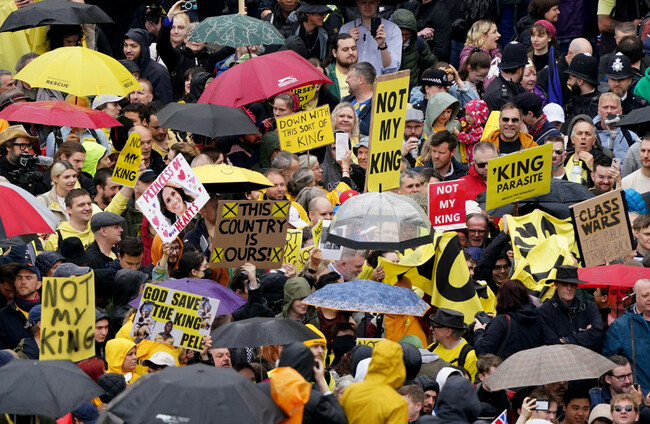
CAMPAIGN GROUP REPUBLIC is to stage its first major anti-monarchy demonstration in London since its members were arrested on the day of King Charles III’s coronation.
A few hundred people are expected to gather near the House of Parliament during the first state opening of the king’s reign today.
The state opening marks the start of a new parliamentary session and normally takes place annually with MPs, peers and the monarch all in attendance at the Palace of Westminster.
A key component of the ceremony is the King’s Speech, where he sets out the legislative programme for the coming session. The king has no role in setting the legislative agenda, but reads out the list on behalf of the British Prime Minister and the UK government.
With a general election expected next year, Rishi Sunak has put a series of criminal justice laws at the heart of the King’s Speech, in an attempt to draw dividing lines with Keir Starmer’s Labour.
Other measures in the speech include giving police the power to enter a property without a warrant to seize stolen goods, such as phones, when they have reasonable proof that a specific stolen item is inside.
The Metropolitan Police was criticised after six Republic members were detained ahead of a pre-agreed coronation protest on 6 May.
Chief executive Graham Smith, who is now taking legal action against the Met, was among those held for more than 14 hours under the sweeping powers of the new Public Order Act.
Smith said today’s protest was about the place of the Crown in parliament and the “ramshackle state of our constitution”.
“Our parliament is opened by a king wearing a crown while sitting in the Lords,” he said.
“It is just weird we continue with this pantomime that celebrates the worst, least democratic aspects of our political system.”
Republic has experienced an unprecedented growth since the coronation, Smith added.
“Our continued programme of protests serves to remind people of the need for a democratic alternative to the monarchy,” he said.
“The monarchy is wrong in principle, corrupt and secretive in practice, and bad for British politics.
“It’s time it went and polling shows an increasing number of people agree.”
Members of the group were detained on the day of the coronation after legislation came into effect days before the event, creating new offences of locking on or going equipped to lock on under the Public Order Act.
Smith had discussed the planned demonstration for four months with senior Met staff but says he was physically prevented from calling the group’s designated liaison officer when he was stopped and arrested on the day.
On 8 May, they were told no further action would be taken.
Smith wants the Met to admit the arrests were unlawful and is seeking damages and costs.
A spokesman for the force has said: “We can confirm that a judicial review claim has been issued and it would be inappropriate to comment on ongoing proceedings.”

To embed this post, copy the code below on your site













have your say