Sign in. It’s quick, free and it’s up to you.
An account is an optional way to support the work we do. Find out more.
Sign in. It’s quick, free and it’s up to you.
An account is an optional way to support the work we do. Find out more.
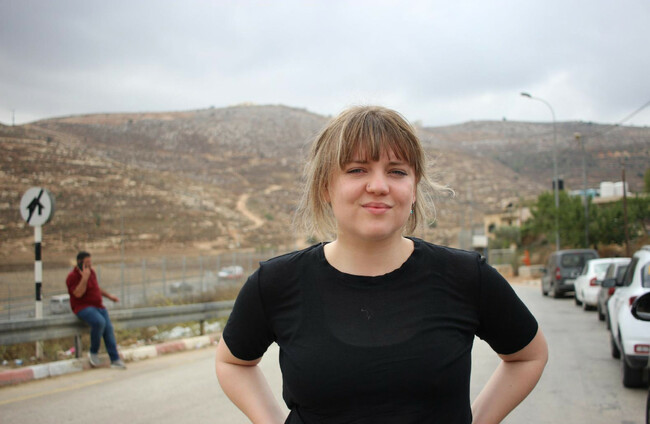

This article is part of a six-day series exploring the realities of life inside the West Bank, from a reporting trip carried out by Eimer McAuley, news correspondent with The Journal, in the week between Ireland’s two football matches with Israel.
WITH THE STREETS of Hebron deserted during a settler tour, I watched two young Palestinian children chat to a group of fully armed IDF soldiers.
It reminded me straight away of iconic photos showing similar scenes during the Troubles in Northern Ireland.
I was born in Belfast in 1998, the year of the Good Friday Agreement. During seven nights in the occupied West Bank, I found myself thinking about stories I’d heard from family about the ‘bad old days’ at home: stand-offs with soldiers, inescapable checkpoints, and the financial toll of conflict on families just trying to get by.
The parallels only go so far. In Northern Ireland, the decades saw a gradual, uneven shift towards peace. In the West Bank, it is hard to see signs of a similar shift. Unemployment has soared, movement restrictions have multiplied, and settlement expansion is accelerating at a pace that Palestinians I spoke to said they had not seen before.
Benjamin Netanyahu, the Israeli prime minister, has been unequivocal in saying that there “will never” be a Palestinian state.
The political climate in Israel offers little reason to expect an improvement. Finance Minister Bezalel Smotrich has called for Israel to go to war in the West Bank and to “do there what we did in Gaza”.
During the week I was there, new Google Earth imagery showing the extent of the destruction in Gaza was published. The prospect of Palestinian cities I had visited and the people I had met there suffering the same fate was difficult to contemplate.
The actions taken by Israel following the Hamas-led attacks of 7 October 2023, in which around 1,200 Israelis were killed, have also left people in the West Bank struggling economically. More than 100,000 work permits that allowed Palestinians to cross into Israel were frozen. Since April 2025, Israel has withheld tax and customs revenues owed to the Palestinian Authority. Unemployment in the West Bank reached 28% last year.
Despite this hardship, and the absence of almost all outside visitors, city life is busy.
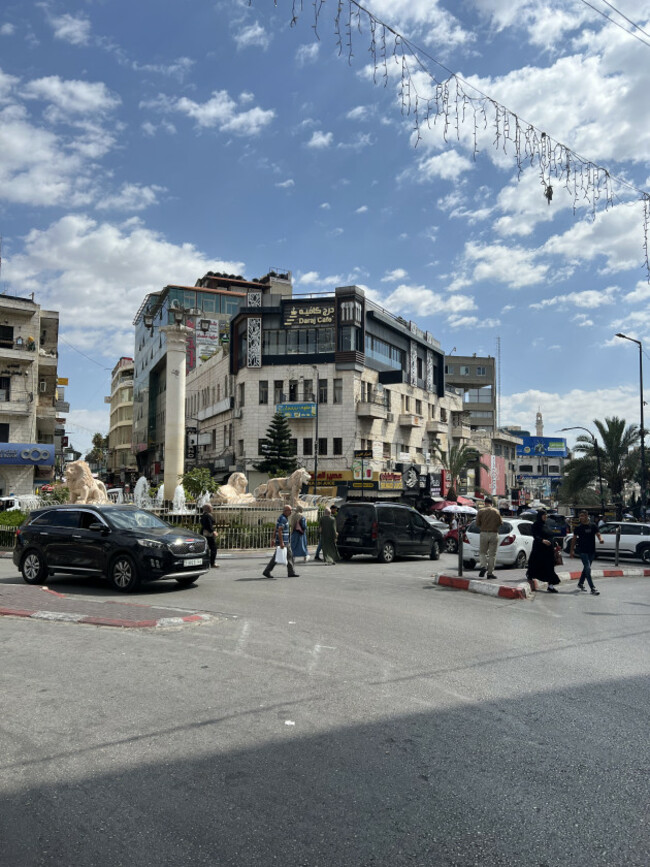
I saw bustling food markets spill onto the streets of Hebron once IDF personnel left at the end of a settler tour; a huge open-air classical music concert in Ramallah city centre; and a packed trad gig in a bar called Garage.
Young people in their 20s danced, drank and chatted politics over cigarette breaks, not unlike a night out in any good Dublin bar.
Despite the appetite for political discourse I encountered everywhere, there is little prospect of a renewed democratic mandate for Palestinian leadership in the West Bank.
Legislative elections have repeatedly been postponed, and the last took place in 2006. On 10 October, Mahmoud Abbas announced that presidential and legislative elections would now be held on 11 September 2027.
Several people expressed deep frustration with the Palestinian Authority and Abbas, but acknowledged that they could not see how an election could take place under current conditions.
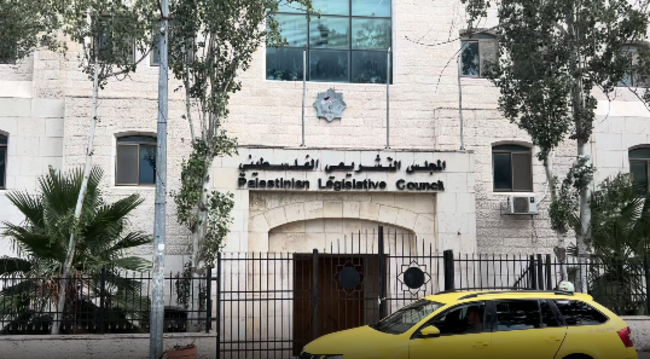
“How would we even transport the ballot boxes to be counted with all the movement restrictions?” one Palestinian journalist asked.
Hamas, too, has lost support. A Palestinian public opinion poll published in August found that its support in the West Bank had fallen from 32% to 18% over 10 months. But dissatisfaction with the existing leadership extends beyond Hamas: 44% of Palestinians surveyed said neither Hamas nor Fatah deserved to lead.
One human rights lawyer I met in a bar in Ramallah put the situation like this:
“Israel has killed over 70,000 people in Gaza. The world is watching. Can they kill another 70,000 people? Yes, probably. But can they kill 7.2 million people? No, they cannot. So we continue.”
It’s a bleak outlook, but one shared by many who are fighting to hold on to their homes on the front line of settlement expansion.
Take Khalil Halatheen, from Umm al-Khair in Masafer Yatta, for example.
His brother Awdah was shot dead last year, aged 31, after confronting a settler on Palestinian farmland. Yinon Levi, the settler who killed him, was detained by Israeli police and later released to house arrest.
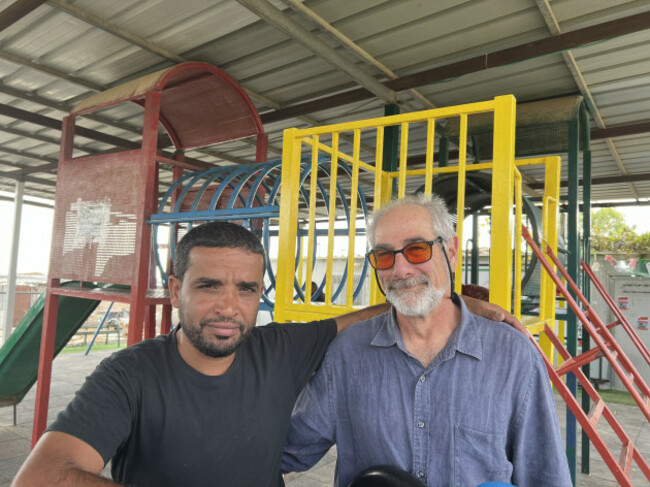
“This is my father’s land. My grandfather’s land. I would rather die on this land than be in any other place as a refugee. It is like what they said in the movie — there is ‘no other land’. This is the place where I will be,” he says.
An Israeli court is due to decide whether a number of homes and communal buildings in his village will be demolished, potentially displacing up to 70 people.
The scale of the Israeli military presence in the occupied Palestinian territories is difficult to convey in photographs. Walking through Hebron, I tried to count the soldiers I could see across a network of five streets in the heart of the Old City, as I had been warned against attempting to film or photograph them. I stopped once I reached 100.
The daily toll of occupation builds up in incremental, quieter ways than the mass presence of soldiers, however.
More often than not, it’s the hours and hours of waiting in traffic to go through checkpoints that people complain about.
Most of the civic society and human rights workers I met with said the same thing when asked how they are: ‘Tired’.
When I met multiple people at different locations, conversation always started the same way: ‘How did you get here? How long did it take?’ followed by a discussion of which routes were closed.
It goes without saying, but tourism in the OPT today is virtually nonexistent.
The Palestinian museum is in a beautiful building in Birzeit. A young woman working there as a tour guide told me that international visitors are few and far between as she gave me an extremely detailed walkthrough of the exhibits.
Most of them are temporary, but currently there is a permanent exhibit featuring three murals by different Palestinian artists: one with thousands of little olive trees, to represent those that have been cut down and stolen.
She said that the idea behind the ‘New Visions’ exhibit was about finding hope for the future through shared culture, identity and history.
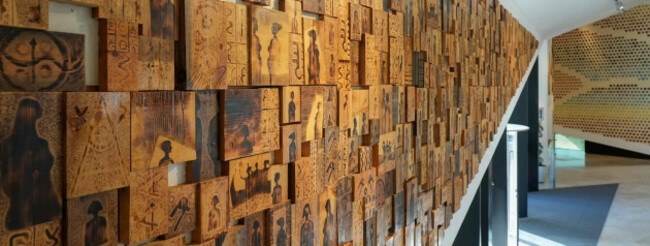
“Around the time that these murals went up in 2024, signs went up on billboards on settler roads in the Occupied West Bank that said ‘There is no future in Palestine’ in Arabic,” she said.
In this context, the tour guide added, it is important that the exhibit is a permanent one.
“It’s about holding onto our vision of a different future, however long it takes,” she added.

To embed this post, copy the code below on your site











have your say