Sign in. It’s quick, free and it’s up to you.
An account is an optional way to support the work we do. Find out more.
Sign in. It’s quick, free and it’s up to you.
An account is an optional way to support the work we do. Find out more.
(Seo alt ónár bhfoireann Gaeltachta. Is féidir an bunleagan as Gaeilge a léamh anseo)
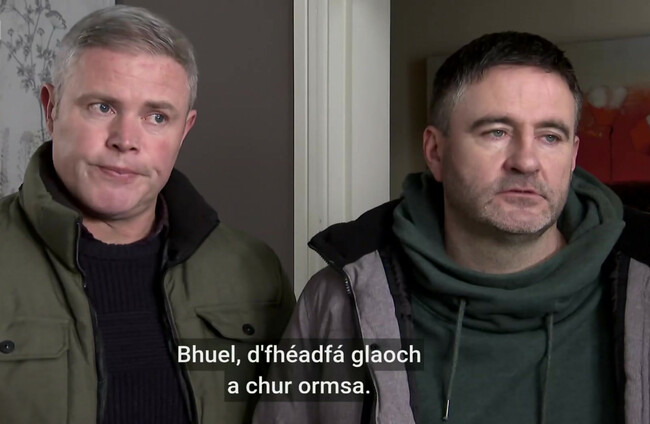
TG4 HAS HAD English subtitles on its drama series and other programmes for many years, but starting this week, viewers of Ros na Rún – the channel’s popular soap opera – now have the choice between Irish or English subtitles on its player, as well as options to watch with Irish subtitles on TV.
This is something a segment of the soap’s audience has been calling for almost from the the early days of TG4 (then Teilifís na Gaeilge) in 1996 but it is only this week that the option has been made available for the first time.
Ros na Rún is TG4′s equivalent of RTÉ’s Fair City, a serial drama which has been telling the stories of the Gaeltacht community on the outskirts of Galway for 30 years. Storylines have featured murders and affairs, gangland plots and a lot more besides.
TG4 director general Deirdre Ní Choistín told The Journal that there is now considerable evidence that subtitles do not interfere with viewers’ experience, and she noted that many people are already watching programmes on streaming services such as Netflix with subtitles.
Subtitles don’t bother people, regardless of the language, and Netflix is now providing versions in every language for quite a few series, including House of Guinness and How to Get to Heaven from Belfast.
She said the Irish language subtitles would help with accessibility for people and would also be of benefit to learners. She also referred to an experience closer to home – TG4 having established an online platform, Molscéal, that distributes stories from Gaeltacht communities and Irish-speaking groups across the country.
“When we set up Molscéal, we made the decision that the subtitles on it would be in Irish only, as that supports the language being visible on social media.
“We found out afterwards that many learners were using Molscéal because they were able to listen, watch and read at the same time, and that this helped with language acquisition.”
This development comes some months after TG4 began making episodes of Ros na Rún available on the broadcaster’s player ahead of their broadcast on the television channel.
Ros na Rún can be watched on the player every Monday before the Tuesday evening episode on TG4, and the second episode of the week is available on the player on Wednesday, before it becomes available on television on Thursday.
From this week, a choice of Irish or English subtitles will be available on the streamed episodes on Monday and Wednesday. While English subtitles will continue on the episodes broadcast on Tuesday and Thursday at 8.30pm, Irish subtitles will be available on the repeat broadcasts later that night at 11.30pm on TG4 on those same evenings. Irish subtitles will also be available on the omnibus edition broadcast every Sunday on TG4.
In a statement issued by the station, it was said that this policy is part of TG4′s ongoing strategy to “provide platform-neutral content and ensure that viewers can access the programmes they love on demand, whenever they choose, wherever they choose.”
“Ros na Rún has a loyal and regular audience on the TG4 Player, and as the ways in which people watch content continue to change, TG4 is committed to serving the needs of that section of the audience who choose to watch content at a time that suits them – whether that is online, on their phone or on a smart television.”
Ní Choistín also said there is a cost to this work, which is being carried out by a company that holds a contract to provide the subtitles.
The move has been welcomed by the Irish language advocacy organisation, Conradh na Gaeilge, who described it as an illustration of the increasing audience for Irish language TV. In a statement, a spokesperson said that it was something the organisation had been seeking for some time. “It will add to the audience for TG4 programmes,” the spokesperson said.
“It will make TG4 programmes available to a wider audience as well”
The Journal’s Gaeltacht initiative is supported by the Local Democracy Reporting Scheme.
This article was originally written in the reporter’s native Irish and has been translated to English here. AI was used as part of the translation process before final edits.

To embed this post, copy the code below on your site















have your say