Sign in. It’s quick, free and it’s up to you.
An account is an optional way to support the work we do. Find out more.
Sign in. It’s quick, free and it’s up to you.
An account is an optional way to support the work we do. Find out more.
LAST UPDATE | 11 Jan 2024
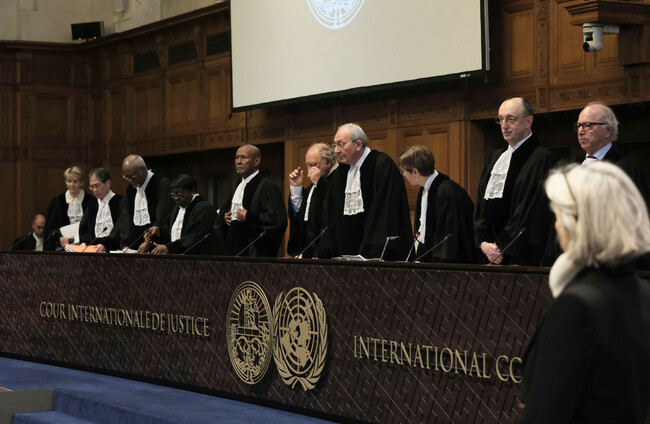
ISRAEL IS TODAY facing accusations at the UN’s top court that it has committed “genocidal” acts in Gaza, charges the country’s president dismissed as “atrocious” and “preposterous”.
South Africa has lodged an urgent appeal to the International Court of Justice (ICJ) to force Israel to “immediately suspend” its military operations in Gaza.
The hearing is taking place current at the Great Hall of Justice in the Peace Palace in The Hague, a world away from the devastation seen in Israel and Gaza since the 7 October Hamas attacks.
South Africa argues that Israel is breaking its commitments under the UN Genocide Convention, a treaty signed in 1948 as the world cried “never again” after the Holocaust.
You can catch up on the latest from this morning’s proceedings below.
Updates from Hayley Halpin, includes reporting by © AFP 2024
In its 84-page submission to the court, Pretoria charged that Israel’s bombing and invasion of Gaza is “intended to bring about the destruction of a substantial part of the Palestinian national, racial and ethnical group”.
Israeli President Isaac Herzog has already hit out at the accusations and laid out his country’s likely defence.
“There’s nothing more atrocious and preposterous than this claim,” said Herzog.
“We will be in the International Court of Justice and we will present proudly our case of using self defence… under international humanitarian law,” he said.
He said the Israeli army was “doing its utmost under extremely complicated circumstances on the ground to make sure that there will be no unintended consequences and no civilian casualties”.
As part of its application to the ICJ, South Africa has requested that the court apply what are called “provisional measures”, i.e. court orders directed at Israel (and other signatories) ahead of the actual trial.
“This is kind of like a preliminary injunction, or what we might call temporary or interim relief, that’s meant to be in place while the case is pending,” explains Michael Becker, a professor of International Human Rights Law at Trinity College.
“So the idea here is that you ask the ICJ to direct the other states to take certain actions or to refrain from engaging in certain conduct in order to protect the rights that are being adjudicated upon in the overall case.”
In detailing its proposed provisional measures, South Africa’s application said:
“The Court should order Israel to cease killing and causing serious mental and bodily harm to Palestinian people in Gaza,” and “cease the deliberate infliction of conditions of life calculated to bring about their physical destruction as a group”.
Additionally, it asked the Court to order Israel “to prevent and punish direct and public incitement to genocide, and to rescind related policies and practices, including regarding the restriction on aid and the issuing of evacuation directives.”
Speaking at The Hague this morning, Pretoria’s Justice Minister Ronald Lamola said: “No armed attack on a state territory no matter how serious … can provide any justification for or defense to breaches of the convention.”
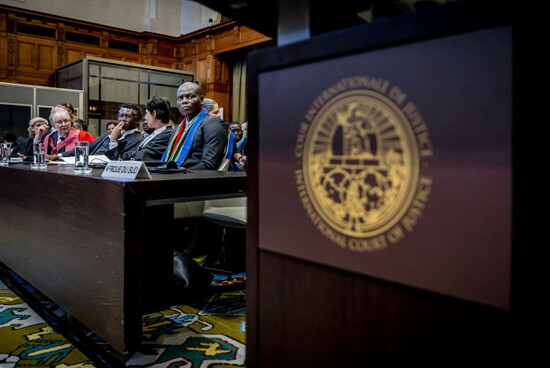
The Guardian is livestreaming the proceedings here, if you wish to watch live:
Counsel Adila Hassim is now speaking. She tells the court that “of all the people in the world currently suffering catastrophic hunger, more than 80% are in Gaza”.
“More than in 1,800 Palestinian families in Gaza have lost multiple family members and hundreds of multi-general generational families have been wiped out with no remaining survivors. Mothers, fathers, children, siblings, grandparents, aunts, cousins, often all killed together,” she said.
“This killing is nothing short of destruction of Palestinian life.”
“Those wounded by Israel in Gaza are being deprived of life saving medical care,” Hassim says.
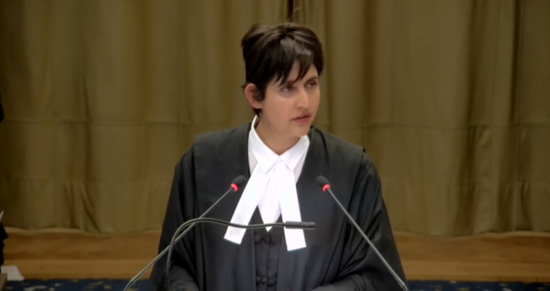
“Genocides are never declared in advance, but this court has the benefit of the 13 weeks of evidence that shows … a pattern of conduct and related intention that justifies a plausible claim of genocidal acts,” Hassim tells the court.
Israeli Prime Minister Benjamin Netanyahu has posted on X, formerly Twitter, and said “Israel has no intention of permanently occupying Gaza or displacing its civilian population”.
“Israel is fighting Hamas terrorists, not the Palestinian population, and we are doing so in full compliance with international law,” he said.
Netanyahu said the IDF is “doing its utmost to minimise civilian casualities, while Hamas is doing its utmost to maximise them by using Palestinian civilians as human shields”.
“Our goal is to rid Gaza of Hamas terrorists and free our hostages. Once this is achieved Gaza can be demilitarised and deradicalised, thereby creating a possibility for a better future for Israel and Palestinians alike.”
"I want to make a few points absolutely clear:
— Prime Minister of Israel (@IsraeliPM) January 10, 2024
Israel has no intention of permanently occupying Gaza or displacing its civilian population.
Israel is fighting Hamas terrorists, not the Palestinian population, and we are doing so in full compliance with international law. pic.twitter.com/amxFaMnS0P
Israel’s military operations in Gaza have pushed the people there to the “brink of famine”, Hassim has told told the UN’s top court.
“The situation is such that the experts are now predicting that more people in Gaza may die from starvation and disease,” than direct military action, she has said.
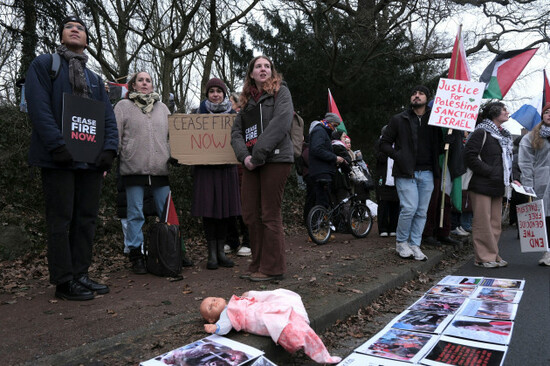
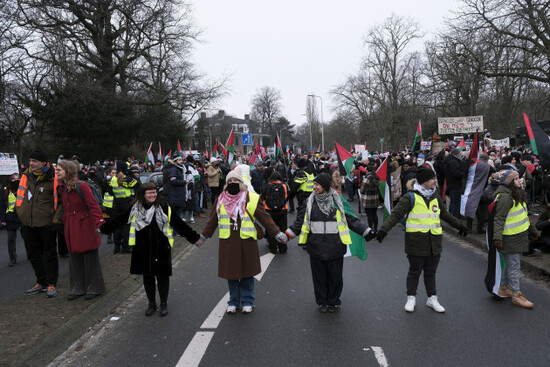
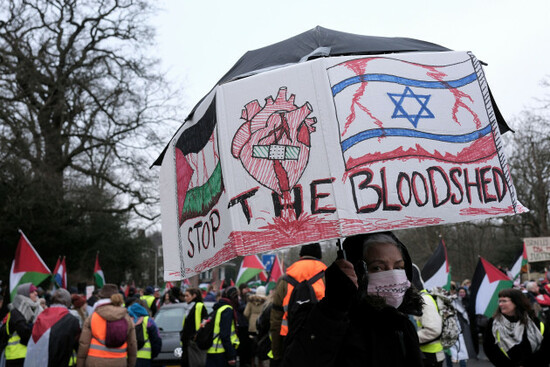
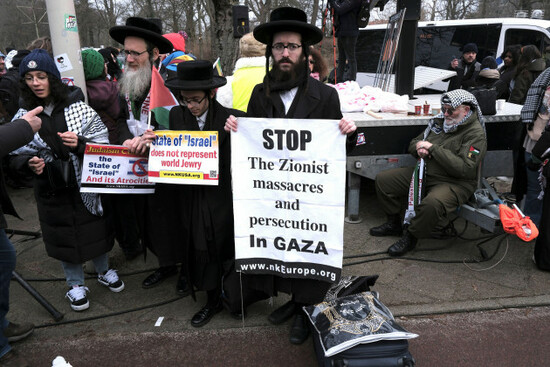
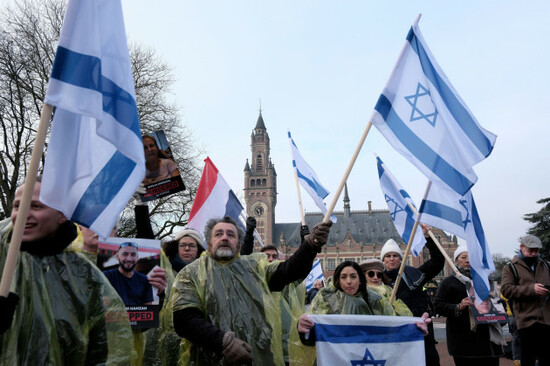
As the hearing takes place in the court this morning, people are protesting outside The Hague.
Dagmar Bosma told the Washington Post that she came to the court to “show solidarity with the South African effort”.
“It is a historical moment. It takes an oppressed people to recognised what is happening, I think, so we are very thankful to South Africa.”
Judith De Jonge, among the pro-Israeli protesters, told the Post that she thinks “it is a shame that South Africa started this case”.
What has the Irish government said about today’s proceedings?
Speaking yesterday, Transport Minister Eamon Ryan said there are “irrefutable” points in the genocide case South Africa has taken against Israel.
Ryan said that Irish people have stood up for the rights of Palestinians over the years.
“Now, more than ever, we stand up for their rights – for self determination but also for an immediate end to the actions the Israeli government and military are taking which are putting those Palestinian people in Gaza at risk of immediate starvation,” he said.
Speaking of South Africa’s ICJ case, Ryan said: “The court case is one of standing effectively first between South Africa and Israel, and there are only two parties to that. But in terms of where we stand, in my mind, it has to be for the basic human rights of the Palestinian people which are being wholesale infringed, in my mind, at the present time.”
Ryan added that the world will “sit in real harsh judgement” if Israel’s government does not desis its campaign.
He clarified that this “does not in anyway undermine the rights of Israelis to safety”.
His comments came after Taoiseach Leo Varadkar said there is no intention within Government for Ireland to join South Africa in its case, and further warned that there is a need to be “careful” about categorising Israel’s actions as a “genocide”.
Speaking on RTÉ Radio One over the weekend, Varadkar said he would feel “uncomfortable” accusing Israel of genocide, given the fact that “six million Jews, over half the population of Jews in Europe, were killed”.
South African lawyer Tembeka Ngcukaitobi is now addressing the court.
He tells the court that “there is now a trend among [Israeli] soldiers to film themselves committing atrocities against civilians in Gaza”.
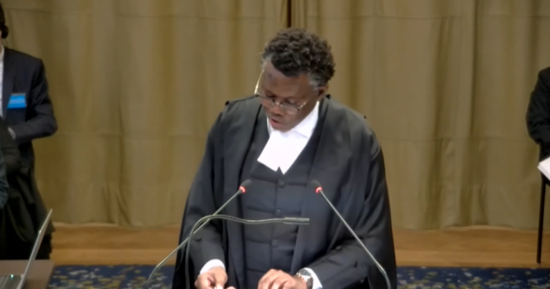
“The intentional failure of the Government of Israel to condemn, prevent and punish such genocidal incitement constitutes in itself a grave violation of the Genocide Convention,” Ngcukaitobi tells the court.
South African professor John Duggard tells the court that South Africa “has a long history of close relations with Israel” and that it did not bring the dispute immediately to the attention of the court.
Instead, he said the country “watched in horror” at the “terrible atrocities committed” on 7 October and the attacks on Gaza that resulted in the “killing of innocent Palestinian civilians”.
He said the South African government “repeatedly voiced their concerns” to the UN Security Council and in public statements that “Israel’s actions have become genocidal”.
Duggard tells the court that “State parties to this convention are obliged not only to desist from genocidal acts but also to prevent them”.
The court has taken a short break in the proceedings.
If you wish to read more on the background of the case, David MacRedmond yesterday wrote an explainer for The Journal which you can find here.
Away from The Hague, US Secretary of State Antony Blinken has arrived in Cairo for the final leg of a regional tour aimed at averting the spread of the Israel-Hamas conflict.
Blinken flew in from Israel for talks with Egyptian President Abdel Fattah al-Sisi.
The Secretary of State has dismissed the ICJ case as “meritless”.

Pictured are protesters outside The Hague this morning.
South African professor Max Du Plessis is now addressing the court.
“What is happening in Gaza now is not correctly framed as a simple conflict between two parties. It entails instead, destructive acts perpetrated by an occupying power, Israel, that is subjected the Palestinian people, to an oppressive and prolonged violation of their rights to self determination for more than half a century,” Du Plessis says.
“And those violations occur in a world where Israel for years has regarded itself as beyond and above the law.”
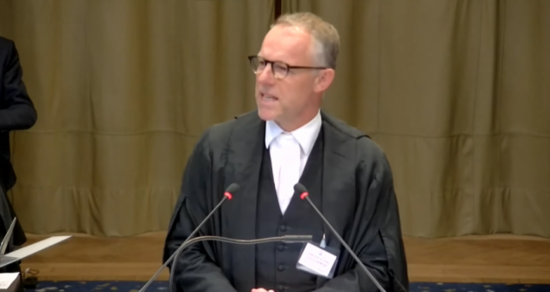
Du Plessis tells the court that “Palestinians in Gaza, as a very substantial and important part of the Palestinian national, racial and ethnic group, simply but profoundl,y are entitled to exist”.
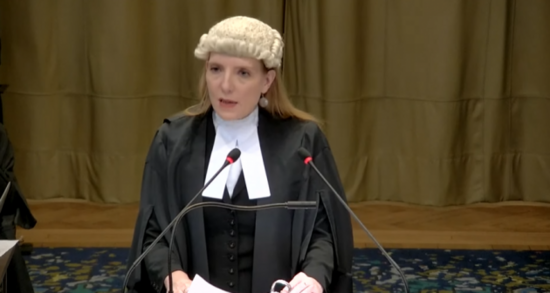
Irish lawyer Blinne Ní Ghrálaigh is advising South Africa on its case against Israel. She is addressing the court today.
“There is an urgent need for provisional measures to protect Palestinians in Gaza against the irreparable prejudice caused by Israel’s violations of the Genocide Convention,” she says.
“It is becoming everclearer that huge swathes of Gaza are “being wiped from the map,” she tells the court.
“Experts warn that death from starvation and disease risk significantly outstripping deaths from bombings.”
Here’s a clip of South Africa’s Justice Minister Ronald Lamola outlining his country’s genocide case against Israel at the ICJ:
South Africa’s justice minister Ronald Lamola outlined the country’s genocide case against Israel, as a landmark hearing opened at the International Court of Justice ⤵️ pic.twitter.com/AvlM8BwhQI
— Al Jazeera English (@AJEnglish) January 11, 2024
“The UN secretary general and its officials describe the situation in Gaza as ‘a crisis of humanity’, ‘a living hell’, ‘a bloodbath’, ‘a situation of utter deepening and unmatched horror where an entire population is besieged and under attack, denied access to the essentials for survival on a massive scale’,” Ní Ghrálaigh says.
“As an undersecretary general for humanitarian affairs stated last Friday, ‘Gaza has become a place of death and despair’,” she says.
“The world should be absolutely horrified. The world should be absolutely outraged. There is no safe space in Gaza and the world should be ashamed,” Ní Ghrálaigh tells the court.
Sinn Féin’s spokesperson on Foreign Affairs Matt Carthy has called on the Irish government to join South Africa in its ICJ proceedings.
“This hearing is a historic event that should be a watershed moment in holding Israel to account for its war crimes against the people of Palestine,” Carthy said.
“I welcome that South Africa made the decision to take this case to the International Court of Justice under the Genocide Convention. As a signatory to the Convention the Irish government is also legally obliged to take action to prevent genocide and, in Sinn Féin’s view, they should reverse position,” he said.
“Ireland made a written submission to the ICJ in respect of the war in Ukraine. Sinn Féin supported that position,” Carthy said.
He said that this “smacks of the double-standards that have been evident since the war in Gaza began that governments, including Ireland, that supported the case taken against Russia now refuse to do so in the case of Israel”.
“The people of Ireland will be closely watching the hearing now underway at The Hague. They will rightly be demanding that the Irish government shows leadership on the international stage in standing up for the people of Palestine against these outrageous war crimes.”
That’s all from us on the liveblog for today.
Here’s a round-up of some of the main points you need to know:

To embed this post, copy the code below on your site















have your say