Sign in. It’s quick, free and it’s up to you.
An account is an optional way to support the work we do. Find out more.
Sign in. It’s quick, free and it’s up to you.
An account is an optional way to support the work we do. Find out more.
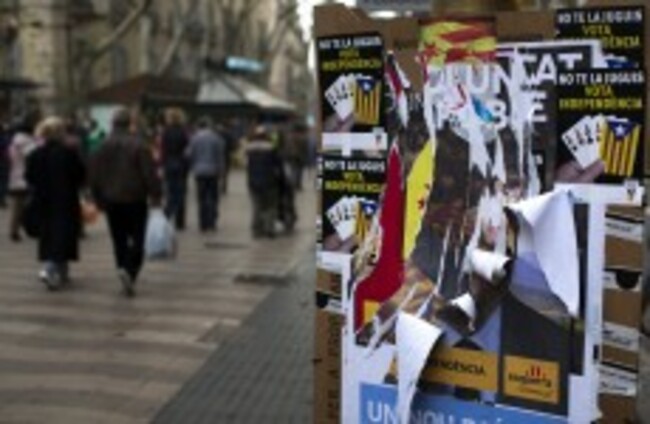
VOTERS IN SPAIN’S Catalonia region favoured the right to decide on possible independence but split their ballots between fractious parties, making the prospect of secession less likely than ever.
Artur Mas, leader of the northeastern region’s ruling center-right coalition, had sought an absolute majority in Sunday’s vote to get a mandate for an independence referendum that the central government says would be unconstitutional. But his Convergence and Union party lost seats while a fierce rival, the pro-independence Republican Left of Catalonia, made big gains.
Mas told reporters today he would not resign, was still committed to pushing for a referendum that he thinks will happen within four years and would try in the coming weeks to cobble together a coalition majority.
We detected a sociological change in Catalonia supporting sovereignty. The people have spoken and now the situation is clearer and more complicated.
Spain’s central government in Madrid predicted today that the result will mark the end of a secession vote drive that has distracted authorities who are trying to prevent Spain from being forced into a bailout.
Far apart
While the two Catalonian parties share the goal of holding the referendum, they are far apart on almost everything else and analysts said it would be very difficult for them to form an alliance.
In power for the past two years, Convergence and Union has introduced painful austerity cuts in Catalonia that have been vigorously opposed by Republican Left.
Catalonia, a region of 7.5 million people that includes Spain’s second-largest city of Barcelona, is one of the areas suffering the most in the country’s 4-year-old economic crisis, which has left unemployment at 25 percent.
Catalonia is responsible for around a fifth of Spain’s economic output and many residents complain that the central government in Madrid takes in more tax money from the region than it gives back. But now Catalonia is the most indebted region in Spain and has had to seek a €5.4 billion bailout from Madrid.
The central Spanish government, which fiercely opposes the idea of an independence referendum, was quick to praise the vote.
Foreign Minister Jose Manuel Garcia-Margallo called the outcome “a good result for Catalonia, Spain and Europe, though not for Convergence and Union.”
Deputy Prime Minister Soraya Saenz de Santamaria described the election as “a serious blow for Mas” but one that “put the priorities in order.” “Voters want governments focusing on the crisis and creating jobs,” she added.
Seats
In all, the ruling party in Catalonia lost 12 seats, going down to 50 in the 135-seat regional legislature, with the Republican Left coming in second with 21. Five other parties split the remainder, with most of those seats going to parties opposed to independence.
Republican Left leader Oriol Junqueras said voters had issued a “mandate to hold a referendum,” but he ruled out forming a coalition with Convergence and Union.
Junqueras said his party would continue to demand that Mas’ government change its austerity policies, calling for lower taxes for most and for banks and the rich to shoulder more costs. But he didn’t rule out working with Mas on specific issues.
Mas’ only other options for coalition partners are the center-right Popular Party or the center-left Socialist Party, but he would have to drop his push for a secession referendum because both vigorously oppose such a vote.
Catalonia has had a long history separatist sentiment, especially since its own language and cultural traditions were harshly repressed by Gen. Francisco Franco’s military dictatorship from the end of Spain’s Civil War in 1939 until his death in 1975.

To embed this post, copy the code below on your site
















have your say