Sign in. It’s quick, free and it’s up to you.
An account is an optional way to support the work we do. Find out more.
Sign in. It’s quick, free and it’s up to you.
An account is an optional way to support the work we do. Find out more.
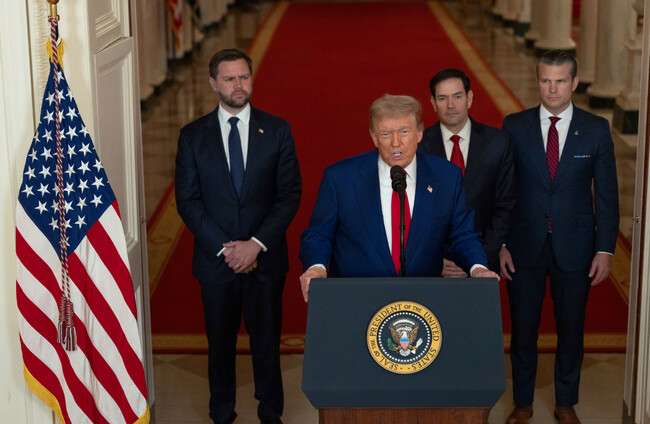
AS THE SMOKE clears from Sunday’s US strikes on Iranian nuclear sites, retrospective analysis of the timeline of events suggest Donald Trump knew he was never going to negotiate with Iran.
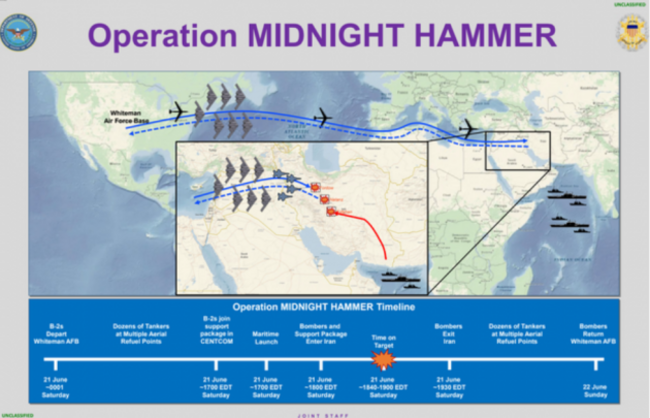
Called Operation Midnight Hammer, the carefully choreographed bombing of critical sites in Fordo, Natanz and Isfahan was carried out by a fleet of B-2 bombers using 14 “bunker buster” missiles and decoy planes in an effort to destroy what Israel maintains is a nefarious Iranian nuclear programme.
In the hours after the mission, Trump claimed it a ”a spectacular military success”.
Less than two days prior to “one of the most complex and historic military operations of all time”, in the words of White House press secretary Karoline Leavitt, Trump communicated that he would make a decision on whether to strike Iran “within the next two weeks”, leaving the door open for negotiations.
In 2018, during his first term, Trump pulled out of a deal brokered by Barack Obama along with Iran, the UK, France, Russia, China, and Germany in which Iran promised to cap uranium enrichment at 3.67% for 15 years, far below the weapons-grade level of 90%.
The New York Times analysed this statement with respect to the timeline of events leading up to US intervention in Iran, suggesting Washington engages in a deliberate exercise of political and military misdirection.
The US published its annual threat assessment, stating: “We continue to assess Iran is not building a nuclear weapon and that Khamenei has not reauthorised the nuclear weapons program he suspended in 2003.”
This was reaffirmed by US director of national intelligence Tulsi Gabbard who told a Senate Intelligence Committee hearing that month that nuclear weaponisation by Iran was not impending.
Trump said this week that Gabbard’s testimony before the committee was “false”, after which she has backtracked on her March statement, attacking “dishonest media” and claiming Iran could soon build a nuclear weapon “if they decide to”.
US and Iranian officials held “constructive” talks in Oman on the subject of limiting Iran’s uranium enrichment and moves towards developing nuclear weapons after Trump sent a letter to Iran’s Supreme Leader Khamenei.
In the letter, Trump gave Iran sixty days to show “substantial progress” on the issue.
To keep the ultimatum viable, Trump asked Israeli Prime Minister Benjamin Netanyahu not to strike before then to allow for negotiations to achieve a peaceful resolution.
Despite Trump’s negotiation window facilitating active talks on limiting Iranian nuclear capabilities, Netanyahu told a group of US lawmakers that he would undertake military action against Iran without seeking American approval, according to CNN.
Netanyahu has for over three decades in politics tried to enlist the help of the US in dismantling Iran’s nuclear programme, constantly warning of weaponisation in the very near future, but to no avail.
Less than a week out from the commencement of Israel’s strikes against Iran, Trump and his national security advisers huddled at Camp David where military plans were drawn up.
Sources told ABC News that among the items on the agenda in those discussions was Israel’s plan to proactively strike upon the passing of Trump’s 60-day deadline.
This claim has legitimacy, considering reports of daily contact between Trump and Netanyahu prior to Israel’s pre-emptive attack on Iran’s military sites and army officials.
The International Atomic Energy Agency (IAEA) released a statement commenting on Iran’s uranium enrichment efforts.
IAEA director general Rafael Mariano Grossi said: “Unless and until Iran assists the Agency in resolving the outstanding safeguards issues, the agency will not be in a position to provide assurance that Iran’s nuclear programme is exclusively peaceful.”
One day after the lapse of Trump’s 60-day window, Israel began airstrikes against Iran, triggering what have become daily missile exchanges between both sides.
The initial attacks killed top Iranian military figures, including Ali Shamkhani, a key nuclear negotiator and close aide to Iran’s leader Ayatollah Ali Khamenei
Three days after fighting began, Trump left the G7 Summit in Canada under the guise of working to resolve the conflict.
That same day, he shirked any appearance of confidentiality about his country’s military plans in Iran, posting to Truth Social: “Everyone should immediately evacuate Tehran!”
In the week leading up to the American strikes on Iran’s nuclear sites, Trump remained ambivalent about whether he would intervene in the conflict, telling reporters “I may do it. I may not do it. I mean, nobody knows what I’m going to do”.
He faced opposition to the move, even from the most ardent of the Maga movement, including the outspoken Republican congresswoman Marjorie Taylor-Greene and conservative TV host Tucker Carlson.
Trump authorised a fleet of US B-2 bombers to drop 14 bunker busters on Iranian nuclear sites in the early hours of the morning local time.
US defence secretary Pete Hegseth said “took months and weeks of positioning and preparation”, implying that the US was always fully intent on assisting Israel is dismantling Iran’s nuclear capabilities if called upon.
To embed this post, copy the code below on your site
















have your say