Sign in. It’s quick, free and it’s up to you.
An account is an optional way to support the work we do. Find out more.
Sign in. It’s quick, free and it’s up to you.
An account is an optional way to support the work we do. Find out more.
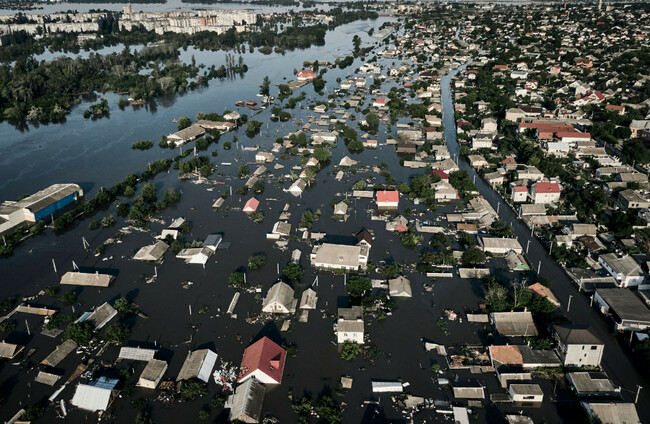
THE DESTRUCTION OF the Kakhovka Dam is swiftly evolving into a long-term environmental catastrophe affecting drinking water, food supplies and ecosystems reaching into the Black Sea, experts have warned.
The short-term dangers - tens of thousands of parcels of flooded land – can be seen from outer space, with greater damage potentially on the way.
Experts say the long-term consequences will be generational.
Thirty five people, including seven children, are missing in southern Ukraine since the flood, Ukrainian interior minister Igor Klymenko said.
While many homes and farms are flooded, there are also vast amounts of fields of newly planted grains, fruits and vegetables whose irrigation canals are drying up.
The Kakhovka Dam was the last in a system of six Soviet-era dams on the Dnieper river, which flows from Belarus to the Black Sea.
The river became part of the front line in Ukraine after Russia’s invasion last year.
“All this territory formed its own particular ecosystem, with the reservoir included,” said Kateryna Filiuta, an expert in protected habitats for the Ukraine Nature Conservation Group.
The six dams along the Dnieper were designed to operate in tandem, adjusting to each other as water levels rose and fell from one season to the next.
When Russian forces seized the Kakhovka Dam, the whole system fell into neglect.
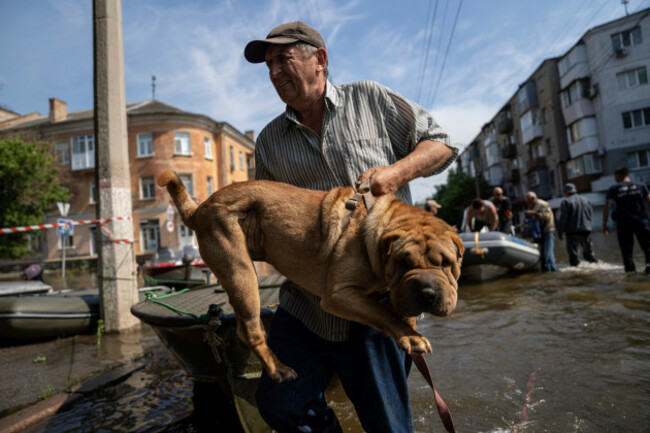
“The water is leaving before our eyes,” a local man told The Associated Press.
“Everything that was in my house, what we worked for all our lives, it’s all gone. First it drowned, then, when the water left, it rotted.”
Ukrainian deputy foreign minister Andrij Melnyk called the destruction of the dam “the worst environmental catastrophe in Europe since the Chernobyl disaster”.
Since the dam’s collapse on Tuesday, the rushing waters have uprooted landmines, torn through caches of weapons and ammunition, and carried 150 tons of machine oil to the Black Sea.
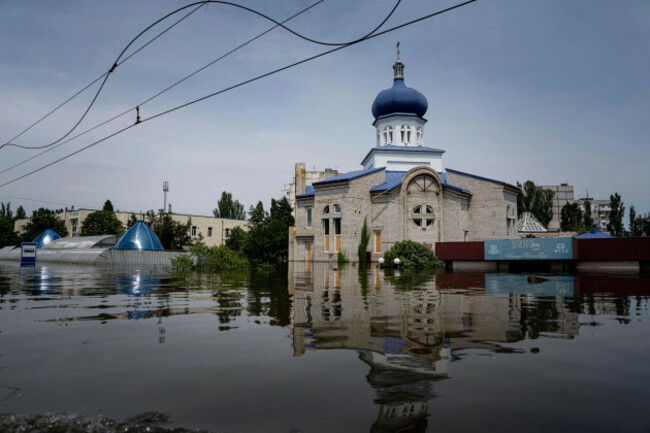
Entire towns were submerged to the rooflines, and thousands of animals died in a large national park now under Russian occupation.
Ukraine’s Agriculture Ministry estimated (24,000 acres) of farmland were underwater in the territory of Kherson province controlled by Ukraine, and “many times more than that” in territory occupied by Russia.
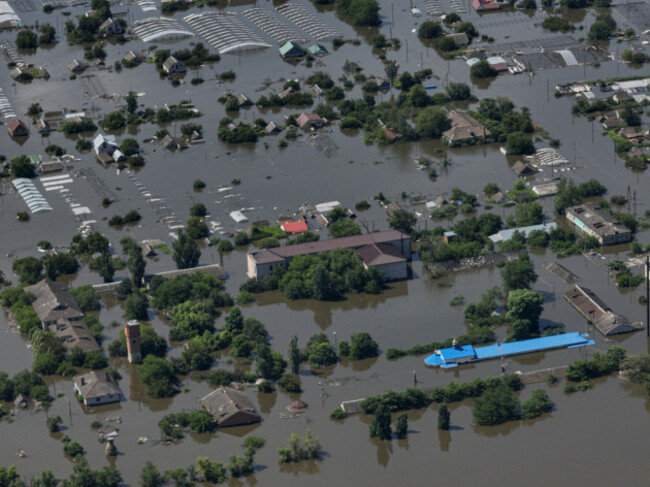
Dmytro Neveselyi, mayor of the village of Maryinske, said everyone in the community of 18,000 people will be affected by the disappearing reservoir within days.
“Today and tomorrow, we’ll be able to provide the population with drinking water,” he said, but is unsure about what will happen after that.
“The canal that supplied our water reservoir has also stopped flowing.”
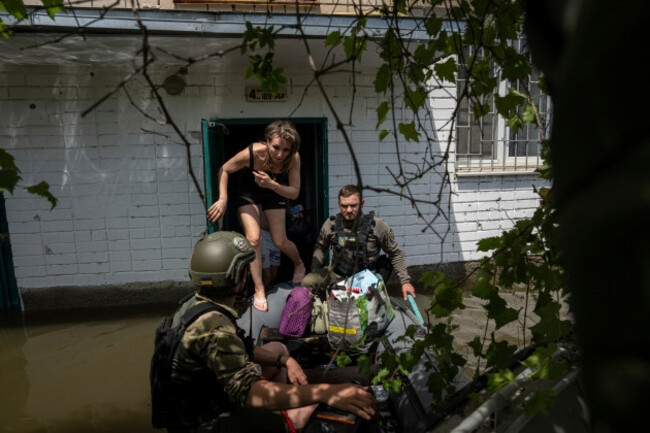
The waters slowly began to recede on Friday, only to reveal the environmental catastrophe looming.
The reservoir, which had a capacity of 18 cubic kilometres, was the last stop along hundreds of kilometres of river that passed through Ukraine’s industrial and agricultural heartlands.
For decades, its flow carried the run-off of chemicals and pesticides that settled in the mud at the bottom.
Ukrainian authorities are testing the level of toxins in the muck, which risks turning into poisonous dust with the arrival of summer, said Eugene Simonov, an environmental scientist with the Ukraine War Environmental Consequences Working Group, a non-profit organisation of activists and researchers.
It will take a decade for the flora and fauna populations to return and adjust to their new reality, according to Filiuta.
In Maryinske, the farming community, they are combing archives for records of old wells, which they will unearth, clean and analyse to see if the water is still potable.
“Because a territory without water will become a desert,” the mayor warned.

To embed this post, copy the code below on your site














have your say