Sign in. It’s quick, free and it’s up to you.
An account is an optional way to support the work we do. Find out more.
Sign in. It’s quick, free and it’s up to you.
An account is an optional way to support the work we do. Find out more.
LAST UPDATE | 29 Mar
IRAN’S PARLIAMENT SPEAKER has said the US is plotting a ground attack despite publicly engaging in diplomatic efforts aimed at ending the war.
“The enemy publicly sends messages of negotiation and dialogue while secretly planning a ground attack,” Mohammad Bagher Ghalibaf said in a statement carried by Iranian state news agency IRNA.
“Our men are waiting for the arrival of the American soldiers on the ground to set them on fire and punish their regional allies once and for all,” he added.
It comes after thousands of US marines and sailors arrived in the Middle East on an assault ship yesterday, as the Washington Post reports that the US Department of Defence is “preparing for weeks of ground operations” in Iran.
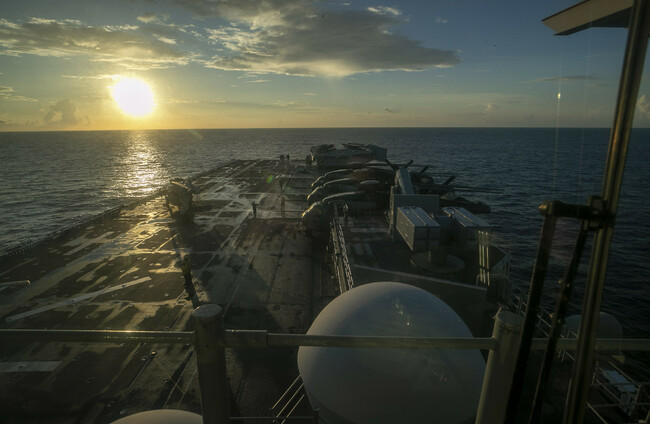
US Central Command confirmed that the Japan-based amphibious assault ship USS Tripoli arrived in the “area of responsibility” yesterday.
U.S. Sailors and Marines aboard USS Tripoli (LHA 7) arrived in the U.S. Central Command area of responsibility, March 27. The America-class amphibious assault ship serves as the flagship for the Tripoli Amphibious Ready Group / 31st Marine Expeditionary Unit composed of about… pic.twitter.com/JFWiPBbkd2
— U.S. Central Command (@CENTCOM) March 28, 2026
There are around 3,500 sailors and marines on board, as well as transport and strike fighter aircraft, as well as amphibious assault and tactical assets.
In images shared on social media by CENTCOM, several Seahawk helicopters could be seen on the ship’s deck, as well as some Osprey aircraft, typically used for personnel transport. Another picture shows an F-35 fighter jet.
Citing US officials who spoke on condition of anonymity, the Washington Post is reporting that any potential ground operation “would fall short of a full-scale invasion” but could involve raids by a mixture of Special Operations forces and conventional infantry troops.
“We’ve looked at this. It’s been war-gamed. This is not last-minute planning,” one official is quoted in the newspaper as saying.
It remains unclear whether US president Donald Trump would approve a ground operation.
Earlier this month, he told NBC News it would be “a waste of time” to send ground troops into Iran because “they’ve lost everything they can lose”.
Meanwhile, US secretary of state Marco Rubio insisted on Friday that the US “can achieve all of our objectives without ground troops”.
"This is not going to be a prolonged conflict."
— Sky News (@SkyNews) March 27, 2026
U.S. Secretary of State Marco Rubio says the U.S. is very confident of achieving its objectives in Iran without ground troops, after saying the war will end in weeks.https://t.co/HdkobKcYlp
📺 Sky 501, Virgin 602, Freeview 233 pic.twitter.com/CK8rhHQhIv
Speculation has grown that the US is planning to invade Iran’s Kharg Island, which processes 90% of the country’s oil exports. According to military strategy experts, any attack would risk not only exacerbating the global energy crisis, but could also result in heavy American casualties.
US vice president JD Vance, who has been notably silent since the war began on 28 February, said in an interview with podcaster Benny Johnson published yesterday that the US has “accomplished all its military objectives” in Iran, but the war must carry on “a little while longer”.
Iran’s navy chief has said that the USS Abraham Lincoln aircraft carrier, which is operating in the Arabian Sea, would be targeted if it comes within range.
“As soon as the USS Abraham Lincoln carrier strike group comes within firing range, we will avenge the blood of the martyrs of the Dena warship by launching various types of sea-to-sea missiles,” Shahram Irani was quoted as saying by state TV, referring to an Iranian frigate sunk by the US on 4 March.
It comes as strikes continue in the Middle East unabated.
In Iran’s capital Tehran, two blasts shook northern areas of the city early this morning, although it was not clear what was targeted.
Iran for its part fired a volley of missiles and drones at plants belonging to two of the world’s largest aluminium producers in Bahrain and the United Arab Emirates, the country’s Revolutionary Guards said, targeting what they described as industries linked to the US military.
Emirates Global Aluminium (EGA) said an Iranian attack wounded six and caused significant damage to its plant, while Bahraini state media said two Aluminium Bahrain (ALBA) employees were injured in a second Iranian attack, without providing more details.
As the spectre of a widening conflict grew, Yemen’s Houthis yesterday claimed their first attack of the war, before the rebels said they fired “a barrage of cruise missiles and drones” at strategic sites in Israel.
The attacks raised concern about the war spreading to the Red Sea, with Saudi Arabia rerouting much of its oil exports there to avoid the Strait of Hormuz, which Iran says it has closed to shipping from hostile powers.
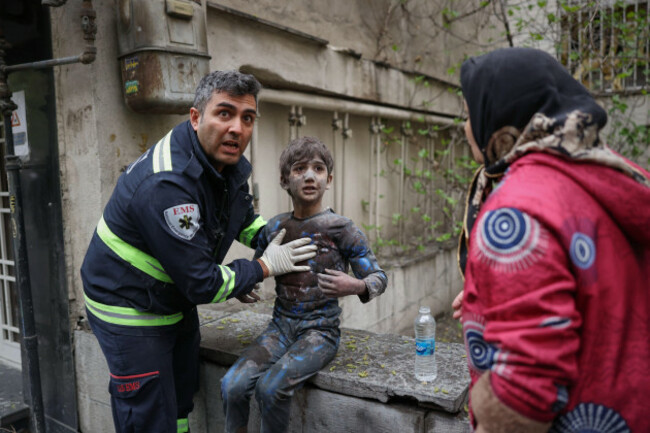
Qatari news channel Al Araby said an Israeli missile had hit and damaged the building housing its office in Tehran.
Footage from inside the office showed broken windows, shattered glass and debris. Outside the building, images showed the streets covered in debris along with damage to surrounding buildings.
Iran’s Revolutionary Guards have threatened to target US universities in the Middle East, while saying US-Israeli strikes had destroyed two Iranian universities.
The IRG demanded a US condemnation of the bombing of universities by noon (9.30am Irish time) Monday.
The American University of Beirut said it would operate remotely over the next two days following the threat.
“At this time, we have no evidence of direct threats against our university, its campuses or medical centers,” AUB president Fadlo Khouri said in a statement.
“At the same time, out of an abundance of caution, we will operate fully online on Monday and Tuesday, with the exception of essential personnel.”
The Tehran blasts came a day after the Israeli military said it struck the headquarters of Iran’s Marine Industries Organisation in the capital, saying the facility developed “a wide range of naval weaponry”.
An Israeli military spokesman said attacks on Iranian military industry had intensified and “within a few days, we will complete attacks on all critical components.”
“I miss a peaceful night’s sleep,” an artist in Tehran told AFP, saying the previous night’s strikes were “so intense it felt like all of Tehran was shaking”.
On the other side, Israel said a new wave of missiles was fired from Iran at its territory this morning, as Gulf nations Kuwait and the UAE reported fresh missile and drone attacks.
Pakistan, acting as a go-between for Washington and Tehran, will host foreign ministers from Saudi Arabia, Turkey and Egypt in Islamabad tomorrow for talks on the crisis.
Iran’s president Masoud Pezeshkian thanked Islamabad “for its mediation efforts to stop the aggression”, while Germany’s Foreign Minister Johann Wadephul said Friday he expected a direct US-Iran meeting in Pakistan “very soon.”
Trump’s special envoy Steve Witkoff said such a meeting could take place soon, and promoted a 15-point plan that Washington says “could solve it all”. This plan, however, has already been rejected by Iran.
Separately, Israeli attacks have continued in Lebanon, which was drawn into the conflict when Hezbollah fired rockets at Israeli territory on 2 March.
On Sunday afternoon, Israeli prime minister Benjamin Netanyahu announced Israel would be expanding operations in Lebanon.
On Saturday, the Israeli military killed three journalists in Jezzine, including Al Manar correspondent Ali Shoeib, one of the network’s most prominent war correspondents, who had covered Israeli attacks on Lebanon for decades.
Fatima Ftouni of Al Mayadeen, and her brother Mohammed, a cameraman, were also killed. Their funeral took place today.
Lebanese authorities, including president Joseph Aoun and prime minister Nawaf Salam, condemned the killings as war crimes.
Iran’s foreign minister Abbas Araghchi has also condemned the killings, saying they amounted to “targeted assassination” and “flagrant violation of international law”.
Israel also killed nine paramedics during raids in southern Lebanon, according to the health ministry.
With reporting from © AFP 2026

To embed this post, copy the code below on your site














have your say