Sign in. It’s quick, free and it’s up to you.
An account is an optional way to support the work we do. Find out more.
Sign in. It’s quick, free and it’s up to you.
An account is an optional way to support the work we do. Find out more.
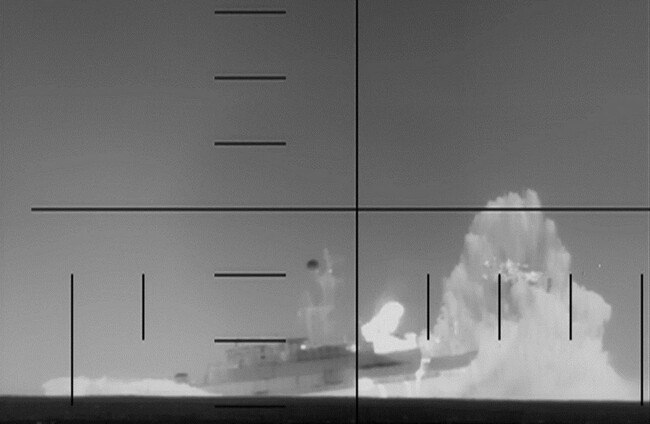
THE FORMER HEAD of the Irish Defence Forces has said that the US-Israeli war against Iran “appears unlawful” and because of that so was the sinking of the country’s warship, the IRIS Dena, off Sri Lanka.
Questions have been raised in recent days over whether the Iranian ship, which was sunk over 2,000 miles from its shores, was a legitimate target. Similar questions have been raised over the whether the US and Israeli strikes across Iran are in breach of international law.
Around 180 people were believed to be on the warship, with Sri Lankan authorities rescuing 32 sailors. US Secretary of Defense Pete Hegseth, commenting on the attack, said those killed had died a “quiet death” after their vessel was targeted by a torpedo.
Mark Mellett was the Irish Government’s lead advisor on military matters and retired as a Vice Admiral and Chief of Staff of the Irish military in 2021. He had served as head of the Irish Navy before that.
Speaking to The Journal he said it was clear that the American and Israeli governments are in breach of International law and that their actions in Iran are unlawful.
Regarding the sinking of the Dena, he said:
“You can’t look at it in isolation without going to the bigger piece. Is this a lawful war or not? Fundamentally it appears that it is not. The war is not lawful under the UN Charter. So that’s clear black and white. There’s no ifs or buts about it.”
Mellett explained that the attack on Iran appears to be unlawful because Article 2(4) of the UN Charter prohibits the use of force against another state except in two circumstances.
According to the charter, which is the founding treaty of the UN, countries are permitted to act in self-defence after an armed attack. Military action on another country is also permitted when it is authorised by the UN Security Council.
Mellett said: “Neither of these two conditions are satisfied. Accordingly, as a follow on, the sinking of the IRIS Dena would also seem to be unlawful.”
The former admiral believes that the only way to bring the US and Israel to book will be for the UN General Assembly to begin protesting the war.
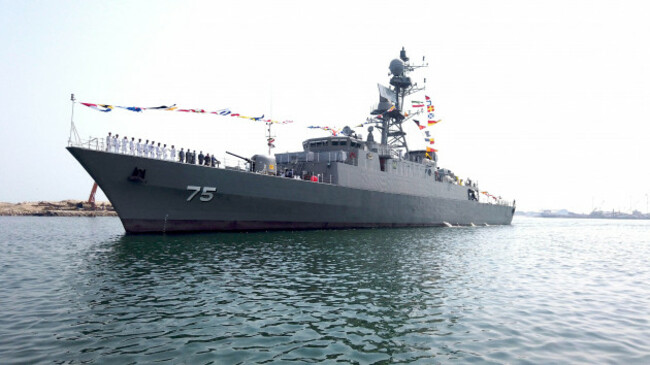
The Iranian naval vessel was returning to Iran from a Naval event in India when it was destroyed by a torpedo launched by an American submarine some 40 nautical miles from the Sri Lankan coast – a neutral island nation off the south-east tip of Indian sub-continent. The frigate had issued a distress call at dawn.
Former Irish Naval Service officer Tony Geraghty said that the explosion would have devastated the vessel in a split second when it detonated at depth under the ship.
A military source with knowledge of naval warfare said that the vessel was likely struck at the rear because the torpedo was homing in on the noise of the propellers – effectively targeting the ship acoustically.
The issue of the legality of the strike is a complex one and is further complicated by the fact the US has not ratified international agreements such as the United Nations Convention of the Law of the Sea.
Much of the international guidance for conducting warfare on the oceans is contained in a 1994 agreement called the San Remo Manual on International Law Applicable to Armed Conflicts at Sea.
Dr Brendan Flynn, who lectures at the school of Political Science and Sociology in NUI Galway, said that the clear interpretation from the San Remo Manual allows the US to mount such an attack.
“My take on that is that when there is a state of war, either declared or in fact, and that war has moved to the sea, it isn’t illegal for a submarine submerged, to attack a warship without warning,” he said.
Flynn referred to the legal principles developed after the sinking of the Belgrano, an Argentinean warship, which was torpedoed by a British submarine in 1982 as a Royal Navy fleet sailed to retake the Falklands Islands after Argentina invaded.
The British had declared an exclusion zone in the South Atlantic to protect their fleet. The Belgrano had zig-zagged in and out of that zone in the hours before she was struck. She was sunk by a submarine outside of the exclusion zone.
Flynn said that the British had stuck to their argument that under the strict rules of war they were entitled under the general customary rules of law “for one warship to have a go at another warship”.

Professor Alessio Patalano of Kings College, London is an internationally recognised expert in naval warfare and strategy.
He said that the justification for the sinking of the Dena was likely that it was returning to Iran and the Straits of Hormuz and could have been used to strike merchant shipping in that area.
He said that a letter from Donald Trump to US Senate President Charles Grassley explained the legal rationale underpinning the action. In that letter there was mention of ensuring the Strait of Hormuz stayed open. This would give some justification for targeting Iranian naval vessels, Patalano said.
See below the document defining the legal foundations upon which the operations have been designed and conducted.
— Alessio Patalano (@alessionaval) March 4, 2026
The key point is indicated in the ambition to ensure the free flow of goods and traffic through Hormuz -which in turn suggests as a conop an active pursuit of targets pic.twitter.com/WeWchsiEgQ
The difficulty for the US, according to Patalano, is that the Dena was some 2,000 nautical miles from the Strait of Hormuz at the time she was struck.
Use of force in law is determined by the proportional nature of the violence used and whether the force is necessary. Patalano said this attack “stretches the boundaries” of those principles. There are also principles associated with self-defence, as in the case of the Belgrano, in which a pre-emptive strike is permitted.
Patalano said self-defence could be the justification if the ship was located closer to the Strait of Hormuz but given its distance from the area, then it is difficult to place the Dena within “that threat picture”.
“This is literally implementing an operational design that is about eliminating the Iranian fleet. The ship was one of many targets pursued similarly regardless of position,” he added.
The naval strategy expert referenced Operation Praying Mantis in 1988 when the US had also targeted Iranian naval targets. He said that on that occasion they gave warnings before launching attacks.
A second Iranian naval ship has sought shelter in Sri Lanka in the wake of the sinking of the Dena. Meanwhile, the US has continued its attacks aimed at the destruction of the Iranian navy, which it said has included killing all of its senior leadership.
Speaking earlier this week, Hegseth insisted the US would “fight to win” in its attacks on Iran. He said there would be “no stupid rules of engagement”.

To embed this post, copy the code below on your site












have your say