Welcome to our Public Beta Site - What does this mean?
Dublin: 11 °C Friday 25 May, 2012

What are the two referendums about? Your guide to the 27 October ballot

Image: Niall Carson/PA Archive/Press Association Images

THE PRESIDENTIAL ELECTION isn’t the only national vote being taken on 27 October: voters around the country will also be asked for their decision on two referendums proposing changes to the Constitution of Ireland.

One regards judges’ pay, while the other concerns giving the two Houses of the Oireachtas the power to carry out inquiries.

Here’s TheJournal.ie’s guide to those referendums:

1. Judges’ pay

The pay of a sitting judge is constitutionally protected in that it cannot be cut. This protection is carried in Article 35.5, which reads:

The renumeration of a judge shall not be reduced during his continuance in office.

Judges currently pay tax and the Universal Social Charge as per other employees, but are not obliged to make any Public Service Pension Levy payments. They can, however, voluntarily make an equivalent contribution.

The referendum proposes introducing an amendment to Article 35 as follows:

5.1 The remuneration of judges shall not be reduced during their continuance in office save in accordance with this section.5.2 The remuneration of judges is subject to the imposition of taxes, levies or other charges that are imposed by law on persons generally or persons belonging to a particular class.

5.3 Where, before or after the enactment of this section, reductions have been or are made by law to the remuneration of persons belonging to classes of persons whose remuneration is paid out of public money and such law states that those reductions are in the public interest, provision may also be made by law to make proportionate reductions to the remuneration of judges.

If passed, this amendment means that a law can be passed under which judges’ pay in certain circumstances, meaning it could be reduced in proportion to cuts already made to public service workers’ pay, if that reduction is stated to be “in the public interest”.

It also means that legislation can be passed which means that judges will be obliged to make Public Service Pension levy payments and any other future similar charges.

However, chairman of the Referendum Commission retired judge Dr Bryan McMahon pointed out to RTÉ’s Morning Ireland earlier this week that the word “class” under 5.2 above is an undefined term and it is not clear what group of people it refers to.

He also said that the word “proportionate” in 5.3 may require Supreme Court clarification and that “proportionate” did not necessary mean the same as ‘equal’.

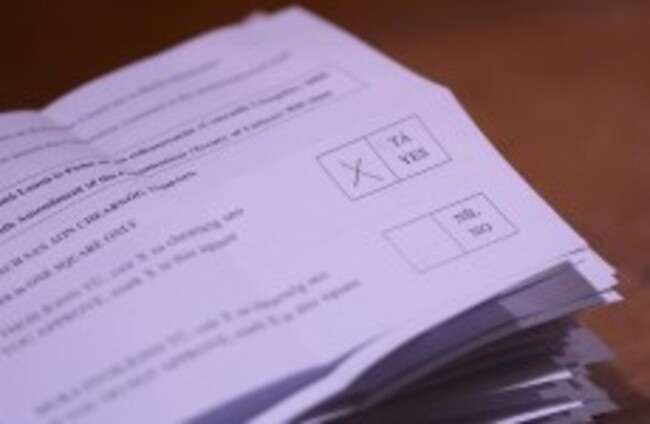
The referendum will appear on the ballot as follows:

The Twenty-Ninth Amendment of the Constitution (Judges’ Remuneration) Bill 2011 proposes to delete section 5 of Article 35 of the Constitution which provides that the remuneration of a judge shall not be reduced during the continuance in office of the judge and to substitute the section here following:

5.1°  The remuneration of judges shall not be reduced during their continuance in office save in accordance with this section.

2° The remuneration of judges is subject to the imposition of taxes, levies or other charges that are imposed by law on persons generally or persons belonging to a particular class.

3° Where, before or after the enactment of this section, reductions have been or are made by law to the remuneration of persons belonging to classes of persons whose remuneration is paid out of public money and such law states that those reductions are in the public interest, provision may also be made by law to make proportionate reductions to the remuneration of judges.’.

IF YOU APPROVE of the proposal, mark X opposite the word YES on the ballot paper.

IF YOU DO NOT APPROVE of the proposal, mark X opposite the word NO on the ballot paper.

2. Powers of inquiry for the Oireachtas

The other referendum being voted on at the end of the month regards granting powers of inquiry into the conduct of any person to the Houses of the Oireachtas, whether or not they are a TD or a Senator.

Either the Dáil or the Seanad would be able to carry out an inquiry alone or in conjunction with the other House. They can also make findings of fact about that person’s conduct.

The referendum proposes renumbering Article 15.10 of the Constitution as Article 15.10.1. This currently reads:

Each House shall make its own rules and standing orders, with power to attach penalties for their infringement, and shall have power to ensure freedom of debate, to protect its official documents and the private papers of its members, and to protect itself and its members against any person or persons interfering with, molesting or attempting to corrupt its members in the exercise of their duties.

The referendum proposes adding the following text to Article 15.10 after the section quoted above:

10.2 Each House shall have the power to conduct an inquiry, or an inquiry with the other House, in a manner provided for by law, into any matter stated by the House or Houses concerned to be of general public importance.

10.3 In the course of any such inquiry the conduct of any person (whether or not a member of either House) may be investigated and the House or Houses concerned may make findings in respect of the conduct of that person concerning the matter to which the inquiry relates.

10.4 It shall be for the House or Houses concerned to determine, with due regard to the principles of fair procedures, the appropriate balance between the rights of persons and the public interest for the purposes of ensuring an effective inquiry into any matter to which subsection 2 applies.

The referendum will appear on the ballot as follows:

The Thirtieth Amendment of the Constitution (Houses of the Oireachtas Inquiries) Bill 2011 proposes to amend the provisions of the Constitution relating to the powers of the Houses of the Oireachtas to conduct an inquiry into any matter stated by the House or Houses concerned to be of general public importance. The proposed amendment would add the following subsections to Article 15.10:

2º Each House shall have the power to conduct an inquiry, or an inquiry with the other House, in a manner provided for by law, into any matter stated by the House or Houses concerned to be of general public importance.

3º In the course of any such inquiry the conduct of any person (whether or not a member of either House) may be investigated and the House or Houses concerned may make findings in respect of the conduct of that person concerning the matter to which the inquiry relates.

4º It shall be for the House or Houses concerned to determine, with due regard to the principles of fair procedures, the appropriate balance between the rights of persons and the public interest for the purposes of ensuring an effective inquiry into any matter to which subsection 2º applies.’.

IF YOU APPROVE of the proposal, mark X opposite the word YES on the ballot paper.

IF YOU DO NOT APPROVE of the proposal, mark X opposite the word NO on the ballot paper.

Launching the Referendum Commission’s information campaign ahead of the 27 October ballot, Dr Bryan McMahon urged voters to inform themselves and use their vote. A copy of each of the Bills referred to in the referendums can be obtained free of charge from any post office.

“The constitution is important, it was enacted by a vote of the Irish people in 1937 and can only be changed if the Irish people vote to change it,” he added.

Find out more on the Referendum Commission website >

Follow TheJournal.ie’s coverage of the Presidential Election >

Read Next:

Comments (37 Comments)

  • sarah mc eneaney 15/10/11 #
    Report this comment

    They should really simplify these as I’m no intellectual just your bog standard citizen and this is like double Dutch to me. Correct me if I’m wrong but basically if I want the judges to pay taxes, levies the same as everyone else. I mark the ‘I approve’ box or visa versa ??

    Reply
    • Alan Hynes 15/10/11 #
      Report this comment

      No, that is not what the amendment is about. The questions of judges having to pay any taxes or levies that are applied to all persons was settled in a case taken in the 1950s – they have to pay. This amendment seeks to empower the government to cut the pay rates of serving judges. However, the amendment is not particularly clear in several respect and the head of the referendum commission has stated that it will require interpretation by the Supreme Court to decide on its true impact – in other words we do not know exactly what we are voting for here.

    • Adrian Martyn 26/10/11 #
      Report this comment

      @Sarah – if you don’t understand it, vote no. It took me a while to figure it out too!

  • David Higgins 15/10/11 #
    Report this comment

    Yes and Yes.

    Reply
    • mart_n 15/10/11 #
      Report this comment

      Can you share your reasoning behind voting yes to both amendments?

    • Michael Hegarty 16/10/11 #
      Report this comment

      YES because when the other public service workers money was reduced by levies, the judges couldnt be until this amendment is passed. And YES because the Oireactas members sgould be allowed to enforce certain people to appear before Commissions of Enquiry, and be allowed pass binding, non custodial findings in regard to what they have found. This could save time and money in Tribunals.

    • mart_n 16/10/11 #
      Report this comment

      Aye, because the few judges, that have not already taken a voluntary pay reduction (as most have), are crippling this country. And call me old fashioned, but I’d prefer that the powers to make findings-of-fact remain solely with those qualified and experienced enough to make such findings in an impartial and transparent way, ie. the judiciary.

  • cybernoelie 15/10/11 #
    Report this comment

    The judges’ pay issue is being driven by populist and emotive ignorance. This amendment will breach a 300 yr old, near-sacred, separation of the powers between the executive and the judiciary which is enshrined in numerous constitutional democracies around the world. There are already at least two other options open that would effectively reduce judges’ pay. This amendment compromises the independence of the judiciary for a once-off financial crisis in the name of public interest.

    Reply
    • cybernoelie 15/10/11 #
      Report this comment

      Plus, the majority of judges have already voluntarily submitted to a pay cut and have reduced their expenses by approx 40% and they’ve indicated they’ll take another cut plus there’s a ruling in place to make them contribute to pensions etc plus new judges can be paid less without this amendment (one has already refused her pay increase) – if all this is already in place and you consider the new Legal Services Regulation Bill 2011 you have to ask yourself – what’s really going on here?

    • Michael Hegarty 16/10/11 #
      Report this comment

      "in the name of public interest"….rightly so, call it populist if you will. And your correct in saying the majority of sitting judges volunteered a pay reduction, but sadly not all did, so we’ll get those few, if and when this bill is passed. Also, when I hear of a 300 year tradition of separation of the judiciary and state, make me laugh. Have you not heard of the Troika of Church, State and Courts that created the "Industrial School Industry" All the O Connell School Judges (22 of them, in fact) sending the boys back to the Christian Brothers Industrial Schools so as to line the monks coffers Independent my backside!!

    • cybernoelie 16/10/11 #
      Report this comment

      Listen to yourself Michael “we’ll get those few” you want to amend the constitution and destabilize our democracy out of spite and pettiness. I’m a former resident of an industrial school but I won’t be looking for revenge on dead judges by undermining our country.

  • Alan Hynes 15/10/11 #
    Report this comment

    The amendment concerning the power of inquiry for the Oireachtas, in particular subsection 4, boils down to this; do you trust politicians to adequately protect your rights in a situation where there may a political advantage to be gained from not doing so? If you do trust them to do so, then you might vote ‘yes’. If not, then you must vote ‘no’.

    Reply
  • Lois Mcgrath 15/10/11 #
    Report this comment

    its the second one i worry about

    Reply
  • cybernoelie 15/10/11 #
    Report this comment

    As for the Oireachtas committee amendment, people need to read this:
    http://www.europarl.europa.eu/da/pressroom/content/20111010IPR28833/html/New-investigatory-powers-for-MEPs

    The proposed amendment would give members of the executive (who want to compromise the independence of the judiciary and abolish the Seanad) quasi-judicial powers to make accusations, hold kangaroo courts and declare judgments on any person – with impunity (Dail privilege means they can’t be sued or held accountable in the courts) – all this also in the name of public interest and common good.

    Vote No for both.

    Reply
  • cybernoelie 15/10/11 #
    Report this comment

    The wording of both amendments is vague, overly-broad and has been criticized by leading academics, legal scholars and members of the legal profession.

    Reply
  • Patrick Coffey 15/10/11 #
    Report this comment

    Why couldn’t they hold the children’s rights referendum (which has been gathering dust for the past 2 years) on the same day?

    Reply
    • Alan Hynes 15/10/11 #
      Report this comment

      They are finding it incredibly difficult to agree on a wording for that amendment, hence the delay.

    • Alan Hynes 15/10/11 #
      Report this comment

      An easy amendment that should have been included was one to remove the crime of blasphemy from the constitution and then to repeal that idiotic law that Ahern pushed through.

  • stephen corrigan 15/10/11 #
    Report this comment

    Is this not a no brainer! Why cant we cut juges pay, whay are there oireachtas enquireys if they cant do anything…….doesnt take muchmthinkingnfor me anyway!

    Reply
    • Alan Hynes 15/10/11 #
      Report this comment

      It might serve you well to actually engage in some thinking on this one and to appreciate the importance of the separation of powers – already in rag order in this state. As to the inquiry referendum – look up and learn from the history of the ‘House Committee on Un-American Activities’ to learn what danger such powers may hold for citizens.

    • cybernoelie 15/10/11 #
      Report this comment

      Exactly Alan. McCarthyism was the first thing that came to my mind. These are horrific amendments with all kinds of possible ‘unforeseen consequences’ down the road.

    • Adrian Martyn 26/10/11 #
      Report this comment

      “doesnt take muchmthinkingnfor me anyway!” has got the country in the state its in.

  • Stuart McCaul 15/10/11 #
    Report this comment

    I’d vote no to the first because I don’t think we should allow any further political influence in the justice system.

    On the second, does anyone know what sanctions could be levied by the parliamentary inquiry on people they investigate? And does anyone know how a fact, once established by the parliamentary inquiry, would be treated by the courts?

    Reply
    • Kieron Jnr Ward 15/10/11 #
      Report this comment

      On the second: as an ordinary joe soap it reads to me as “You’re all sick of tribunals so we’ll conduct our own, in-house, without the legal eagles and have equally unsatisfying consequences to any findings”

  • ponythegringo 15/10/11 #
    Report this comment

    So glad I read this , I am voting no to both… Hold on , if I vote yes to the judges one does that mean Brian curtin will lose his fat pension?

    Reply
    • Alan Hynes 15/10/11 #
      Report this comment

      Eh… no. Pensions of former judges will not be in any way effected by this. It only concerns the renumeration of ‘serving’ judges.

  • Cillian 15/10/11 #
    Report this comment

    I was going to comment on this, but Alan has it all tied up. Vote No on both, unless you trust our idiot TDs enough to “determine.. the appropriate balance between the rights of persons and… an effective inquiry” or unless you don’t want an independent judiciary deciding the outcome of your cases.

    Reply
  • Sean O'Connor 15/10/11 #
    Report this comment

    at leats we’re finally having a bit of a debate on these issues, the Oireachtas inquiries referendum has not received nearly enough attention to date, people aren’t being adequately informed of the consequences of their vote

    No to Oireachtas inquiries, opinions nearly irrelevant re judges pay; it’s an inevitable landslide

    Reply
  • Brian Doherty 15/10/11 #
    Report this comment

    @Susan
    Hi Susan that should read referenda not referendums

    Reply
  • Greg Craig 15/10/11 #
    Report this comment

    As some one involved with the PAC I would be opposed to giving more powers to committees . I told this committee 3 years ago that the evidence they received was wrong and they ignored me . They have now discovered that I was right and have now to correct the record and should correct their report but will they ?? These committees are star chambers !

    Reply
  • Adrian Martyn 15/10/11 #
    Report this comment

    Nice to see some coverage on these important points.

    Reply
  • Neil van Dokkum 18/10/11 #
    Report this comment

    Really glad to see some informed discussion on these proposed amendments, which both scare the hell out of me. The first opens the door to manipulation of the judiciary by the executive, which is the first lesson in Dictatorship 101. The pay issue is a red herring as most of the judges pay it anyway and why is it necessary to go through an incredibly expensive referendum just to catch a few stragglers? Clearly there are bigger issues at stake. The second amendment opens the door to any TD with a grudge and some nonsense committee backing him/her up to conduct a witch-hunt, a la McCarthy. The clue in the second proposal is the use of the phrase “with due regard to the principles of fair procedures” – what the hell does ‘with due regard’ mean? Essentially it means “we will if we feel like it”, rather than the more appropriate “subject always to the rules of natural justice”, which is a much higher threshhold of due process. What this could mean, in its most extreme form, is that the person who is being investigated will not have the right to reply, or perhaps will not have the right to a public forum in which to defend themselves. Again, this is classic McCarthyism.
    Please please vote ‘no’ to both, and please tell as many of your friends what is really going on here. We need to reverse the apparent landslide, esp. with regards to the judges’ pay amendment.

    Reply
  • Rachel Lynch 23/10/11 #
    Report this comment

    my dad always said if the government can’t be bothered to engage in debate about a change to the constitution its because they have something to hide… vote no!

    Reply
  • anne dunne 25/10/11 #
    Report this comment

    Really informative reading all these comments. Thanks guys.

    Reply
  • Aonghus Collins 27/10/11 #
    Report this comment

    “The referendum will appear on the ballot as follows:”

    Awkward… =p

    Reply

Add New Comment