Sign in. It’s quick, free and it’s up to you.
An account is an optional way to support the work we do. Find out more.
Sign in. It’s quick, free and it’s up to you.
An account is an optional way to support the work we do. Find out more.
SOME 30 COUNTRIES have been given permission to land military aircraft in Shannon airport, in the last five years.
That includes the 10 nations granted permission to land there so far in 2014.
In answer to a recent parliamentary question by Fianna Fáil spokesperson Brendan Smith, Foreign Affairs Minister Charlie Flanagan revealed that military airplanes from the following countries had landed in Shannon since the year began:
Argentina, Bahrain, Belgium, Canada, Egypt, France, Italy, Libya, Panama, USA.
In response to a query by TheJournal.ie, the Department of Foreign Affairs has also issued a list for the 2009-2013 period, which means the full list for the last five years is as follows:
Afghanistan, Argentina, Austria, Bahrain, Belgium, Canada, China, Croatia, Czech Republic, Egypt, France, Germany, Israel, Italy, Jordan, Libya, Malaysia, Mexico, Netherlands, New Zealand, Panama, Philippines, Portugal, Romania, Russia, Saudi Arabia, Sweden, Ukraine, United Arab Emirates, United States of America.
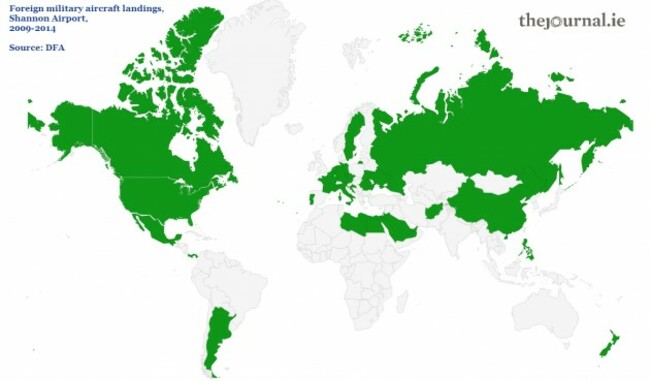
In response to a query from TheJournal.ie, a spokesperson from the department confirmed that a foreign military aircraft landing was refused on one occasion this year, but would not say which country it came from.
The rejection of the request for permission was “on the basis that [it] did not meet with the normal conditions that apply…”
The 1952 Air Navigation (Foreign Military Aircraft) Order states that the Minister for Foreign Affairs must give permission before a foreign military aircraft can fly over or land in Ireland.
As described by Minister Flanagan in the Dáil recently, requests for permission are submitted by the Embassy of the country concerned, and are only granted under the following “strict conditions”:
The aircraft must be unarmed, carry no arms, ammunition or explosives and must not engage in intelligence gathering, and that the flights in question must not form any part of military exercises or operations.
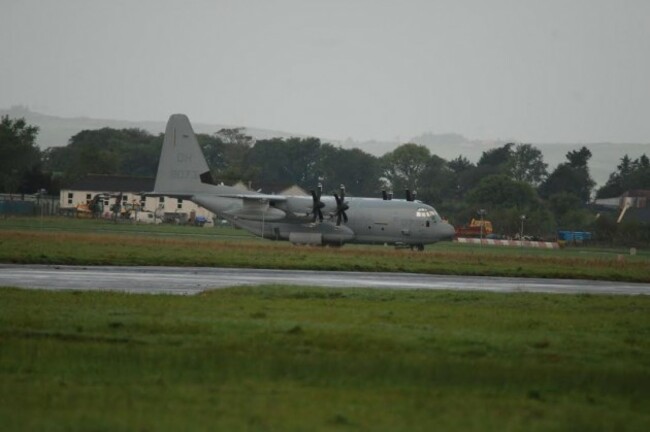
There has been renewed concern of late over the use of Shannon airport by foreign militaries.
On Wednesday, the department once again denied that the CIA has used the airport to transport prisoners who were tortured, in light of a US Senate report which revealed the details and extent of CIA torture.
Last Tuesday, Minister Flanagan apologised to the Dáil and corrected the record to show that a controversial US Marine Corps aircraft had in fact landed at Shannon on 30 September.
This was after four previous denials of the landing, in answer to four parliamentary questions from Independent TD Clare Daly.
The confusion over the Hercules C-130 transport aircraft QH-8073 led Independent TD Mick Wallace to question whether the Department was comprehensively keeping track of foreign military flights and landings.
If this aeroplane had permission to land, why did the Department not have a record of it? Clearly, it did not have a record…
It is proof that the Government did not know and that control of the military aircraft in Shannon has been outsourced to a civil authority, which is scary, given the importance the Government says it attached to it.
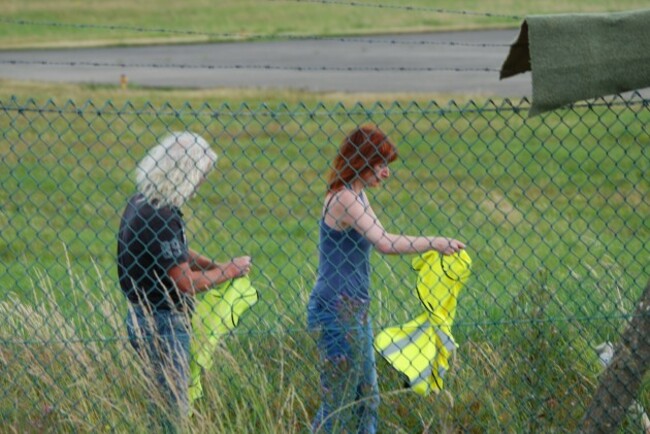
Activists, led by the Shannonwatch group, have recently stepped up their lobbying for inspections of foreign military aircraft for arms and ammunition.
Last Wednesday the Oireachtas Petitions Committee was told by the Department’s Secretary General Niall Burgess that foreign militaries had requested roughly 700 exemptions from the ban on weapons.
85% of those related to the personal weapons of military staff, but 15% were classified as “dangerous goods” – explosive materials, which were not authorised “where it is considered [they] have a military purpose.”
On the subject of inspections, Burgess told the committee:
It has been the practice of successive governments to accept in good faith that details provided by diplomatic missions to all departments are accurate.
This approach is in accordance with international practice and reflects the principle of sovereign immunity.

To embed this post, copy the code below on your site










have your say