Sign in. It’s quick, free and it’s up to you.
An account is an optional way to support the work we do. Find out more.
Sign in. It’s quick, free and it’s up to you.
An account is an optional way to support the work we do. Find out more.
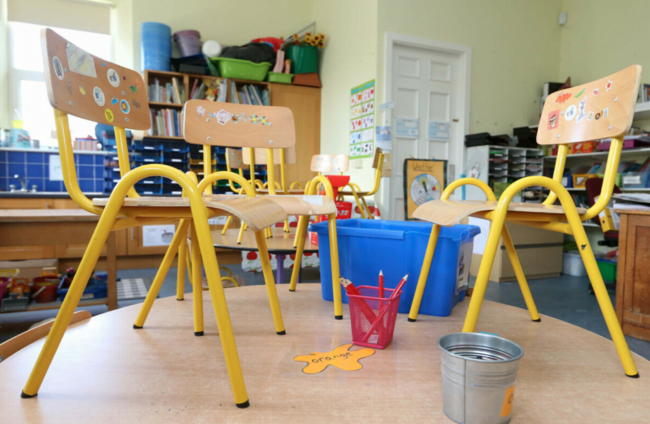
PRIMARY SCHOOL TEACHERS who are members of the Irish National Teachers’ Organisation (INTO) are set to begin a work-to-rule today amid an ongoing public sector pay dispute.
The INTO is the largest teachers’ trade union in Ireland, representing over 48,000 members.
The move is part of wider industrial action involving more than 100,000 public sector workers.
As part of work-to-rule, the INTO said that its members in primary and special schools will not work beyond their contracted daily teaching hours.
John Boyne, the union’s general secretary, said today that the situation was “an absolute disgrace” that previous government leaders “would not have allowed to happen”.
Teachers in schools that use the Croke Park hours to provide extra supervision before and after school will no longer do so.
Croke Park hours are additional working hours that were brought in by the Croke Park and subsequent Haddington Road agreements.
According to Máirín Ní Chéileachair, assistant general secretary of INTO, the responsibility for the safety of children on school grounds is that of the school’s board of management.
Schools which use the Croke Park hours have been instructed to carry out safety assessments.
Parents were also to be informed that schools will not be opened until the official start time if it is not safe for children to be dropped off without supervision.
Speaking on RTÉ Radio 1, general secretary of the INTO John Boyle said “school insurance companies realised that there could be a problem from next Monday
“What they advised boards of management to do is that if you cannot take on this additional risk when you don’t have these teachers out in the cold freely supervising the children for no pay any longer, that you as a board may have to only open the school gates at the actual start of the school day rather than half an hour beforehand.”
Boyle was asked whether parents would have to rearrange their work schedules and childcare drop-offs as a result.
He said that for parents who start work at 9am and usually drop their children to school around half an hour beforehand, “this may not be possible in many schools where Croke Park hours are being used”.
Boyle added that “people are going to have to get used to industrial action that does hit hard on people”.
He maintained that children will still be coming to “be taught and to learn for the school day, but they will not be supervised beforehand”.
As part of the action, teachers will also refuse to attend formal parent-teacher meetings or staff meetings held outside normal school hours.
Extracurriculars involving teaching within official school hours will not be impacted, nor will activities teachers voluntarily take part in outside of school hours.
Ireland’s main second-level teachers union, the Association of Secondary Teachers in Ireland (ASTI) are also set to begin industrial action involving withdrawal from selected activities such as the Croke Park hours today.
A INTO ballot for industrial action had a turnout of 57.5%. Of those, 99.5% voted to support the action.
The union said it is taking the action “to secure a credible pay settlement for the second half of 2026 and beyond”.
The previous public sector pay deal expired at the end of June. It provided for general pay increases of 9.25% for public sector workers, along with a 1% local bargaining fund.
On Friday, Minister for Public Expenditure Jack Chambers accused trade unions of being ‘unwilling’ to negotiate amid the’all-out strike’.
In a strongly worded statement issued by his department, the minister said the unions and representative associations have decided to move to industrial action “rather than engaging in substantive talks”.
Speaking to Newstalk this morning, the INTO’s general secretary called government ministers’ claims about the union setting preconditions “an absolute lie” and said the government was setting preconditions of its own.
Industrial action will continue throughout October, with public-sector unions planning two strike days.
The INTO says it has lost confidence in the government’s approach to pay negotiations, arguing that talks have focused too much on reforms rather than workers’ pay.
Boyle said teachers’ pay has increased by 20% over five years, while inflation has risen by 27.5%, leaving them 7.5% behind the cost of living.
Ní Chéileachair previously stated that unless Chambers “engages with public service unions in good faith”, work-to-rule will continue and a 24-hour strike will be held on 14 October.
To embed this post, copy the code below on your site











have your say