Sign in. It’s quick, free and it’s up to you.
An account is an optional way to support the work we do. Find out more.
Sign in. It’s quick, free and it’s up to you.
An account is an optional way to support the work we do. Find out more.
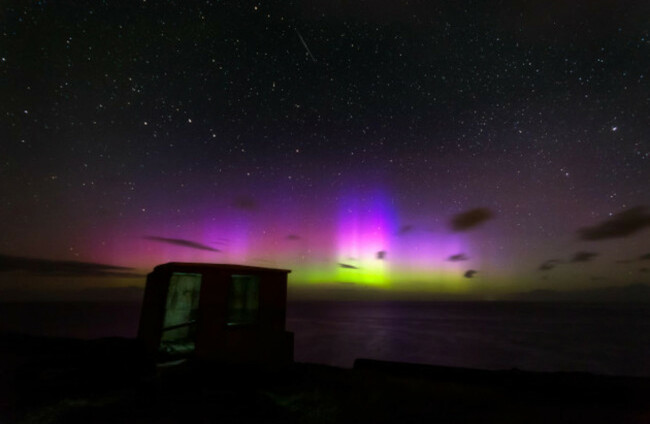
THE NORTHERN LIGHTS brightened the sky in parts of Ireland last night and many people have shared the striking imagery on social media from all over the country.
Aurora borealis, or the Northern Lights, occurs as a result of charged particles from the sun launched along Earth’s magnetic field colliding with gases in Earth’s upper atmosphere.
In simpler terms, particular pieces of the Sun’s crust can shed and later make its way towards and drop down into the Earth’s atmosphere.
Those pieces then mix with the different types of gas particles in the air and, depending on the type of gas and the amount of pieces of shedding, different colours appear in the sky.
According to Met Éireann, the different colours indicate different things.
Blue and purple lights indicate that there is a high amount of nitrogen in the atmosphere and that a large volume of charged particles from the Sun have made their way to the Earth. This is called intense solar activity.
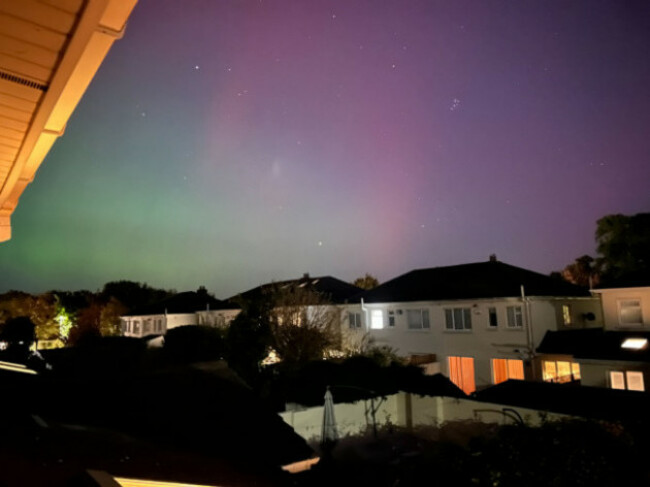
When these particles mix with ionized nitrogen molecules, the bright blue and purple lights will be clearly visible. The hue of the colours depend on external factors, such as light pollution.
The higher in the air the gas is, the brighter and more colourful the lights will become according to the Irish Meteorological Service. Usually, blues and purples will appear if those gas particles are approximately 95 kilometers in the air.
But last night, many images showed a mix of bright green and pink lights in the air.
Those colours will appear if ‘excited atomic oxygen’, which just is a more reactionary form of the gas, is present high up in the atmosphere.
If a smaller volume of charged particles from the Sun mix with a higher concentration of the reactionary oxygen in the air, green lights will be more vibrant and appear clearer in the sky. This also indicates that there is a lower level of solar activity taking place.
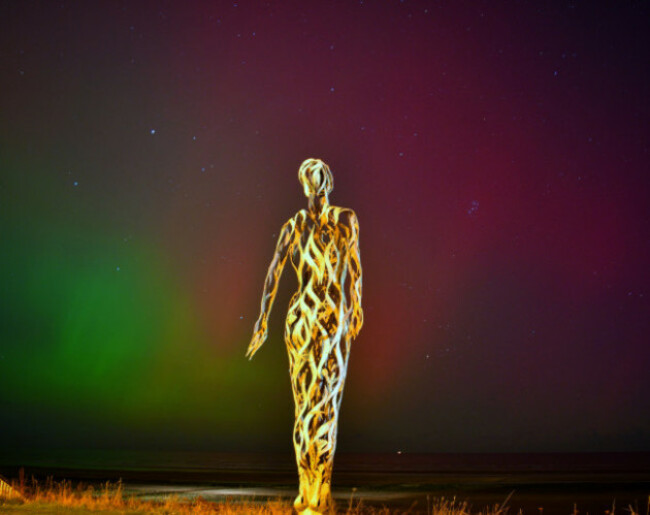
Pink lights are only visible when a higher volume of the charged particles mix with a lower concentration of the reactionary oxygen. This indicates that intense solar activity is taking place.
These colours will appear if the excited molecules are up to approximately 240 kilometres in the sky. The National Weather Service based in the United States have also shared this useful infographic on the phenomenon:
If you're seeing the Northern Lights tonight, here's an explainer of how the different colors can appear! We are currently seeing a vivid display of pinks and greens here at the office! pic.twitter.com/S0NLzG5HOa
— NWS Northern Indiana (@NWSIWX) October 11, 2024
Wil Cheung, an astronomer and fellow of the UK’s Royal Astronomical Society, previously told The Journal that the Sun is currently experiencing what is called a “solar maximum”.
This marks the peak of a roughly 11-year cycle in the Sun’s activity and means that the Northern Lights will become more common and clearly visible in the weeks ahead.

To embed this post, copy the code below on your site












have your say