We need your help now

Support from readers like you keeps The Journal open.

You are visiting us because we have something you value. Independent, unbiased news that tells the truth. Advertising revenue goes some way to support our mission, but this year it has not been enough.

If you've seen value in our reporting, please contribute what you can, so we can continue to produce accurate and meaningful journalism. For everyone who needs it.

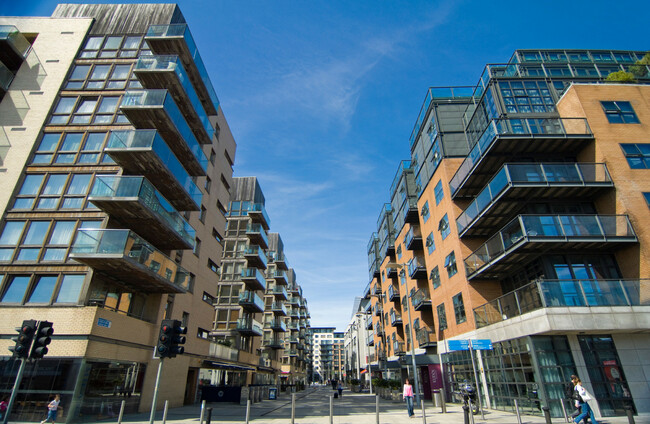
Apartments near the Phoenix Park in Dublin. Alamy Stock Photo

How Ireland’s affordable rent scheme delivered 30% price cuts - and how it could be improved

Cost rental is easing pressure for some, but it’s nowhere near big enough to fix Ireland’s rental crisis.

IT’S A BAD time for Irish renters.

Prices have been on a relentless upward march for years, with the annual rate of inflation often cracking 10%.

More young people are being forced to share homes with their parents, while those who manage to live independently fork over an ever-rising share of their income.

Prices are up by 5% over the last year. Rents for existing tenancies have reached €1,500 a month, while those taking out new leases face paying almost €1,800.

For Dublin, those figures jump to an average of almost €2,000 and €2,300 a month respectively. These are difficult to manage for anyone earning relatively ‘normal’ wages, and prohibitive for anyone in low-paid work.

All of this negativity is why it’s worth holding onto the few positive developments. One came through recently – that Ireland’s affordable rental scheme has resulted in substantially lower-cost prices.

Cost rental is working — but it’s still too small

A new study from the Economic and Social Research Institute (ESRI) found that cost rental housing has delivered “substantial affordability gains”. That is, homes provided under the scheme are an average of 30% cheaper than comparable accommodation in the private market.

It is a success worth highlighting. The goal for the initiative is to provide rental homes which cost at least 25% less than normal – the findings show that this goal is being regularly exceeded.

The concept of ‘cost rental’ is summed up in the name. That is, the rent for a home should only cover development and maintenance costs.

This type of accommodation only aims to be self-sustaining – the goal is not to make a profit.

Built by state organisations and approved housing bodies (AHBs), it is targeted at the so-called ‘squeezed middle’. That is, those earning too much for social housing, but not enough that they can comfortably afford to handle the costs of the private market.

Applicants must have a net annual household income below €66,000 in Dublin and €59,000 in the rest of the country.

They have to meet several other requirements, such as the rent price not being more than 35% of their net income.

Tenants also have security of tenure. Following an initial six-month probation, tenancies are of unlimited duration – essentially never having to worry about eviction.

These homes still account for a small proportion of the overall market. There are about 3,600 cost rental homes in Ireland. As of the 2022 census, there were over 330,000 rental properties.

The model has proved incredibly popular, with their scarcity further fuelling demand. Dozens of these new cost rental units regularly receive thousands of applications.

The problem: Ireland’s model is tied to market rents

However, there is something which may help the system improve further – breaking the link with market rents.

Ireland’s cost rental model is unusual. The idea is to provide accommodation which is not subject to market rates. Ireland’s system instead reinforces the link, by setting a very clear 25% benchmark.

This can cut both ways. In some areas, cost rental accommodation could be even cheaper.

The system is one which we have adopted from European countries, such as Austria and Finland.

In Vienna, the Austrian capital, social housing is 32% cheaper than rent in the private market. Ireland stacks up well. But in Finland, cost rental housing can be anywhere from 15% to 45% under the going market rate.

If Ireland’s system was true cost rental, it’s likely that rents in some areas would be even lower.

The ESRI was clear in its comments, recommending that the “explicit link to market rents be phased out”.

It said instead, cost rental prices should be set “purely on the basis of economic costs” – that is, only set relative to development and maintenance costs, as intended.

This could also come in useful when the link to market rate cuts the other way, making it difficult to deliver the accommodation at all.

A perfect example of this came last week, when approved housing body Clúid abandoned its plan for 40 cost rental units in Cabra, Dublin.

The organisation said it ran into viability problems due to rising costs.

“Rising costs in areas such as planned maintenance, cyclical costs and component replacement mean that it would not be possible to deliver these as cost-rental homes with rents 25% below market rate,” Clúid said in a statement to the Irish Times.

Essentially, the rent prices (if 25% lower than normal) would have been too low to pay for the development and maintenance costs.

This is another area where it could be useful to abandon the link to market rates. If the homes can be developed with rents set 20% or 15% below market rates, they are still providing desperately-needed affordable accommodation. Better built this way, than not at all.
There are two final points worth touching on. One, almost all cost rental homes built in Ireland so far have been in Dublin suburbs.

While rent prices are highest in the capital, there are plenty of areas around the country which are also suffering from inflation. Most obvious is the counties surrounding Dublin and the country’s other cities – Cork, Limerick, Galway and Waterford.

The ESRI study mentioned that a “more broad-based presence countrywide” could strengthen the likelihood of cost rental “evolving into a central component of Ireland’s rental housing system”.

This leads into the second point – the possible wider impact that the scheme could have.

Can cost rental actually bring prices down?

Obviously cost rental is great for the tenants who are lucky enough to get the cheaper homes. But what about the thousands who don’t and are left stuck in the private market?

The idea / hope is that providing lots of new homes at lower rents will create a ‘dampening effect’. That is, put downward pressure on the market and push down prices somewhat, or at least slow the rate of inflation.

The logic is simple – a higher supply of cheap homes means there is less demand for more expensive accommodation, leading to price falls.

Right now, it is likely that there simply is not enough cost rental to have a meaningful impact. However, the ESRI research said a 10% increase in affordable accommodation causes a measurable reduction in price.

“It must however be kept in mind that these price dampening effects are a long-term aim,” it said. “Cost rental in Ireland is only at the initial phase of tenure development, accounting for in the region of 1% of the rental stock so far.”

But the promise is there if the initiative is rolled out widely enough. And all signs point to the fact that there is enormous demand there from tenants.

Ireland’s aims for delivery are relatively modest. Previous plans set a target of building 2,000 cost-rental homes a year, while there is not even a set target in more recent documents.

The difficulties faced by Clúid also indicate that even these could face complications unless managed properly.

The research indicates that the way forward likely involves breaking the explicit link to market rents – to ensure that as many cost rental homes as possible can be built quickly and sustainably.

Readers like you are keeping these stories free for everyone...
A mix of advertising and supporting contributions helps keep paywalls away from valuable information like this article. Over 5,000 readers like you have already stepped up and support us with a monthly payment or a once-off donation.

Close
17 Comments
This is YOUR comments community. Stay civil, stay constructive, stay on topic. Please familiarise yourself with our comments policy here before taking part.
Leave a Comment
    Submit a report
    Please help us understand how this comment violates our community guidelines.
    Thank you for the feedback
    Your feedback has been sent to our team for review.

    Leave a commentcancel

     
    JournalTv
    News in 60 seconds