Sign in. It’s quick, free and it’s up to you.
An account is an optional way to support the work we do. Find out more.
Sign in. It’s quick, free and it’s up to you.
An account is an optional way to support the work we do. Find out more.
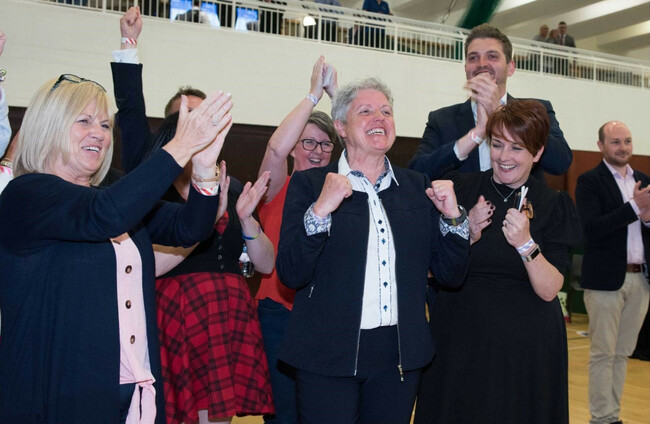
THE DEMOCRATIC UNIONIST Party’s first openly gay candidate has been elected to Antrim and Newtownabbey Borough Council.
Alison Bennington received 856 first preference votes and was elected after the sixth count in the Northern Ireland local elections.
The DUP has openly spoken out against same-sex marriage but claims it is not anti-LGBT+.
Speaking to IrishNews, DUP leader Arlene Foster said she was not going to discriminate against someone because of their background and believed there had been some conflation between Bennington’s sexuality and her party’s policy on same-sex marriage.
“The two should not be seen as coming together because Alison signed up to the policies that we stand on, and we stand as you know on the policy that marriage is between a man and a woman.”
Foster added that Bennington signed up to the party because she knew that the DUP was “the best vehicle to support the Union”.
Before her election, Bennington had previously told IrishNews: “I regard my private and family life as a matter for myself in the same way as everyone else.”
In 2015, the DUP blocked a vote in favour of legalising same-sex marriage in the North in 2015, despite it being supported by a majority of the Stormont assembly.
Earlier this year, a bill calling for same-sex marriage to be legalised in Northern Ireland has passed its first parliamentary stage in the House of Lords.
The decision on whether to legalise same-sex marriage in Northern Ireland would normally be decided by the Northern Ireland Assembly in Stormont, however that collapsed over a year ago.
In 2018, Arlene Foster became the first DUP leader to attend an LGBT event as she spoke at a PinkNews event in Stormont. While the DUP has blocked marriage equality, Foster said that didn’t mean she didn’t respect LGBT people.
Northern Ireland remains the only part of the UK where same-sex marriage is still banned. It was legalised in England and Wales in July 2013, and Scotland in February 2014.
The issue of marriage equality has been a central sticking point in the talks to restore power-sharing in Stormont, with Sinn Féin calling for it to be legalised and DUP strongly opposed.

To embed this post, copy the code below on your site













have your say