Sign in. It’s quick, free and it’s up to you.
An account is an optional way to support the work we do. Find out more.
Sign in. It’s quick, free and it’s up to you.
An account is an optional way to support the work we do. Find out more.
A MAJORITY OF people on the island of Ireland would vote for Irish unity as part of the EU, according to a poll.
An EU sentiment poll also indicates that 73% in Northern Ireland would vote for the UK to rejoin the EU, while more than 70% of people both north and south believe the EU should become more independent of the US.
The poll also indicates a continued decline in satisfaction with the direction of the EU since 2023, with issues such as migration and cost of living cited as concerns.
European Movement Ireland’s Island of Ireland EU Poll 2026, conducted by Amarach Research, found that support for Ireland remaining a member of the EU is at 82% in Ireland and 76% in Northern Ireland.
The online survey was carried out among 1,200 adults in both jurisdictions between 26 and 31 March 2026. The margin of error is plus or minus 2.2%.
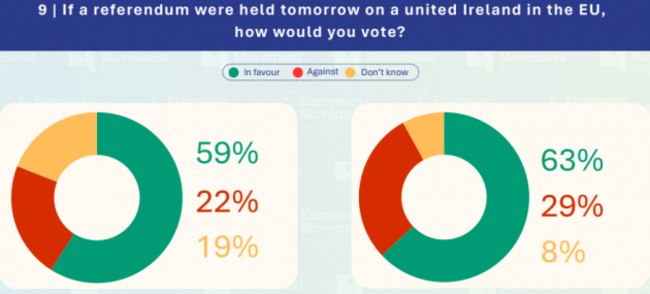
The poll indicated that if a referendum were held tomorrow on a united Ireland in the EU, 59% in Ireland would vote in favour and 22% against, with 63% voting in favour in Northern Ireland and 29% against.
Almost three-quarters of respondents in Northern Ireland said that if the UK held a referendum tomorrow on rejoining the EU, they would vote in favour (73%), with 23% stating they would vote against.
The poll also indicates that 71% south of the border believe the EU should seek greater independence from the United States, with the figure jumping to 79% in Northern Ireland.
Almost half of Irish respondents said Ireland should take part in increased EU defence and security cooperation (48%), with 32% saying no and 20% stating they were unsure.
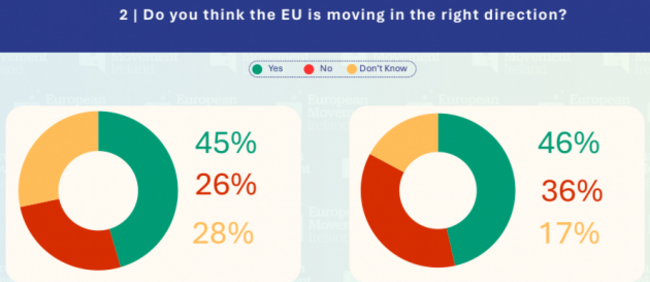
There appeared to be a decline in satisfaction with the direction of the EU from 58% in 2023 to 45% in 2026.
The top issues flagged with those who are dissatisfied were migration (31%), economic and regulatory issues (27%), and federalism and national sovereignty (26%).
Those who believe the EU is moving in the right direction cited unity and cooperation (33%), economic benefits (25%) and stability and security (19%) as their reasons.
In Northern Ireland, 46% expressed satisfaction with the direction of the EU, and 36% expressed dissatisfaction.
The top three reasons for dissatisfaction were economic and regulatory issues (36%), federalism and national sovereignty (26%) and immigration control (19%), with unity and cooperation (50%), economic benefits (25%) and defence (18%) listed as the top reasons for satisfaction with the EU.
Trade is listed in both jurisdictions as the issue where the EU performs its strongest, and migration as its weakest point.
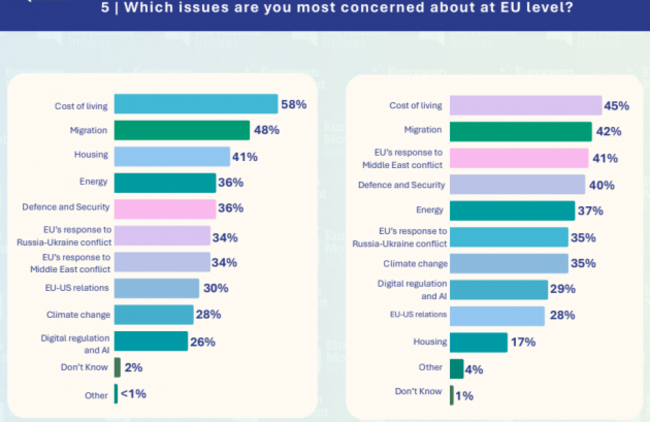
Asked what their top five concerns at EU level were, Irish citizens said cost of living (58%), migration (48%), housing (41%), energy (36%) and defence and security (36%).
In Northern Ireland, the five main concerns were the cost of living (45%), migration (42%), the EU’s response to the Middle East conflict (41%), defence and security (40%) and energy (37%).
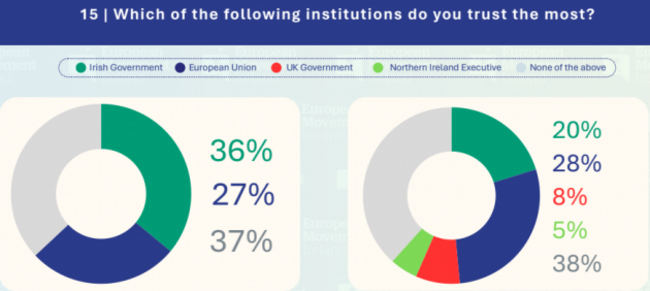
A plurality of respondents in Ireland (37%) said they do not trust either the Irish government or the EU, with 36% stating they trust the Irish government and 27% stating they trust the EU.
Asked which institution they trusted the most, 28% of respondents in Northern Ireland said the EU, 20% said the Irish government, 8% said the UK government and 5% said the Executive, with 38% stating they trusted “none of the above”.
Asked where they get their information on EU issues, 65% in Ireland said newspapers, radio and TV; 51% said the traditional media’s online offering; and 33% said social media; while in Northern Ireland, 68% said the traditional media’s online offering; 62% said newspapers, radio and TV and 39% said social media.
Chief executive of European Movement Ireland David Geary said that while there was “strongly pro-European” sentiment in Ireland and Northern Ireland, in Ireland there were “areas of disconnect emerging”.
He said that Ireland “can’t be complacent” as it prepares to take on the six-month EU Council presidency term in July.
“The highest-level support for the EU is among the 18 to 34 and 55-plus age cohort, but really evenly split between men and women, which is good to see,” he said.
“There are some areas of disconnect that are emerging, only 45% of people believe the EU is moving in the right direction. That’s obviously something that needs to be focused on,” he said.
“The question that we ask on a regular basis is ‘upholding core values’. Now, 50% say that it is which is really good, but 33% say no, and 17% say they don’t know. So that’s effectively split between people who do believe it’s standing up for its core values and it isn’t.
“We would see the presidency as a key opportunity for a reinvigorated national conversation on our place in the EU.”
He said that the responses in favour of Irish unity were higher in this poll compared to others due to the “EU framing”.
“There was higher ‘don’t knows’ in the south, 19% compared to 8% in Northern Ireland, and higher support than other unity polling, which is likely due to the EU framing,” he said.
“I think there is a clear appeal of EU membership.”
He said that the EU element of Irish reunification was just one dimension, and that areas such as health, education and justice would also require consideration.
He also said that the high number stating that Northern Ireland should have a greater say in EU decision-making (73%) was significant, adding: “62% of ‘Leave’ voters support more representation, despite opposition to rejoining.”
He said: “I think it’s really welcome that the Irish Government plans to include Northern Ireland in the presidency, I think that’s a really positive step in the right direction.”

To embed this post, copy the code below on your site













have your say