Sign in. It’s quick, free and it’s up to you.
An account is an optional way to support the work we do. Find out more.
Sign in. It’s quick, free and it’s up to you.
An account is an optional way to support the work we do. Find out more.
LAST UPDATE | 7 Jul

In this brand-new series, journalist and spoken word artist Cormac Fitzgerald travels to a different town or suburb each week to cover the gigs and cultural experiences you rarely see covered by Irish media outlets.
This week’s subject: The All-Ireland Amateur Drama Festival. What makes people give up so much of their free time to tread the boards?
******
A FEW YEARS ago I had the lead role in a play being staged by the Dublin Shakespeare Society, one of the oldest running amateur drama groups in the country.
I had never acted in an amateur drama before – I had never really ‘acted’ before in the traditional sense – but the director had seen some of my spoken word poetry performances and thought that I could bring a certain intensity to the lead role.
What I wasn’t prepared for was the intensity of taking part in the play. Months of preparation went into a run of five nights.
In the last few weeks, we were rehearsing nearly every night, trying to get it right, and a full set had to be built. It was down to the wire, and from actors, writers, directors, production and backroom workers there was upwards of 30 people involved. No one was paid for their time. Everyone was there for the love of the game.
After the final staging, the audience clapped, and we took our final bow; the stage was struck, some drinks were had, people hugged and kissed and everyone went home (well, some of us foolishly went onto Fibbers nightclub).
And that was it – all that work, struggle, fun, time. Done.
I have been thinking since about amateur drama; thinking about what drives people of all ages to give up so much of their lives to act or take part in an amateur play. People working full-time jobs, raising families, living busy lives, then heading to some poorly lit room to jump around the place in the pursuit of… what?
This curiosity is what brought me to the foyer of the Dean Crowe Theatre in Athlone, Co Westmeath, on a Tuesday evening in early summer, about halfway through this year’s RTÉ All Ireland Drama Festival (AIDF).
I was there to watch a production of Sive, the iconic John B Keane play, and to chat to everyone involved about what brought them here.
The story of an orphaned teenager being auctioned off by unscrupulous adults to an aged bachelor farmer in north Kerry, Sive holds iconic status in the lore of the AIDF and amateur drama in general. It was rejected by the Abbey Theatre before being staged in Athlone by the Listowel Amateur Drama Group and winning the festival all the way back in 1959.
Now, not for the first time, Sive was back at the Dean Crowe.
But on this occasion, the players weren’t plucked from the hills around Listowel, but from the wilds of south county Dublin. The Dalkey Players were staging the play, and the pre-show chatter was focussed on some “twist” that director Emma Jane Nutly was bringing to the production.
Billy Keane, the late-John B.’s son, protector of his legacy and the owner of John B. Keane’s pub in Listowel, was in attendance. Would the Dalkey Players do a good enough job?
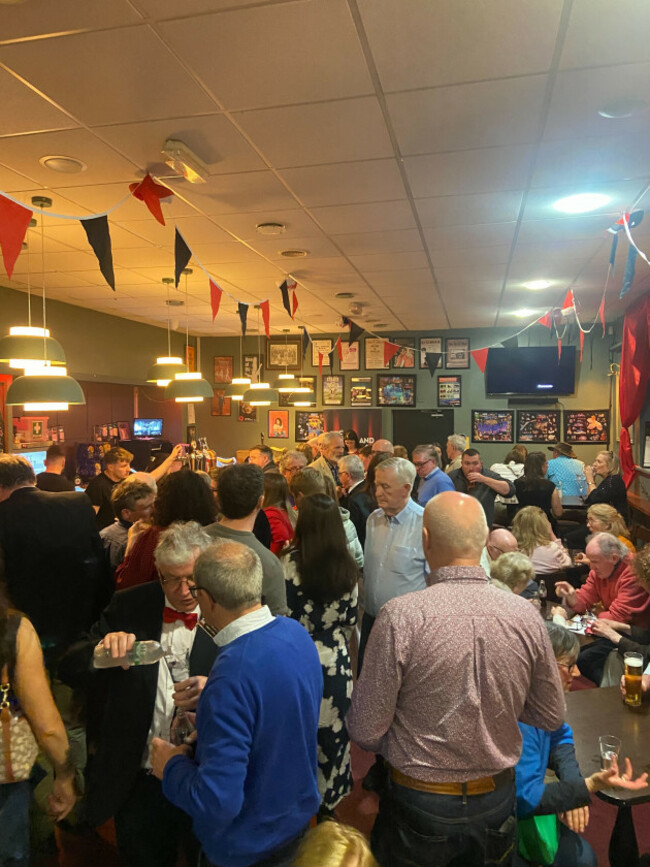
Every year, amateur drama groups from towns, cities, villages across the country get together in the evenings and weekends to audition, rehearse long hours, and stage their plays as part of the AIDF.
Some will then go on to ”do the circuit” of local festivals, where their work is adjudicated on.
The top nine plays then go forward to be staged in the All-Ireland in Athlone across nine nights in early May, with a gala ball and awards ceremony held on the final night, and streamed live online on RTÉ.
A good way to understand the passion and the fanaticism of the whole thing, is to think of the GAA.
Just like in Gaelic Games, the groups come from all over the country and there are winners and losers, bruising encounters, local rivalries, near misses and countless people working behind the scenes.
And like the GAA, the vast majority of the people involved are unpaid, giving up many, many hours for the sheer love of the game.
I had some experience of the commitment that’s needed to get a show on the stage, but the All-Ireland represents a different level of time and energy.
“From my perspective, it’s all community based,” Festival Director Michael McGlone told me.
“For me the roots of amateur drama are in your local community and that’s what you’re representing if you’re lucky enough to get to the stage of the finals.”
And it is not just the drama groups themselves. Michael McGlone and the 10 other members of the festival committee, along with the wider group behind the scenes, put in long, long hours to ensure everything runs smoothly, manning the box office, working the crowd, ushering people to their seats when the performance is set to begin.
The play went off well on the night. There were about 500 people in attendance and another 50 on the waiting list (I had leveraged my nefarious journalism connections to get a ticket).
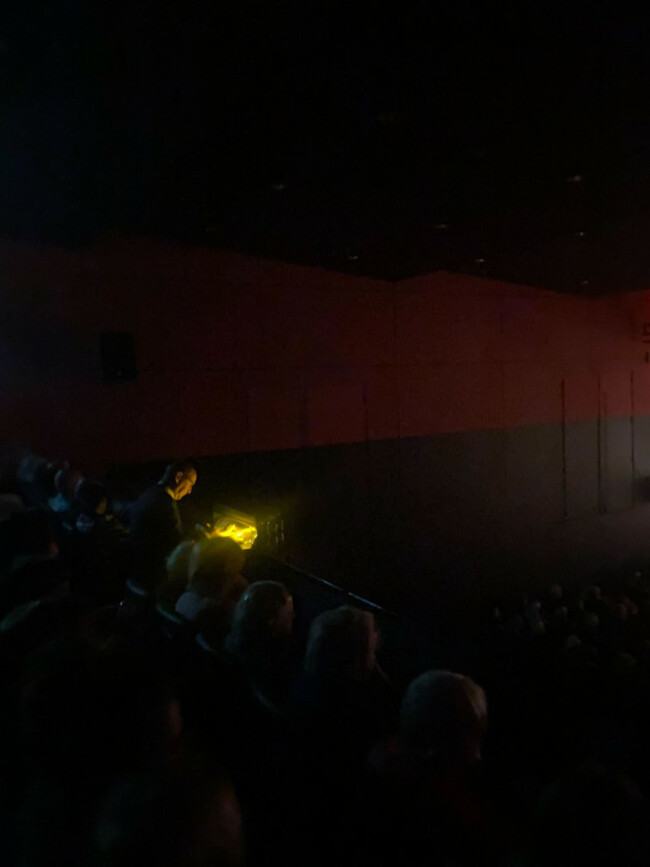
I was seated a little behind the adjudicator of the festival, Padraic McIntyre, who was positioned in the middle of the front row of the balcony scribbling notes by lamplight for the duration of the performance.
Sive is a classic tale of rural poverty, avarice and bitter resentments set in 1930s rural Ireland. Widely considered to be John B Keane’s best work, its language and themes are inseparable from the landscape and the context of north Kerry. It would be hard, then – impossible, maybe – to fully do the play justice without being steeped in that same context.
But the Dalkey Players do a good job all the same. While the accents may occasionally travel east along the M7 from north Kerry to south Dublin, in general the acting is top-notch across the board.
The staging, lighting and set design were also nicely done, and the production overall was more enjoyable than much of the “professional” theatre I have attended lately. The Dalkey Players version added in three “Bog Spirits”, ethereal presences that flit through the action, interacting with Sive but invisible to the rest of the cast, adding a ghostly dose of the surreal to the action.
Once the play was over, the crowd leapt to its feet for a standing ovation, and Padraig McIntyre took to the stage to have his say. He pulled no punches, singling out characters, staging and direction. In general, he deemed the play and the inclusion of the Bog Spirits a success, but threw in a fair bit of criticism too.
After his closing remarks, the audience retreated to the bar. But before they could rest, the cast and crew of the Dalkey Players first had to have professional photos taken on the stage, and then everyone had to muck in to strike the set so that everything could be fully set up for the following night’s performance.
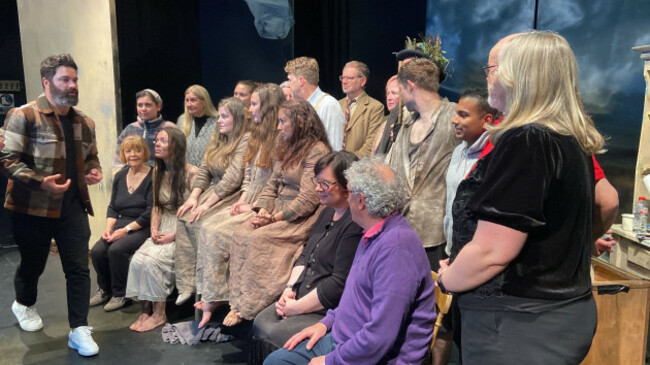
Then, just as the poor cast and crew were finally getting a much-needed drink, I pulled one or two away to find out what brought them here. All that work and those long, long hours. Is it about winning?
“We’re certainly competitive and worked very hard,” director Emma Jane Nutly told me.
But in the end, she said, “you just have to concentrate on doing the story the best that you possibly can. And what will be, will be”.
“I think that’s very, very rich. In our group the youngest person is 17 or 18 and the oldest person is in their 80s, and there’s something very rich and special about that.”
For Sharon Nealon, who played Nanna Glavin in the play, amateur drama is a chance to completely switch states.
“Socially it’s lovely. It’s just such a way to get your head charged after a long day in work,” she said.
“It’s a creative outlet. I’m not artistic. I can’t paint, I don’t play music. But it’s a way to express yourself and just flex that muscle in a way.”
Back out in the bar, with the hard part done, I watched people hug and talk to each other like close friends and family. It was clear to see that they were a solid unit and had come from all walks of life and spent many hours together. Theatre (amateur or otherwise) has an aura and a romantic mystique about it – grease paint and footlights, props and staging, big personalities and wine, hard work and treading the boards and all of it.
In my brief time in amateur drama, I felt all those things, too. Away from the pressures of a professional practice, amateur drama retains a lot of the romanticism and fun that comes with theatre, without the deep struggle of trying to survive as an actor or an artist in a difficult industry.
There are far worse things you could do for fun, artistic satisfaction, community and all the rest of it, than join your local amateur theatre group.
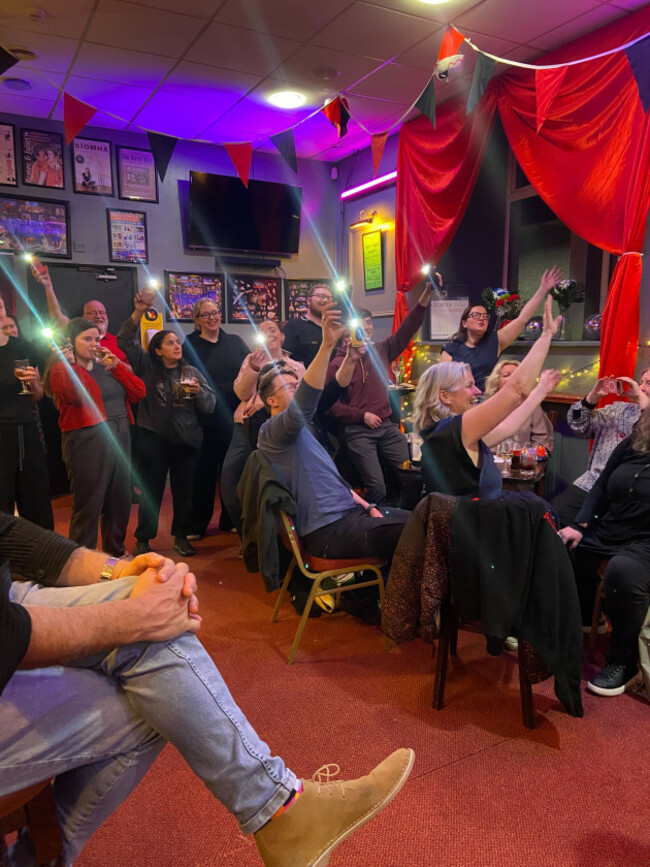
As things went, 2026 wasn’t to be Dalkey’s year. Sive secured a very respectable third place at the Gala awards on the Saturday’s night. The outright winner was Enda Walsh’s Ballyturk, staged by the Kilmeen Drama Group from west Cork.
But we will give the last word to someone who knows Sive and the production more than most.
“I thought it was a magnificent production,” Billy Keane told me when I cornered him in the bar after the show.
“Different. Which we need… It’s funny – I had forgotten about my Dad for a while. For a few months. Even though we were very close. I came in tonight and I felt a great sense of him. Because that’s the place he walked into in 1959… and won this incredible, beautiful competition.”
Well, there you have it from the man himself.
South Dublin did North Kerry proud.

To embed this post, copy the code below on your site










have your say