Sign in. It’s quick, free and it’s up to you.
An account is an optional way to support the work we do. Find out more.
Sign in. It’s quick, free and it’s up to you.
An account is an optional way to support the work we do. Find out more.
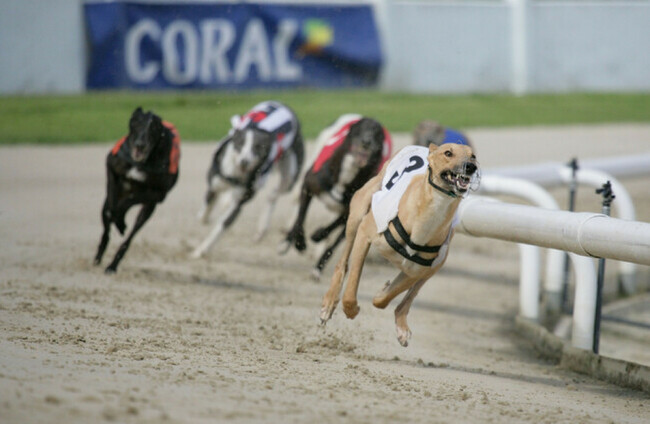
A BAN ON greyhound racing will come into force “as soon as practicably possible” in Wales, resulting in renewed calls for a ban in Ireland.
Huw Irranca-Davies, the deputy First Minister, made the announcement in the Senedd in Cardiff Bay on Tuesday.
Once in place, Wales will be the first part of the UK to implement a ban on the sport.
However, no date for implementation has been announced, with the minister saying there was work to do to avoid unintended consequences.
The push to ban greyhound racing in Wales garnered cross-party support and comes after a petition against the sport attracted 35,000 signatures.
New Zealand announced similar plans in December, and the ban won’t come into force until August 2026 to allow those affected to transition into new work.
“It’s very welcome and clearly the clock is now ticking for greyhound racing,” People Before Profit TD Paul Murphy told The Journal.
The deputy said that the industry’s own figures reported that 133 dogs died on the tracks last year, an average of 11 dogs every month.
However, statistics obtained from Irish Council Against Blood Sports show that 202 greyhounds died at races in Ireland last year – a record number of deaths at tracks in a single year.
Murphy noted that following the decision of Wales, there are “few countries around the world that still allow greyhound racing”.
In addition to Ireland, greyhound racing is also legal in other parts of the UK, as well as the US, Australia, Mexico and Vietnam.
However, the US only has two operational tracks, both of which are in West Virginia, while there are no operational racing tracks in Mexico or Vietnam.
“It highlights that the tide of progress is towards banning greyhound racing,” said Murphy, “but we need to keep the pressure up in Ireland to do something similar.”
“Over 100 greyhounds die on the tracks every year in Ireland, and more die off the tracks, including being killed because they’re not fast enough.”
And in 2019, an RTÉ investigation found that almost 6,000 greyhounds were killed for not racing fast enough in 2017.
“It is an inherently cruel, so-called sport,” said Murphy.
Murphy noted that parties such as his have “focused our fire on calling for an end to the massive public subsidy to greyhound racing”.
In November, the Dáil approved nearly €20 million in funding for greyhound racing industry.
“Without that subsidy, greyhound racing would not exist in Ireland, it would not be able to survive,” said Murphy.
“The public is paying €20m a year for this animal cruelty to continue and that subsidy should be ended immediately.”
He said the funding could be “diverted to grassroots sports that involve a significant number of people and it would really go a long way elsewhere”.
However, Murphy added that it’s “essential that there is a just transition, and those involved in the greyhound industry need to be assured of a decent job elsewhere, not connected to this cruel industry”.
“Some of this money needs to be used to ensure a just transition,” said Murphy, “but it would leave a significant amount of money left over to real grassroots sports.”
In a post on X, Hefin David, Labour member of the Senedd, raised concerns about what will happen with the land on which there is a greyhound track in his area.
Murphy told The Journal that there would need to be a “discussion in the community about what’s the best thing to do with these sites”.
“Ideally, they would be turned into some sort of public recreation spaces, such as parks or football pitches, things that enable a greater number of people to enjoy what should really be public space.
“But I think that’s probably a case-by-case issue as to what is most appropriate.”
Meanwhile, the former Welsh Conservative leader Andrew RT Davies, claimed that “there will be illicit greyhound racing going on once you shut the licensed track”.
However, Murphy said such illicit racing wouldn’t be feasible.
“You need to have a track and for it to make sense financially, you need to have quite a lot of patrons coming in – or get a bunch of state money, and if it was illegal, they wouldn’t be getting state money.
“Of course, we need to ensure there isn’t illicit racing, but I don’t see why it would be a significant issue, and I haven’t heard of that being an issue in other countries that have gotten rid of greyhound racing.”
Murphy added: “Without the public subsidy, greyhound racing in Ireland disappears.
“So if there’s no public subsidy, there is not enough of a market for illegal, underground greyhound racing to exist.”
-With additional reporting from Press Association

To embed this post, copy the code below on your site












have your say