We need your help now

Support from readers like you keeps The Journal open.

You are visiting us because we have something you value. Independent, unbiased news that tells the truth. Advertising revenue goes some way to support our mission, but this year it has not been enough.

If you've seen value in our reporting, please contribute what you can, so we can continue to produce accurate and meaningful journalism. For everyone who needs it.

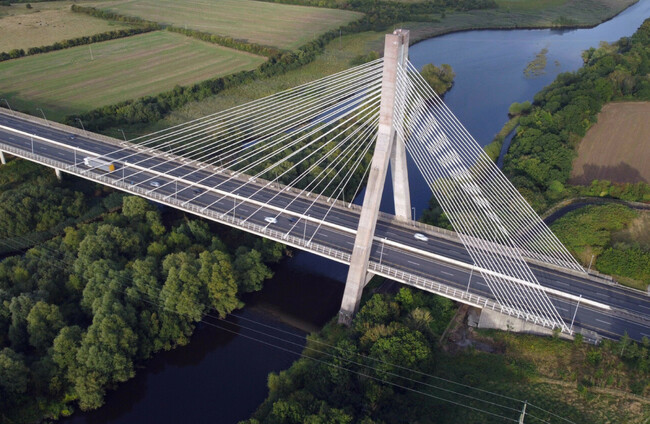
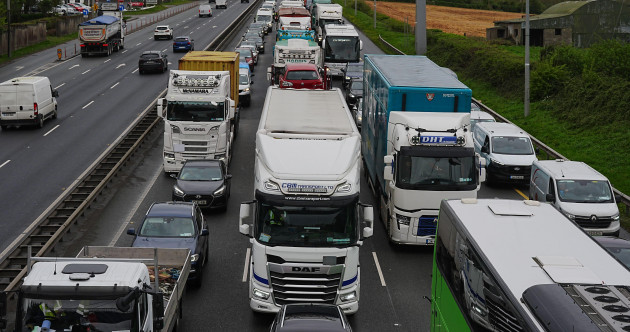
The Mary McAleese bridge on the M1 motorway that links Dublin and Belfast. Alamy Stock Photo

Dublin City Council votes to urge government to prepare for Irish unity

While largely symbolic, it adds to the political debate around Irish unity.

THE GOVERNMENT HAS been urged to prepare for an Irish unity referendum following the passing of a motion by Dublin City Council.

Members of the country’s largest local authority overwhelmingly approved a Sinn Féin proposal calling on the government to establish an all-island Citizens’ Assembly and a Joint Oireachtas Committee on Irish unity.

The motion also urges the government to secure a date for a referendum on unity as provided for in the Good Friday Agreement, although this element faced stronger opposition from other councillors who otherwise backed the motion.

While largely symbolic, it adds to the political debate around Irish unity. The council will not write to the Taoiseach with its wording.

Sinn Féin councillor Mícheál Mac Donncha, who proposed the motion, said the motion was a “progressive step towards a shared, peaceful and agreed future”.

“The debate and discussion on Irish Unity is happening across the island and I believe local government has an important part to play in this,” Mac Donncha said.

Lord Mayor Ray McAdam said he supported many elements of the motion but the Fine Gael councillor cautioned it “must be approached with care, respect and intellectual honesty” ahead of any vote.

Citing his own childhood of growing up in Co Cavan along the Border and attending school in Co Fermanagh, McAdam said any new Ireland must be “generous, inclusive home” to all communities.

“We risk building a state without building a shared nation,” he said.

McAdam added that while he welcomed the increasing conversation around unity, he said that looking to secure a date for a unity referendum risked “putting the cart going before the horse”.

In response, Mac Donncha said the Irish government must work to achieve the referendum vote as otherwise it risks leaving it up to the British government who he claimed will “sit on their hands” over any vote.

Views among the parties

Janet Horner said that communities in both states face similar challenges, such as homelessness, “escalating” violence against women and “scapegoating of minorities”.

“Focusing on these shared challenges also offers us a practical way to offer shared solutions and common ground in which we really, in a practical way, form the building blocks of what a united country would look like,” Horner said, urging a “much closer partnership with Belfast and Derry” in response.

Horner’s party colleague Ray Cunningham noted that the Greens are an-all-island party but said that unity is “not on the political agenda” in the North, explaining that his colleagues instead focused on homelessness and environmental destruction such as in Lough Neagh.

The Labour Party members were more split on the issue. This was acknowledged jokigly by veteran councillor Dermot Lacey who said that he didn’t want to cause a “rift” in his own party, but decried the idea of “nationhood” as a “relatively recent” and “damaging” invention.

Lacey opposed the motion on the basis that the call for a border poll would be “extremely divisive” and instead said he supported Taoiseach Micheál Martin’s viewpoint of cooperation on “bread and butter” issues.

His party colleague Darragh Moriarty said his party wants to see a government department devoted to Irish unity as part of plans to ready the ground for reunification.

People Before Profit’s Conor Reddy said the best time to prepare for a united Ireland is “now” and that it was important to make it clear that “50% plus one is also democracy”, so that opponents don’t try to claim that a larger majority is required to pass secure unity.

“It’s important that principle is upheld in any future referendum,” Reddy said.

Independent Malachy Steenson said he “fully supported” Irish unity, adding that he believed the Good Friday Agreement had “abandoned the northern state to the British state”. The far-right councillor claimed that it does not offer a pathway to reunification due to power for a referendum remaining with the British government’s Northern Ireland Secretary of State.

Readers like you are keeping these stories free for everyone...
A mix of advertising and supporting contributions helps keep paywalls away from valuable information like this article. Over 5,000 readers like you have already stepped up and support us with a monthly payment or a once-off donation.

Close
JournalTv
News in 60 seconds