We need your help now

Support from readers like you keeps The Journal open.

You are visiting us because we have something you value. Independent, unbiased news that tells the truth. Advertising revenue goes some way to support our mission, but this year it has not been enough.

If you've seen value in our reporting, please contribute what you can, so we can continue to produce accurate and meaningful journalism. For everyone who needs it.

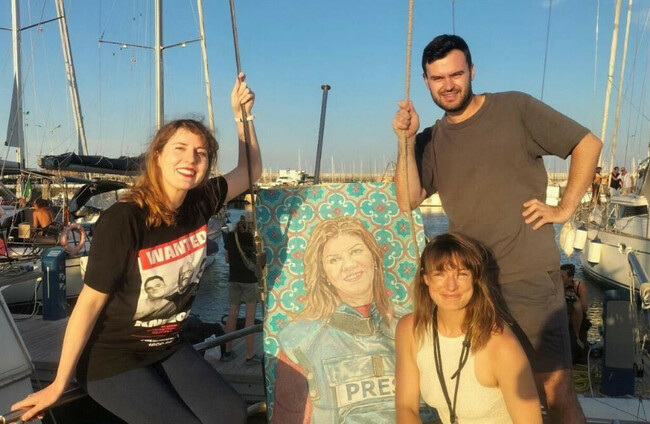
Leigh Brosnan BL with Gemma McLoughlin Burke BL and Alexander Hogg, who are also sailing on the Shireen, with a mural of Shireen Abu Akleh. Leigh Brosnan/The Journal

Lawyer sailing toward Gaza I can't stand idly by while the rule of law is decimated

Leigh Brosnan explains how International Law invalidates any claim by Israel that the Global Sumud Flotilla is illegal or a threat to security.

THE GLOBAL SUMUD Flotilla is bound for Gaza, aiming to open up a maritime corridor and deliver life-saving aid to Palestinians there. Shoals of vessels, carrying everyday people constitute delegations from 44 states, and are setting sail from Barcelona, Tunisia, Greece and Sicily.

I am joining a group of practising lawyers and legal academics on board an Independent Legal Support Boat. The boat is named ‘Shireen’, after Jerusalem-born journalist Shireen Abu Akleh, who reported on the injustices experienced by Palestinians for 25 years before being killed in May 2022.

Our role is to provide real-time communiqués as the flotilla carries out this historic, deeply symbolic voyage, as well as to monitor and create a database of any breaches of the rights of participants. If there are breaches of international law – Israel should be held to account. The Independent Legal Support Boat will not attempt to break the siege; we will remain in international waters.

Israel has completely halted the delivery of humanitarian aid to Palestinians in Gaza since 2 March 2025. In May, Israel established the Gaza Humanitarian Foundation (GHF) in partnership with the US. The privatisation of the delivery of aid is contrary to International Humanitarian Law, which presumes relief actions are carried out either by states or by impartial humanitarian organisations (Additional Protocol I, Article 70, Fourth Geneva Convention, Articles 59 & 60). GHF represents the construction of an aid model that seems deliberately designed to sideline this principle.

GHF sites are reminiscent of the killing fields of the Cambodian genocide. As of 15 August, the UN Office of the High Commissioner for Human Rights reports that of the 1,760 Palestinians killed while seeking food since 27 May, 994 were killed in the vicinity of GHF sites. On 22 August 2025, the UN body responsible for monitoring hunger worldwide officially declared that all the inhabitants of Gaza Governorate and its environs are suffering from a person-made famine. Approximately 500,000 people are in risk of death and destitution because of this policy of starvation. This figure is stark and, in my view mandates an equally concerted response of mutual aid from the international community.

I am sailing because as a lawyer, I cannot stand idly by while the rule of law is decimated. Laws exist to set codes of conduct to limit the harm we do to each other. International law is the rules that govern how States interact. Human rights are a way of shielding against overreach of the State on our fundamental freedoms. Right now, all are under severe threat.

An attempt to decomplexify

‘Law’ itself is a web of customs, treaties, norms, pieces of legislation, conventions. It is a notoriously nebulous paradigm.

Law, at least in theory, is premised on the foundation of equality – that it must be applied without ‘fear or favour’ to use the language of Ireland’s constitution, Bunreacht na hÉireann. Everyone gets the same rights, and everyone gets the same punishments. Those with more critical lenses will perhaps feel how discrepant the theory is to the practice – but still, this is the ideal.

States demand citizens act in compliance with the law. If not, people face the consequences, vis-à-vis criminal sanctions or civil compensation. Our relationships with the State must be reciprocal, in that States must be subject to the same accountability and legal responsibility as we are, or else the social contract breaks down. This in essence is the Rule of Law.

Multiple legal systems exist. If you live in Ireland there are civil and criminal laws – two tandem channels. At the same time there is a hierarchy, so domestic (local) law interacts with and is superseded by EU and International Law.

In terms of the flotilla’s mission, arguably the most relevant and applicable legal frameworks are maritime law and International Humanitarian Law (IHL).

The right to innocent passage

Maritime law is rooted in ancient civilisations. It was set up to enshrine, as a foundational norm, freedom of movement for traders from one country through the waters of another. The right to ‘innocent passage’ is the entitlement of foreign vessels to navigate through territorial waters (up to 12 nautical miles from the coast of any jurisdiction) unimpeded. The ‘coastal power’ has the right to set laws and regulations for activity in its territorial waters, but they must be international law compliant.

We are also in the legal territory of International Humanitarian Law. Its current post-World War II iteration codifies what is legal in terms of the treatment of ‘combatants’ as opposed to ‘civilians’ in times of armed conflict. It is self-evident that a group of students, doctors, activists, grandfathers, mothers and human rights respecting individuals are not combatants. The participants are civilians. The participants pose no harm or risk to the State of Israel, and therefore they have the right to innocent passage through territorial waters.

At all times during armed conflict, there is an absolute duty to differentiate between civilians and combatants. According to the Israeli military’s internal statistics, fatalities have been 83% civilians.

If a policy of starving civilians is unlawful (which it is, as per the Fourth Geneva Convention (Article 23), Additional (Protocol I, Article 70), San Remo Manual (Rule 102), Genocide Convention, (Article II(c)), and Rome Statute (Article 8(2)(b)(xxv)), then the measures (blockade) deployed to enforce the policy are, by extension, also unlawful.

Most recently, the UN Security Council adopted Resolution 2417, which categorically states that starvation as a method of warfare is prohibited. This invalidates any claim by Israel that their blockade, on land and/sea is legal. Starvation is also a form of ‘collective punishment’, outlawed under Article 33 of the Fourth Genocide Convention. 

Israeli Minister for National Security Ben Gvir’s statement on 31 August, threatening a ‘terrorist’ designation of participants, is part of a deliberate attempt to create an association of the flotilla with violence. The flotilla is unequivocally non-violent. It follows in the footsteps of a long lineage of non-violent direct action such as Gandhi’s salt march against British colonial rule; Nelson Mandela’s struggle against apartheid in South Africa; and the Greta Thunberg-inspired global student movement of ‘Fridays for Future’ protesting climate change. Stating that the flotilla may be supporting Hamas or threatening national security is as legally unsound as it is factually unhinged.

Another false dichotomy is that the flotilla is ‘political’, as opposed to ‘humanitarian’. First, he attempts to enforce this synthetic differentiation in order to muddy the water. Legally speaking, it is irrelevant. All the vessels are declared as peaceful, aid-carrying and flagged. People taking part in the flotilla may embody their own politics but there is no overarching political aspect to the flotilla. Second, these terms are not mutually exclusive – it is not a zero-sum game. The participants individually can carry both humanitarian and political motivations. Any suggestion to the contrary does not have a legal basis. Again, the pertinent fact is that the flotilla itself is not politically aligned. 

War crimes

It is true that the participants do not have official status of a humanitarian organisation or actor. However, legally that has no bearing. International Humanitarian Law still applies. It talks less about who can do what; and more about what cannot be done and to who (‘positive’ versus ‘negative’ rights). Israel has no legal authority to intercept the mission, as the participants are ‘protected persons’ under Article 4 of the Fourth Geneva Convention. Further, Article 23 of the same Convention requires the free passage of essential humanitarian supplies like food and medical supplies for vulnerable populations. Where State and humanitarian actors have failed to do so, citizens are stepping up to the mark.

I believe the integrity of the international legal order is at breaking point. What has been notable about Gaza is that the evidence of the intentionality of killing, starving, maiming, and forcibly transferring Palestinians has been explicit. Israeli cabinet members, IDF and IOF soldiers and fanatic settlers now all boast about their atrocity crimes online. This makes the relative invisibility of intervention or sanctions by the international community all the more unjustifiable.

Another distinctly sadistic aspect to these horrors is the extent to which they are gamified. Emergency responders working in what remains of Gaza’s primarily grazed healthcare system have divulged that on some given days, multiple patients would have been shot by snipers in the shins, or hands or testes – in a perverse target-practice style carnage. Footage shared on social media has shown a gender reveal in the form of detonating civilian infrastructure. The contemporaneous, explicit and trivialised confessions of these war crimes are unchartered waters for the international community.

Never before have we seen such systematic acts of aggression broadcast so brazenly. We have been drip-fed terror in the form of content for almost two years. This hypermodern dimension to human rights catastrophes is horrific to consume and in my opinion has been severely injurious to our shared sense of humanity.

What it does do however, is invalidate any denial of the genocidal nature of Israel’s operations. 

By January 2024, Law for Palestine had amassed more than 500 ‘genocidal’ statements by Israeli Knesset members – what they believe are sufficient to satisfy one of two limbs of the legal definition of genocide, ‘intention’, or mens rea. The other limb is ‘execution’ or the actus reus. Footage of the carnage in across Gaza speaks for itself. As does the death toll. How can we condone the total lack of consequence for these war and atrocity crimes? Accountability within the international community is at an inflection point – either the current international legal systems prevail or unravel.

To summarise the legal status of the flotilla and its actions, all vessels and passengers are entitled to move, peacefully, through the territorial waters of any State including Israel. Israel is not legally permitted to lay siege to Gaza, restrict the entry of aid, and/or declare a blockade. Therefore, any attempts to deliver aid could not be unlawful.

One of the slogans of the flotilla is “We sail because our governments fail.” Let this be what jolts our respective leaders to reassert fidelity to the rule of law.

As a fierce proponent of the law, I fully endorse this civil society mass mobilisation.

The law is on their side.

The world is watching.

Leigh Brosnan is an asylum barrister based in Dublin. She sits on the Executive Committee of the Socialist Lawyers’ Association of Ireland and is a member of Irish Lawyers for Palestine. 

Readers like you are keeping these stories free for everyone...
A mix of advertising and supporting contributions helps keep paywalls away from valuable information like this article. Over 5,000 readers like you have already stepped up and support us with a monthly payment or a once-off donation.

Close
JournalTv
News in 60 seconds