We need your help now

Support from readers like you keeps The Journal open.

You are visiting us because we have something you value. Independent, unbiased news that tells the truth. Advertising revenue goes some way to support our mission, but this year it has not been enough.

If you've seen value in our reporting, please contribute what you can, so we can continue to produce accurate and meaningful journalism. For everyone who needs it.

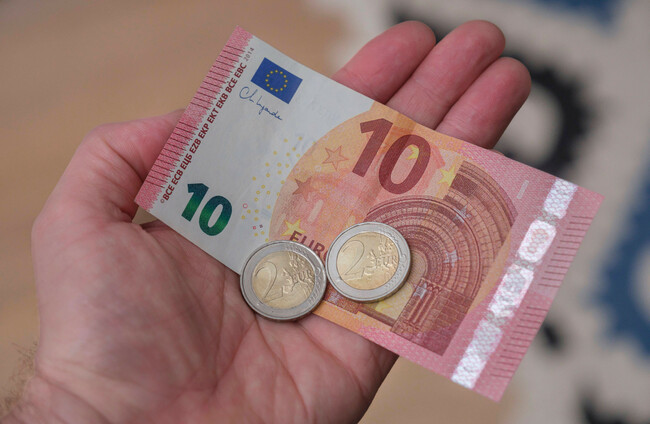
The hourly minimum wage rate is set to increase to €14.15 in 2026. Alamy Stock Photo

Ireland’s minimum wage will rise above €14 per hour - will this cause inflation?

A rise in the minimum wage could ruffle prices, but the effect is likely smaller than you think.

WHEN AN ARTICLE invokes Betteridge’s law of headlines, you know it’s going to be good.

For those unfamiliar with this iron-clad rule, it goes: “Any headline that ends in a question mark can be answered by the word no.’

That’s somewhat of a spoiler for this piece. But the truth is that we might have caught out ‘ol Betteridge this time.

Now, to state upfront – the view of most researchers is that increasing the minimum wage is not a major driver of inflation.

But – there is enough conflict and caveats that a response to the headline needs a bit more nuance than a straight ‘no’.

So, first of all – what’s happening?

Ireland’s minimum wage will increase in just a few months. Come January 1, 2026, it will increase to €14.15 per hour.

This is a rise of €0.65 from the previous rate of €13.50. It represents an annual increase of almost 5%. This is a fairly significant rise, considering the general rate of inflation is just under 3%.

It’s part of a long-term government move to introduce a ‘Living Wage’, which will be set at 60% of the national median wage. The Living Wage would currently be just over €15 an hour.

Labour groups have pushed hard for the move, arguing it’ll be a major help for low-paid workers.

Sounds good, so what’s the concern?

Almost every time the minimum wage increases, employer groups and businesses in low-pay sectors (such as tourism) claim it puts them under unfair pressure.

This was part of the hospitality industry’s successful campaign to lobby for a lower VAT rate, arguing it was needed to offset rising costs.

Some consumers also tend to be concerned at minimum wage rises, worrying it will lead to a direct impact on prices.

For a very simplistic, hypothetical example. Say staff costs are 100% of company X’s expenses, where all its workers are on minimum wage.

The worry goes something like – staff costs rise by 5%. Company X has to raise prices by 5% to make up the difference.

Now prices are higher, and workers are no better off.

Obviously, the numbers above would never occur in the real world.

But the concern is largely the same – that wage rises just feed inflation, while doing little to actually improve living standards. This is also sometimes referred to as a ‘wage price spiral’.

But does increasing the minimum wage actually cause this?

Multiple studies show that while minimum wage rises do feed into inflation, the overall impact tends to be pretty small.

For example, a research brief from the Upjohn Institute, an employment research body in the US, found that for the restaurant sector, prices rose by only 0.36% for every 10% increase in the minimum wage.

Similarly, a Professor of Economics at University College London estimated that hiking the minimum wage by 20% would still only lead to a 0.2% rise in general inflation. “Such a slight increase would be hardly recognised by most people,” he argued.

Empirical studies also suggest a modest impact.

A much-cited 2008 study published by the University of Leicester looking at multiple research papers said that “most studies reviewed found that a 10% minimum wage increase raises overall prices by no more than 0.4%.”

Again, this is the level of general inflation in a month or two. It means that a big minimum wage increase would hardly register on a national level – at least in terms of turbo-charging inflation.

However, some studies have suggested a stronger link.

A 2020 study found a 10% increase in the minimum wage caused grocery store prices to rise by between 0.6% and 0.8% – still low, but above what other researchers found.

Also, while the impact may be small on a national scale, it may be significantly larger in sectors which employ lots of lower-paid workers.

In an Irish context, findings have been broadly similar. A study from the ESRI (Economic and Social Research Institute) examined the 2016 minimum wage rise, when it increased from €8.65 to €9.15 per hour.

It found that the measure “had no significant impact on the labour costs of the vast majority of Irish firms that employ minimum wage workers”.

Again though, this was at a nationwide level. For companies where “more than half of their employees” were on the minimum wage.

So, why does raising the minimum wage have such a small impact on inflation?

The most obvious answer is because a relatively small number of workers earn the minimum wage.

It’s estimated that only about 10% of the Irish workforce is on this level of pay, so the direct impact will be fairly small.

Likewise, companies with with low-paid staff don’t tend to just employ minimum wage workers. They also normally employ plenty of staff earning above the threshold, who are relatively unaffected by the price hikes.

This all means that while there might be noticeable inflation in one sector (such as retail), as a whole nationally, the impact will be small.

Other likely reasons are that business productivity increases over time (such as with new technology), meaning they can afford improved pay.

Several business groups argue that minimum wage increases still puts upward pressure on pay, creating a knock-on impact with other staff looking for raises.

This tends to be referred to as ‘spillover’. There is some evidence of this. A study published by the OECD (an intergovernmental group of rich countries) found that a 10% increase in the minimum wage typically raises the median wage (what’s considered a country’s ‘typical’ wage) by between 1% and 2%

The effect is clearest for workers who earn about 30% more than the minimum – after that, the link is much looser.

But going back to the direct impact of minimum wage increases. Impacted businesses tend to have three main options for dealing with it.

  • Raise prices
  • Accept lower margins
  • Reduce staff hours

There’s evidence that many Irish small businesses gravitate towards option three, with minimum wage staff getting an average of an hour less per week in work.

However, this still wasn’t enough to offset the benefit from the pay rise.

Bringing this all back to inflation. The research – both from Ireland and abroad – is relatively in sync.

While there is evidence that raising the minimum wage does feed into inflation, the impact tends to be small, and is absorbed quickly.

There are arguments against raising wages for low paid workers. But fears of a major knock-on impact on inflation is a concern which does not seem to hold up to scrutiny.

Readers like you are keeping these stories free for everyone...
A mix of advertising and supporting contributions helps keep paywalls away from valuable information like this article. Over 5,000 readers like you have already stepped up and support us with a monthly payment or a once-off donation.

Close
JournalTv
News in 60 seconds