Sign in. It’s quick, free and it’s up to you.
An account is an optional way to support the work we do. Find out more.
Sign in. It’s quick, free and it’s up to you.
An account is an optional way to support the work we do. Find out more.
LAST UPDATE | 26 Nov 2025
THE IRISH GOVERNMENT is spending money in the Budget “like there’s no tomorrow” despite the “significant and predictable budgetary pressures” that will arise from supporting an ageing population and addressing climate change.
That’s the warning that has been delivered today by the Irish Fiscal Advisory Council.
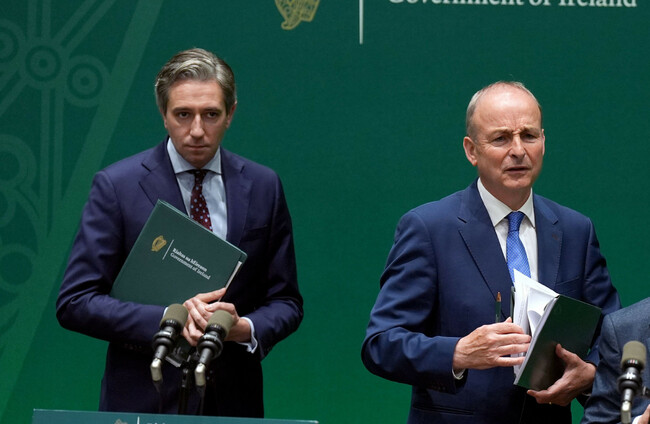
But the Tánaiste, and new Finance Minister, Simon Harris says the economy is “in a position of relative strength” and he plans to submit his own “medium-term” plan by the end of the year.
Ifac is the government’s independent budget watchdog, which assesses how the government is managing the public finances and the economy.
In its latest fiscal assessment report, Ifac hit out at Budget 2026 for containing no forecasts beyond next year, noting that “good planning requires forecasts that go more than 15 months ahead”.
Ifac said that the last time a Budget didn’t have a forecast beyond the following year was in 2021, which was delivered amid “ extraordinary uncertainty” arising from the Covid pandemic.
In comparison, Budget 2025 contained a forecast out to 2030. Ifac has called for Budgets to forecast at least five years ahead and to move away from year-to-year budgeting.
Asked about the criticisms by IFAC on the way into Cabinet, Harris said he would submit a medium-term economic soon.
He said he also agreed with a multi-annual budgetary plan as suggested by IFAC, calling it a “sensible suggestion”.
He said he had requested a meeting with IFAC last week, after he became finance minister, because he was aware of “the danger of group think” in Ireland previously.
“My number one immediate priority as our country’s new minister for finance is to produce, with government colleagues, a medium-term economic plan to move beyond the temptation for short-termism and to anchor both our spending and taxation plans for the years ahead in this medium-term framework.
“I intend to have that work completed with government colleagues, with the Taoiseach, with Minister (for Public Expenditure Jack) Chambers, by the end of this year.”
He said the Irish economy was “still in a position of relative strength” but that there was “huge” global uncertainty and now was not the time for complacency.
Harris added: “What I want to see as minister is an end to this drift spending, where in year there’s additional spending.
Not every problem can be monetised, sometimes people just actually have to look at ways of reforming, ways of better delivering services.
“We’re increasing budgets, we’re expanding budgets, but people, agencies, departments, now need to live within those budgets, and we need to get back to that annual cycle of budgeting, grounded and anchored in a new medium-term plan that will be produced by the end of the year,” Harris continued.
“I think that is a safe, prudent and sensible measure to take to keep our country and our economy secure in these turbulent times.”
Seamus Coffey, chair of Ifac, said this would provide more certainty to government agencies over future funding and limit overruns.
Spending is currently happening at a much faster pace than Budget 2025 allowed for and at the current pace of growth, overruns of €2 billion are likely.
Ifac added that the government is failing to save for a rainy day despite “significant and predictable budgetary pressures” on the horizon.
Costs associated with supporting an ageing population and addressing climate change will amount to 6% of the national income by 2050 – €20 billion in today’s terms.
Currently, one in 6.5 people are aged 65 or over, and this will increase to one out of every three people by 2057.
Ifac stated that “action sooner rather than later will ultimately be less costly” and added that “now is the time to prepare for these challenges, while the economy is strong”.
However, the government will only save 15% of corporation tax receipts this year, down from 32% last year (and 36% in 2022).
It means that for every €6 in corporation tax, €5 will go towards ongoing spending with only €1 going towards saving for upcoming costs.
Ifac warned that budgetary policy continues to add money into the economy when it is not needed and that the government is “increasing spending at twice the sustainable rate”.
“By adding money into the economy when it is strong, the public finances are less well prepared for the next economic downturn and predictable budgetary pressures,” said Coffey.
He called on the government to “support the economy when it’s weak, but show restraint when it’s strong” as it is now with high employment and rising wages.
Meanwhile, Ifac warned again of an overreliance on corporation tax.
If corporation tax was excluded, a deficit of almost €14 billion would be expected next year.
There will be a surplus of €5 billion next year when corporation tax is included.
And when excess corporation tax receipts are excluded, revenue is now at its lowest level relative to national income since 1980.
While Ifac acknowledged that corporation tax receipts “may well increase”, it added that they “remain high risk” and noted that “just three companies account for most of the excess corporation tax”.
Elsewhere, Ifac called on the government to set limits for net spending that have “legislative footing” and noted that previous limits were “purely symbolic”, with no penalty when limits were exceeded.
Coffey had a meeting with the new Minister for Finance Simon Harris last week and said he “went through the key concerns in terms of the overall rate of spending, recent inability to stick with the Budget amounts and vulnerabilities in the public finances”.
“We are only running a surplus next year of €5 billion,” said Coffey.
“With the strength of the economy, with all of this corporation tax that’s coming in, it does leave us vulnerable, so that was the nature of the conversation.”
He said Harris gave no feedback from his perspective but stated that he would “take on board” the advice offered by Ifac.
“We will be sending this final report to the Minister and will be looking for a response over the coming weeks,” added Coffey.
With reporting by PA

To embed this post, copy the code below on your site











have your say