We need your help now

Support from readers like you keeps The Journal open.

You are visiting us because we have something you value. Independent, unbiased news that tells the truth. Advertising revenue goes some way to support our mission, but this year it has not been enough.

If you've seen value in our reporting, please contribute what you can, so we can continue to produce accurate and meaningful journalism. For everyone who needs it.

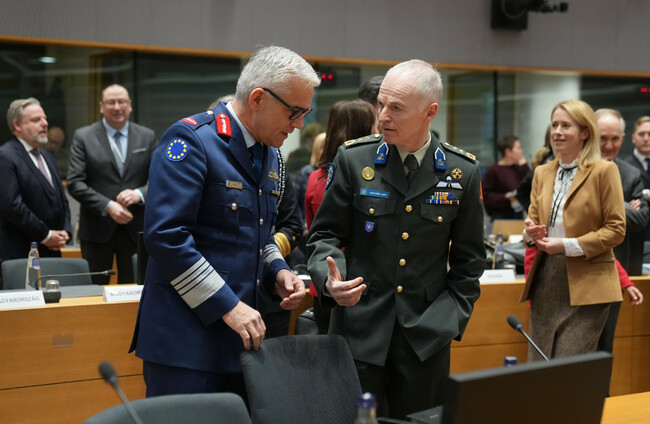
General Seán Clancy with Director General of the European Union Military Staff, Lieutenant General Michiel van der Laan and EU foreign minister Kaja Callas to the right. Alamy Stock Photo

'All about Ukraine': Irish general in the top EU military job on what's coming across his desk

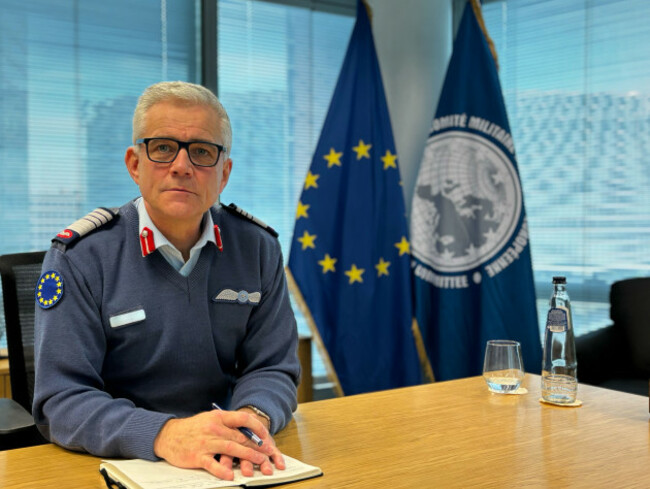
This week The Journal met General Seán Clancy in his office in central Brussels overlooking the Berlaymont building of the European Commission.

OVER THE COURSE of a weekend General Seán Clancy moved from leading Ireland’s Defence Forces to being the most senior European Union General. 

This week The Journal met Clancy in his office in central Brussels overlooking the Berlaymont building of the European Commission. 

Behind his table there are pictures of family at home and a model of the AgustaWestland 139 Irish Air Corps helicopter he once flew. 

Inside the building there is a secure large open plan office room where his ‘cabinet’ manages affairs. It is a busy room with groups of military and civilian staff working and meeting. 

There are a lot of Irish voices and faces in Defence Forces uniforms but it is a multinational group of people from multiple countries.

Clancy took over the role in June shifting from managing the small forces of Ireland to landing headlong into working on the military expectations of the Union’s 27 member States.

He is now chair of the European Union Military Committee (EUMC), which is made up of the heads of armed forces from each of the 27 member states. 

He chairs the meetings of all Chiefs of Defence (CHODs) across the bloc and liaises with the civilian leadership of the EU to convey a military perspective on policy. 

“The change happened in the space of 24 hours,” he said, noting that he finished up with the Defence Forces at the end of May and started in Europe at the beginning of June. 

Clancy, a former helicopter rescue pilot from Mitchelstown, Co Cork, said that the difference between his Irish Defence Forces work and his current role comes down to “the scale and the breadth of it”, noting “it’s the outward looking piece as much as anything else that that has changed”.

As we reported earlier this week Clancy has said that the rebuilding of the military of EU member states was a priority but that it was not about preparing for war but rather about preventing it.  

IMG_6358 General Seán Clancy in his office in Brussels. Niall O'Connor / The Journal. Niall O'Connor / The Journal. / The Journal.

‘Focused inwardly’

Clancy said as Chief of Staff of the Irish Defence Forces he was directly working on the military as it moved forward day to day in a “directional” manner. He said that a lot of his time as head of the Irish military he was “focused inwardly” but the job in Brussels is a lot different.

The General said that his job in Europe is about “finding opportunities to shape and influence the [military] environment aligned with the political intent”.

“But more importantly is in establishing really good rapport and relationship with the CHODs [Chiefs of Defence] themselves and I would be in regular contact with them,” he said, referring to the military chiefs from across the member states. 

The second part of Clancy’s role is to engage with the various ambassadors and “at the political and security committee level, and finding what the various nuances and approach they have to the issues of defence and security”.

Throughout our discussion, Clancy was keen to stay away from commenting on the state of the Irish Defence Forces and events at home. 

In terms of the major issues that have come across his desk in his time in the job so far, he touched on – amongst other issues – the US stance on Greenland, concerns of the nuclear ambitions of Iran, and the actions of the Shadow Fleet of Russian sanction-dodging oil tankers and the threat they pose to critical infrastructure.

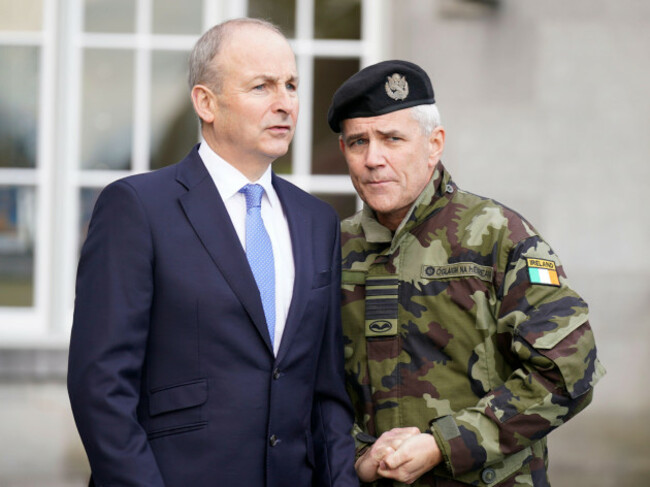
minister-for-defence-micheal-martin-and-chief-of-staff-of-the-irish-defence-forces-lieutenant-general-sean-clancy-review-the-men-and-women-of-the-123rd-infantry-battalion-at-kilkenny-castle-prior-t With Taoiseach Micheál Martin while he was Chief of Staff of the Irish Defence Forces. Alamy Stock Photo Alamy Stock Photo

Regardless of all those moving parts, the one constant in the job, Clancy said, has been the Russian full-scale invasion of Ukraine, which is now now entering its fourth year. 

The EU has moved to step up plans to deepen defence readiness in response to Russia’s actions and in a bid to fill the gap left vacant by America’s role as Europe’s traditional security backstop. 

He said the effort to get a handle on EU defence has “an urgency” to it and this has been informed by that war rather than anything else. 

‘Urgency’

Walk the hallways of EU buildings, talk to diplomats and officials – even stand on street corners and you discover rapidly that the biggest issue for everyone in Brussels is defence and security. 

Clancy said it goes across all portfolios – whereas before it was economic plans that took precedent, now defence covers all aspects of EU life. He described the current environment as a “paradigm shift”. 

“Defence and security is the number one, and therefore it’s palpable, the urgency that’s there,” he said. 

While Clancy is clear on the need for Europe to build a resilience against the shocks of future crises he said that member states also  measure their response to defence based on their geography. The General said that for those in the east of Europe the main factor is their proximity to Russia but that that may be different for countries on the western reaches of the continent. 

While countries in the east are more likely to feel what he calls the “breath of the bear” countries much further to the west, including Ireland, are also vulnerable to so-called hybrid attacks, including cyber attacks. 

“We see more and more now how Ireland is becoming more and more aware of the hybrid threat,” he added. 

Despite the difference Clancy said that across the member states: “There is a clear, common understanding of the challenges.”

Clancy has travelled to Ukraine to visit and talk to officials there. He said that while individual nations may be focused on their own issues, as a unit the EUMC sees the Ukrainian struggle with Russia as the key issue that must be focused on.

He said this is “the most important issue, and all the other issues are revolving around it”. 

“Ireland, Spain, other countries are becoming aware and engaged in it [the threat from Russia] from a different perspective, not from the physical threat, if you like.

“This is why Ukraine is so important, and this is why Europe standing with Ukraine is so important as much as anything else.”

Readers like you are keeping these stories free for everyone...
A mix of advertising and supporting contributions helps keep paywalls away from valuable information like this article. Over 5,000 readers like you have already stepped up and support us with a monthly payment or a once-off donation.

Close
JournalTv
News in 60 seconds