We need your help now

Support from readers like you keeps The Journal open.

You are visiting us because we have something you value. Independent, unbiased news that tells the truth. Advertising revenue goes some way to support our mission, but this year it has not been enough.

If you've seen value in our reporting, please contribute what you can, so we can continue to produce accurate and meaningful journalism. For everyone who needs it.

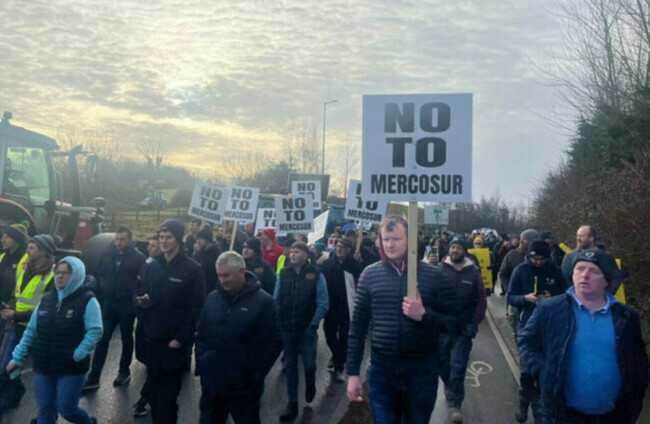
Protestors in Athlone in January at rally backed by farm groups and several political parties. Eoghan Dalton/The Journal

EU-Mercosur trade deal to apply provisionally from May, despite pending court ruling on legality

Brussels has ploughed ahead as it pushes to diversify trade in the face of challenges from the United States and China.

THE EU HAS SAID a free trade agreement with South American bloc Mercosur will provisionally enter into force on 1 May – despite a pending court ruling on its legality.

The mammoth deal to eliminate tariffs on more than 90% of trade between the two blocs has proven divisive in Europe, with France leading opposition over concerns some of its farmers will be worse off because of it.

But – backed by a majority of EU countries – Brussels has ploughed ahead as it pushes to diversify trade in the face of challenges from the United States and China.

“Today is an important step in demonstrating our credibility as a major trading partner,” EU trade chief Maros Sefcovic said.

“The priority now is turning this EU-Mercosur agreement into concrete outcomes, giving EU exporters the platform they need to seize new opportunities for trade, growth and jobs.”

The move comes as Paraguay ratified the deal last week, becoming the last Mercosur member to do so after Argentina, Brazil and Uruguay.

“Provisional application ensures the removal of tariffs on certain products as of day one, creating predictable rules for trade and investment,” the European Commission, in charge of EU trade policy, today said.

It added it had notified Mercosur partners.

“EU businesses, consumers and farmers can thus start reaping the benefits of the deal immediately.”

Chambers Ireland, the country’s largest business organisation, welcomed the announcement and said it marks a “significant step forward for European and Irish businesses seeking to diversify exports and strengthen international trading relationships”.

It said the agreement will “allow businesses to begin benefiting from reduced tariffs and improved market access across Mercosur countries while the formal, democratic ratification process continues”.

Chambers Ireland chief executive Ian Talbot said the provisional application “sends a strong signal of the EU’s continued commitment to open, rules‑based trade at a time of growing global uncertainty”.

He added: “Events in the Middle East over the last few weeks are just the latest demonstration of the risks inherent as a result of continued geopolitical tensions and of the importance of trade diversification.

“We continue to call on the Irish Government to recognise and embrace the safeguards negotiated and commitments made by the EU to protect any significantly impacted sectors.

“By reducing barriers and expanding access to a major global market, the EU–Mercosur agreement highlights the importance of trade in supporting growth, competitiveness and economic resilience.”

The EU had already signalled in February it would provisionally implement the deal, prompting a public split between its two largest member states France and Germany.

The pact still needs a green light from lawmakers in the European Parliament, which referred it to the EU’s top court within days of being inked in January.

The deal had been backed by most EU nations and the European Commission, but opposed by Ireland, France, Poland and farmer groups.

France unsuccessfully attempted to block the deal over worries for its farmers, who fear being undercut by cheaper goods from Brazil and its neighbours.

Foreign Affairs Minister Helen McEntee last month also reiterated that Ireland does not support the move.

“While Ireland could not support the overall agreement, the Mercosur market provides opportunities for agrifood exports in dairy and spirits as well as pharmaceuticals, engineering and manufacturing,” she said.

The accord creates one of the world’s biggest free trade zones. Together, the EU and Mercosur account for 30% of global GDP and more than 700 million consumers.

It favours European exports of cars, wine and cheese, while making it easier for South American beef, poultry, sugar, rice, honey and soybeans to enter Europe.

-© AFP 2026 and with additional reporting from Diarmuid Pepper

Author
View 21 comments
Close
21 Comments
This is YOUR comments community. Stay civil, stay constructive, stay on topic. Please familiarise yourself with our comments policy here before taking part.
Leave a Comment
    Submit a report
    Please help us understand how this comment violates our community guidelines.
    Thank you for the feedback
    Your feedback has been sent to our team for review.

    Leave a commentcancel

     
    JournalTv
    News in 60 seconds