We need your help now

Support from readers like you keeps The Journal open.

You are visiting us because we have something you value. Independent, unbiased news that tells the truth. Advertising revenue goes some way to support our mission, but this year it has not been enough.

If you've seen value in our reporting, please contribute what you can, so we can continue to produce accurate and meaningful journalism. For everyone who needs it.

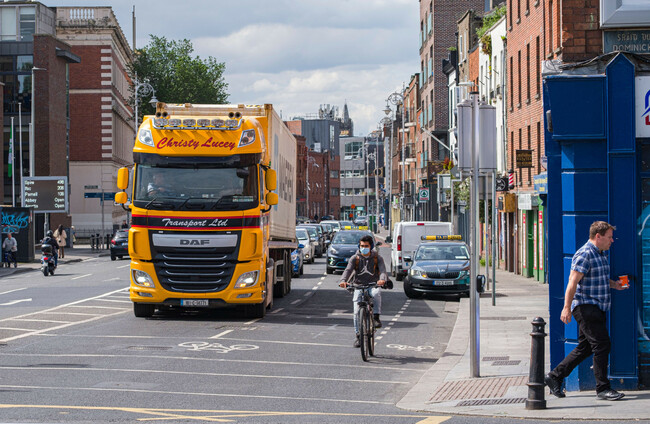
A heavy good vehicle (HGV) and cyclist sharing the road on Bolton St, Dublin Alamy Stock Photo

Dublin City Council backs plan to phase out trucks with high blind spots from city streets

The proposal follows the recent death of cyclist Johnny Santos, who was hit by a cement truck on Abbey Street.

DUBLIN CITY COUNCIL has backed a motion calling for stricter safety standards for heavy goods vehicles in the city, in a move aimed at improving visibility for drivers and reducing the risk to cyclists and pedestrians.

The emergency motion, brought forward by Green Party councillor Ray Cunningham, proposes introducing a phased ‘Direct Vision Standard’ for Heavy Goods Vehicles (HGVs, basically any commercial vehicle or truck with a weight exceeding 3,500 kg used for transporting goods) applying for Dublin city permits from 2027 onwards, increasing gradually to full compliance by 2031.

The proposal follows the recent death of cyclist Johnny Santos, who was hit by a cement truck on Abbey Street earlier this month. Councillors referenced him during this evening’s meeting as a reminder of the dangers posed by large vehicles in urban areas.

Cunningham’s motion would require HGVs to seek permits to operate in parts of the city to meet progressively higher visibility standards based on the London system, which rates trucks according to how much direct visibility a driver has from the cab.

Under the plan, vehicles would need to meet at least a one-star rating from 2027, rising to two stars in 2028, three stars in 2029, four stars in 2030, and five stars from 2031 onwards.

Cunningham told the council the system would be simple to implement using existing vehicle data.

“It’s based on the design of the vehicles at the point of production,” he said, “so it’s easy to implement”.

“You just put in the make and model of the vehicle in the year of production, and that tells you what the rating is.”

He argued that incorporating the rating into Dublin City Council’s existing HGV permitting system would influence fleet purchasing decisions well in advance of each deadline.

“This would have an immediate effect all through the city, because delivery vehicle fleets are replaced on an ongoing basis,” Cunningham said.

He added that operators would adapt their purchasing decisions once the requirements were clearly signalled.

“If this motion is passed, then anybody looking to buy an HGV for their fleet will say: ‘I need it to be able to deliver in the city centre in three years’ time’. So they will buy something with at least a three-star rating.”

Cunningham said the long-term goal was to improve safety across Dublin by reducing blind spots in large vehicles.

“This will make it safer not just in the core city centre, but all across the city,” Cunningham said.

“We can overnight make vehicles safer for pedestrians and cyclists and avoid further incidents like that just a couple of weeks ago,” he said in reference to the death of Johnny Santos.

Councillors supporting the motion pointed to the vulnerability of cyclists in the city and the need for stronger design standards for trucks operating in urban environments.

However, Dublin City Council officials raised concerns about the limited reach of the current HGV permitting system.

Executive Manager for Traffic Brendan O’Brien said the council’s permit regime primarily applies to five-axle vehicles operating within the city centre cordon during restricted hours, meaning many trucks operating in Dublin would fall outside its scope.

He also noted that EU regulations are already introducing new safety requirements for heavy goods vehicles, including blind spot detection systems, and suggested that broader regulatory change may be more effective.

“The broad thrust of the motion is welcome,” O’Brien said.

“However, it only affects a small proportion of trucks within a limited area and timeframe.”

Following discussion, the motion was passed, and referred to the Mobility and Public Realm Strategic Policy Committee for further examination.

Lord Mayor Ray McAdam also agreed to write to the Minister for Transport, seeking further consideration of the proposal at national level.

Dublin has seen repeated calls for improved HGV safety standards in recent years, particularly from cycling and road safety campaigners.

Readers like you are keeping these stories free for everyone...
A mix of advertising and supporting contributions helps keep paywalls away from valuable information like this article. Over 5,000 readers like you have already stepped up and support us with a monthly payment or a once-off donation.

Close
52 Comments
This is YOUR comments community. Stay civil, stay constructive, stay on topic. Please familiarise yourself with our comments policy here before taking part.
Leave a Comment
    Submit a report
    Please help us understand how this comment violates our community guidelines.
    Thank you for the feedback
    Your feedback has been sent to our team for review.

    Leave a commentcancel

     
    JournalTv
    News in 60 seconds