We need your help now

Support from readers like you keeps The Journal open.

You are visiting us because we have something you value. Independent, unbiased news that tells the truth. Advertising revenue goes some way to support our mission, but this year it has not been enough.

If you've seen value in our reporting, please contribute what you can, so we can continue to produce accurate and meaningful journalism. For everyone who needs it.

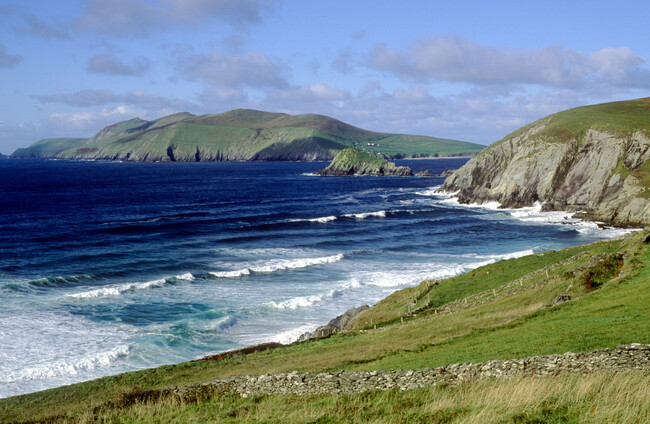
Peig Sayers spent much of her life on the Great Blasket Island but was born and raised in Dún Chaoin. Alamy Stock Photo

Peig was no Cáilin Ciuin, but her voice lives on 90 years since her book's publication

Almost a century after its first publication, the autobiography of Peig Sayers is still being read avidly, although it has yet to be made into a movie along the lines of ‘An Cailín Ciúin’.

(Seo alt ónár bhfoireann Gaeltachta. Is féidir an bunleagan as Gaeilge a léamh anseo)

WHILE THE AUTOBIOGRAPHICAL book Peig was a source of torment for a generation of secondary school students who studied it for the Leaving Certificate until the mid-1990s, evidence continues to emerge showing that she was a pioneering woman who gave a voice to Gaeltacht women in a way that had never been done before.

Mairéad ‘Peig’ Sayers, who was born in 1873, is being commemorated this month - it was in July 1936 that her book was first published, a work in which she described her life: the hard existence she had from her youth in Dún Chaoin, her life on the island, and her return to the mainland.

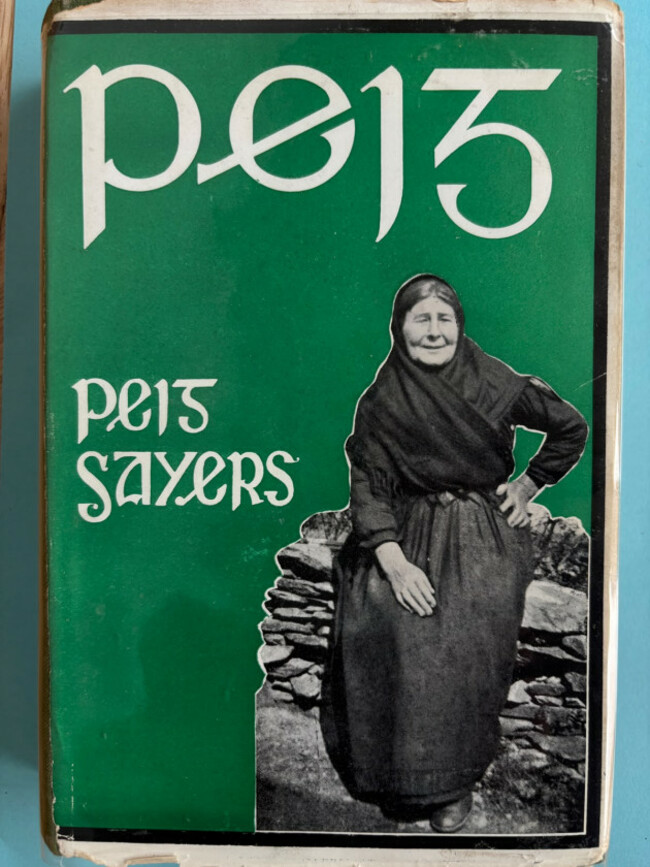
7afa0aa9-60e4-4600-89e4-f02e5ec597a1 Peig's autobiography was first published in July 1936. The Great Blasket Centre The Great Blasket Centre

Her life is also being recalled at the Great Blasket Centre in Dún Chaoin – the Gaeltacht community where she was born and raised – which received a special gift last week: a copy of the first edition of Peig.

“We are enormously grateful to Caitlín Nic Amhlaigh who gave us this precious book,” said Lorcán Ó Cinnéide, Director of the Centre, speaking to The Journal. The donor is a retired teacher from Corca Dhuibhne by origin who now lives in Ballyshannon in County Donegal.

Ó Cinnéide explained that the book was of particular importance as it was the first work of its kind to give a voice to a Gaeltacht woman.

“The dust jacket describes Peig as follows — ‘an ordinary woman of the people, but Peig Sayers, the author, was an extraordinary woman in her gift for storytelling, in her wit and her warmth in spite of the hardships she endured, and in her philosophy regarding the affairs of life and time.’”

He also recalled what his own late father, the poet Caoimhín Ó Cinnéide – who knew Peig – particularly towards the end of her life – had said about her. “He said to me: she was a great character, full of craic, full of curses and full of spirit,” he said.

“You would know, let us say, that you were in the presence of someone who had standing, who had authority and who had something to say and had no reluctance to say it.

“That is a reading entirely different from the kind of understanding people had of her from the book.”

He said it was from Peig that the largest collection of stories in the archive of University College Dublin came, and he said that hundreds of copies of her book are sold every year at the Blasket Centre, particularly the English language version.

While many television and radio programmes, research projects and written works have been produced about Peig, Ó Cinnéide said no attempt had ever been made to produce a dramatic film about her life.

“There was more talk of making a film about the likes of ‘Twenty Years A-Growing’- the book by Muiris Ó Súilleabháin – and a script had been written for it by the poet Dylan Thomas,” he said.

We had An Cailín Ciúin before this, and it drew enormous audiences – time will tell whether we will have a dramatic film about Peig, the girl who was anything but quiet, based on her autobiography which is still being read avidly almost a century after its debut!

The Journal’s Gaeltacht initiative is supported by the Local Democracy Reporting Scheme

Readers like you are keeping these stories free for everyone...
A mix of advertising and supporting contributions helps keep paywalls away from valuable information like this article. Over 5,000 readers like you have already stepped up and support us with a monthly payment or a once-off donation.

Close
28 Comments
This is YOUR comments community. Stay civil, stay constructive, stay on topic. Please familiarise yourself with our comments policy here before taking part.
Leave a Comment
    Submit a report
    Please help us understand how this comment violates our community guidelines.
    Thank you for the feedback
    Your feedback has been sent to our team for review.

    Leave a commentcancel

     
    JournalTv
    News in 60 seconds