Sign in. It’s quick, free and it’s up to you.
An account is an optional way to support the work we do. Find out more.
Sign in. It’s quick, free and it’s up to you.
An account is an optional way to support the work we do. Find out more.
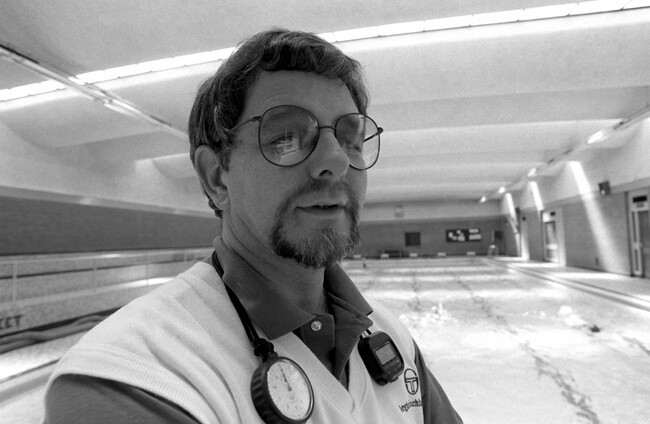
ON THE FIRST day of the trial of George Gibney, he did something that took me and several other people in the courtroom by surprise.
The 77-year-old was there to face 78 counts of indecently assaulting four girls, and one count of attempting to rape one of them, on dates between 1971 and 1981. These were later reduced to 41 counts.
He had been their swimming coach. The girls were aged between eight and 15 at the time.
The abuse was alleged to have taken place in several locations in south county Dublin, including Glenalbyn swimming pool in Stillorgan and Newpark Sports Centre in Blackrock, where Gibney helped set up Trojan swim club in 1976.
Sitting in a wheelchair in Court 20 on the sixth floor of the Criminal Courts of Justice on Dublin’s Parkgate Street, Gibney appeared frail and aged, his hair white, his face wrinkled. He wore glasses, a loose red shirt-jacket with a polo shirt underneath and grey tracksuit bottoms, and held a number of pages stapled together in his hands, which a solicitor was showing to him while they spoke in hushed tones.
As Mr Justice Mícheál O’Higgins entered the room, the legal teams introduced themselves: James Dwyer SC and Jane Horgan-Jones BL for the prosecution, Patrick Gageby SC and Karl Monahan BL for the accused. The jury of six men and six women took their seats, and the court heard that each charge would be read to Gibney, after which he would indicate how he was pleading.
“Not guilty” was his response to the first 11 counts. But then his legal team interrupted, and asked if they could have a moment with their client. The same solicitor who had spoken to Gibney before the proceedings spoke to him again, and asked him if he understood.
Count 11 was then read to Gibney again.
“Guilty,” he replied.
His response was the same for the next three counts. “Not guilty” came the answer to count 15, before his legal team asked for another moment with their client. “This is the last one,” the solicitor could be heard saying to the defendant.
Count 15 was then read to Gibney again, and just like the previous four, his answer was: “Guilty.”
To say this was unexpected is an understatement.
Gibney had admitted to the jury that he indecently assaulted one of the complainants on sample dates between May and September 1976 when she was a young teenager. But for the other 74 counts against him, he was maintaining that he was innocent.
There was an air of bafflement in the wood-panelled room as the word was repeated five times, as though no one knew it was going to happen.
It was during a Florida court hearing in July 2025, which The Journal was present for, when he consented to being extradited to Ireland to face these 79 counts that Gibney had indicated he planned to fight them. The decision to plead guilty to five counts, it seems, came later.
It remains unclear what his thinking was.
Gibney sat with his eyes closed for a period of time when prosecuting counsel James Dwyer opened the state’s case. At one point, the accused rubbed his eyes and ran his hand through his white hair. At another point, his face contorted in what seemed to be discomfort when he used his hand to help him cross one leg over the other.
When James Dwyer told the room that Gibney “exploited his position of authority as a swimming coach and sexually abused these young girls who had been entrusted to his care”, there was no visible reaction from the defendant.
“It is my view that you will find he is guilty,” Dwyer told the jury. In the end, he was right.
When the first complainant began giving evidence to the court, Gibney had been moved from his wheelchair to the wooden bench just next to it. Sitting on a cushion, he did not look up to the witness box on his right as the woman told the court how he first assaulted her at a disco at Newpark Sports Centre when she was aged 13, hugging her and putting his hand on her bottom. Nor did he look at the other complainants when they gave evidence.
For the rest of us in court, it was hard to tear your eyes away from each of the women as they eloquently and powerfully put into words what this man had done to them. He had been an adult in a position of power in 1970s Catholic Ireland where child sexual abuse wasn’t spoken about in society.
Some of the details of their testimonies were difficult to listen to.
The first complainant said Gibney was known to her family and was in her home on various occasions. It was on one of these visits, she recalled, when he came into the bedroom that she shared with her sister, sat on the edge of her twin bed and kissed her, taking her hand and putting it on his penis outside his clothes. He said nothing.
“I don’t remember a whole lot being said on any occasion to be honest,” she told the court.
The majority of the abuse happened in Gibney’s office, she said, because there was a lock on the door.
She described how she would sometimes be wearing her school uniform when it happened. On some occasions, her abuser would answer the phone in his office and continue to hold her as he spoke to the person on the other end. On another, she recalled her anxiety rising as she spotted her mother’s car through the heavy net curtains of the window in the office, waiting to collect her daughter from training.
Asked how long the alleged abuse went on for, she said: “Many months. I can’t put an exact figure on it. It certainly wasn’t just a couple of times. It was months.”
She said the abuse “petered out” when she was around 14. Besides two school friends whom she confided in at the time, she told no one else about the abuse. It wasn’t until 2020 when her sister made a complaint to gardaí about Gibney that she also decided to come forward.
“I thought, do you know what? Now is the time,” she told the court.
Her sister, the second complainant, recalled being in bed while babysitting for Gibney and seeing an adult’s silhouette coming into the room, recognising them by their voice before their hand came under the covers and touched her breasts and torso.
That adult was Gibney.
Her description of her 14-year-old self being “in a state of panic” and feeling “so ashamed of my behaviour” about “what I was doing to his wife” after another incident, when Gibney had followed her into a changing room and put his hand down her clothes, was hard to hear.
She stopped swimming after this incident, and didn’t start again until later in life.
“I’m sad that I gave up. This has accompanied me over 50 years,” she said.
The third complainant described how Gibney “started taking an interest in me” when she was around eight or nine. Her parents were separated, and she felt “very positive” about her coach. “It’s very easy to turn around now and say I was lacking a father figure and that I did not have a male role model,” she said.
She recalled stopping in the shop to buy sweets on her way home from swim training and walking outside to find Gibney waiting in his car, offering her a lift. Sometimes there were other people in the car. Other times he was alone. It was on the times that he was alone that he would abuse her in the same car in different locations once or twice a month, she said. The abuse stopped when she was 12, after he tried to rape her.
Defence counsel Patrick Gageby SC put it to her during cross-examination that there was “no indecency or molestation” on Gibney’s part.
“You’re trying to say that I’m lying. Is that what you’re saying?” the complainant asked.
“Yes,” Gageby responded.
“Well you’re wrong,” she said.
The jury agreed with her.
The fourth complainant was also assaulted by Gibney in his car.
She recalled sitting in the passenger seat at around 5am on a winter morning after he had collected her to bring her to swim training, and how his hand came to rest on her knee before moving up her leg to her groin as he leaned in closer to her. She said “it was all very slow” and she felt “really embarrassed” and “trapped”.
Despite this, she told him “to get his hands off me or I’d tell my dad.”
He did, telling her: “Sure, you’re too ugly anyway. Fat and ugly. Nobody would want you anyway.” She was around 13 years old. She never got in a car with him again.
While these disturbing details were being relayed to the court, Gibney remained largely still. His expression unchanged, though his eyes shifted from the prosecution counsel to his own legal team, from the presiding judge to the red-coloured carpet on the floor.
On the eighth day of the trial, after the prosecution evidence concluded and they closed their case, the time came where the defence could call evidence. In criminal trials, because the burden of proof rests on the prosecution to prove the accused’s guilt, the defence is not legally required to call evidence or witnesses.
That is what happened in this case. Gibney was not called to the stand to give evidence, nor were any other witnesses called in his defence. Apart from his pleadings on the first day, the court did not get to hear him address the charges against him.
His defence counsel, Patrick Gageby SC, told the 12 jurors in his closing speech that nothing he said was to “excuse any misconduct” and stated that “abuse by a person in authority of children is a criminal offence” and “revolting”.
He did his best to suggest there was a “lack of curiosity” in the investigation, noting that there were no photographs of where the alleged abuse took place and pointing to what he said were inconsistencies in the women’s evidence.
In the end, the jury decided that the evidence they had heard from the four women at the centre of this case was enough to convict Gibney. It took them seven hours and 40 minutes to find him guilty of 39 counts of indecent assault and one count of attempted rape.
Gibney’s demeanour did not change as the verdicts were read. He remained as he had been for the 11-day trial, sitting still with his eyes looking to the judge’s bench.
He was wheeled alone from the courtroom into the custody of the Irish Prison Service to await his sentencing. The women hugged their families and supporters.

To embed this post, copy the code below on your site










have your say