Sign in. It’s quick, free and it’s up to you.
An account is an optional way to support the work we do. Find out more.
Sign in. It’s quick, free and it’s up to you.
An account is an optional way to support the work we do. Find out more.
LAST UPDATE | 29 Apr 2025
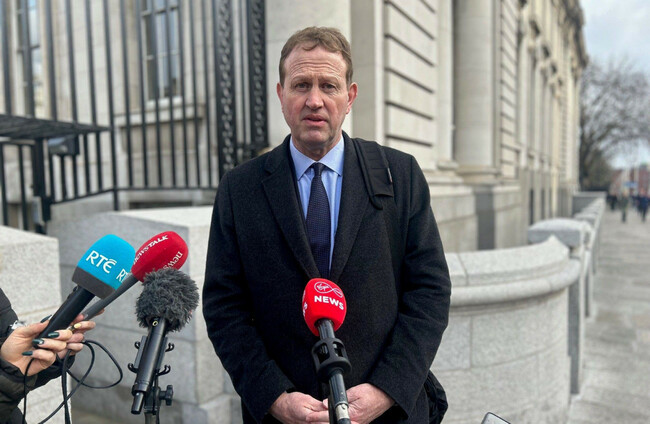
JUSTICE MINISTER Jim O’Callaghan has received government approval to forge ahead with legislation to overhaul how Ireland responds to people seeking asylum in the State.
The government is dubbing it “the most significant reform of Irish asylum laws in the history of the State.”
The International Protection Bill 2025 will replace the 2015 Act and aims to dramatically speed up the time it takes to process a person’s application for international protection.
Justice Minister Jim O’Callaghan said today most cases will be processed within three months, while others will be done within a maximum of six months.
“If they are entitled, they’re perfectly entitled to stay here. They’re welcome to Irish hospitality. If they’re not, they have to leave,” the minister said.
O’Callaghan said the speeding up of the process will be achieved by increased staffing and a streamlining of how the current system operates.
“At present, you’ll be aware that the process of people applying for asylum and appealing any decisions at the international protection office can take up to three years. It’s too long, it’s too costly, it’s unfair on the people who are going through the process.
“And what I want to do is to achieve a much smoother and less costly process,” he said.
Once enacted, one of the main changes the bill will introduce is that asylum seekers will no longer have an automatic right to a full oral hearing if their application for international protection is refused.
The minister said fewer oral hearings at appeal stage will speed up asylum applications as it will allow decisions to be made without the need for applicants, legal representatives and translators all to be present.
Instead of oral hearings for appeals of rejected asylum applications, decisions will be made based on existing information on file for individuals.
The legislation also opens the door for the creation of detention centres for people who are seeking international protection.
Asked by The Journal if the use of detention centres is going to be seen in Ireland, the Justice Minister said:
“I don’t think so, but it is a provision that is going to be contained within the legislation. But simply because it’s contained within it doesn’t mean it’s going to be used.
“I would have thought the appropriate mechanism is going to be we’re going to have accommodation centres that are going to be owned by the state. The most important part of the whole process is that we’ll have a speedier process.”
The bill will see the creation of ‘Screening Centres’ for most people seeking asylum.
In an Irish context, the Department of Justice has said these are being seen as a “one-stop shop” to register and lodge applications, complete relevant checks, determine the appropriate pathway for applicants, and to provide legal counselling.
The Department said: “It is expected that those undergoing Screening will generally be subject to appropriate alternatives to detention or allocation to a geographic area.”
It will generally be expected for people to present at a screening centre when they arrive to Ireland if they are seeking asylum.
This new bill must be passed by both houses of the Oireachtas in time for it to come into operation on 11 June 2026, this is to align with the EU Asylum and Migration Pact that Ireland signed up to last year.
Essentially, the pact agrees a new housing strategy for asylum seekers that focuses on “moving away from reliance on private providers”.
It also allows some member states the option of paying a monetary contribution to the bloc rather than accepting migrants.
Under the pact, Ireland will have permission to return IP applicants who have moved here back to another EU member state to have their claim processed if they have travelled here from that country.
The government has said it is intended that the Irish bill will be drafted and published by the end of 2025.
Responding to the proposed legislation today, Social Democrats TD Gary Gannon said the efforts to reduce the amount of time it takes to process an asylum application, particularly the plans to reduce the use of oral appeals, seem “unduly harsh”.
“Asylum is complex. It’s not a one-size-fits-all model.
“There’ll be any number of people who can’t potentially give written testimony and will have to give oral testimony in terms of levelling out traumas, levelling out any number of issues about why they’ve had to come here in search of sanctuary,” Gannon said.
Aontú leader Peadar Tóibín said his party also has no interest in the creation of detention centres.
“But we do have to have a situation where the policy is implemented in a strict fashion. And one of the difficulties I have at the moment is most of the deportations are happening on a voluntary basis. You cannot have a voluntary deportation system,” he said.

To embed this post, copy the code below on your site














have your say